From Power to Presence: How Men Can Relearn to See Women — and Themselves — with Love

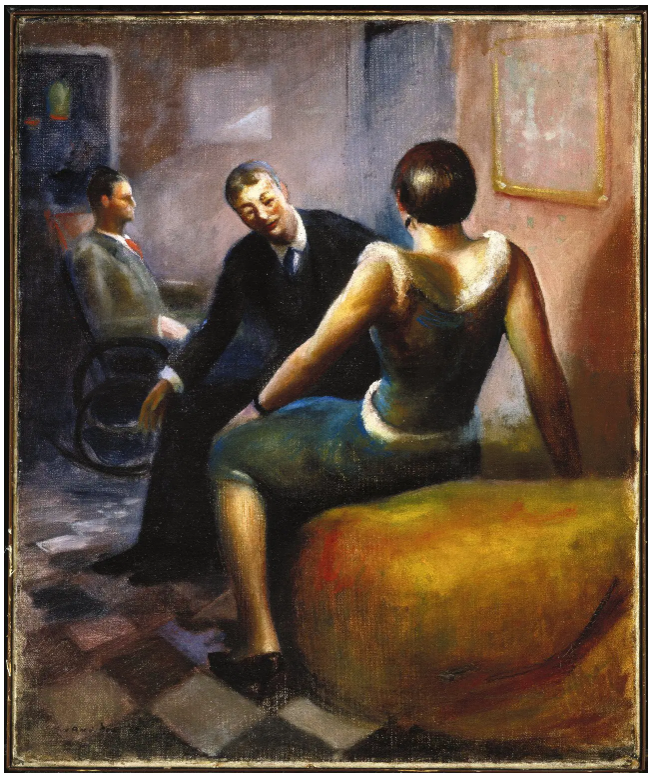
Evening by Guy Pène du Bois

There is a quiet courage in the work of re-seeing the world.
For many men, this work begins not with guilt or accusation, but with awakening — an honest recognition that much of what they were taught about love, success, and worth was filtered through lenses they never consciously chose.

Those lenses shape how they see women, how they see each other, and how they see themselves. To begin to notice those patterns is not weakness; it is the beginning of freedom.

This reflection is not about blame. It’s about understanding how culture shapes perception — and how men can reclaim their humanity by learning to see others, and themselves, more clearly.


The Inherited Lens: Hierarchy as Habit

Every man inherits a framework before he ever chooses one. From childhood, subtle messages define strength as dominance, emotion as fragility, and control as competence. These are not personal flaws; they are the scaffolding of culture itself.

Simone de Beauvoir described how societies often define men as the default — the doers, the decision-makers — while women are cast as the context, the mirror, or the support. This hierarchy doesn’t only limit women; it quietly confines men too. It isolates them from tenderness, empathy, and interdependence. It makes vulnerability feel like exposure rather than connection.

You can see this everywhere: in the workplace meeting where a man feels pressure to speak with certainty even when unsure; in the father who provides materially but hides his own exhaustion; in the friendship where warmth is replaced by banter because sincerity feels unsafe. These are learned reflexes, not truths about manhood.

Recognizing them isn’t self-criticism — it’s awareness. Hierarchy was never chosen; it was absorbed. Seeing through it becomes the act of rewriting it.


Objectification and the Loss of Depth

Objectification begins as a survival strategy — a way of managing complexity by reducing it to something we can control. It is not born from cruelty but from fear: fear of vulnerability, of rejection, of emotional overwhelm. For many men, objectification has been the only safe way to relate in a culture that punishes emotional openness.

From an early age, boys are taught to notice beauty before they are taught to notice humanity. They are rewarded for pursuit, praised for conquest, and rarely shown how to look at another person without desire or evaluation. This conditioning trains the eye to flatten — to turn the infinite depth of a person into a surface that can be categorized.

In this sense, objectification is not merely about sex. It’s a perceptual habit, a narrowing of sight. It can show up in how a man views women, but also in how he views himself — as a role, a provider, a performer — anything but a being.

Simone de Beauvoir called this “the reduction of the Other.” The woman becomes not an equal subject but a mirror for male identity. Yet in doing this, the man also becomes diminished. He trades intimacy for control, authenticity for image.

Maurice Merleau-Ponty’s philosophy of perception helps us see why this is so damaging. When the gaze becomes detached, it severs the relationship between body and soul, between self and world. The person looking loses the capacity for connection — not because he is incapable of love, but because his way of seeing has been trained to avoid depth.

To unlearn objectification, a man must learn to look longer — to see the human being behind his reflexes. This doesn’t mean rejecting attraction; it means letting attraction coexist with respect, curiosity, and wonder. It means learning to feel without possessing.

When he does, something shifts. What once felt like temptation becomes tenderness. What once triggered guilt becomes gratitude. He begins to understand that seeing another person as whole is not restraint — it is freedom.


Seeing as Participation — Merleau-Ponty and the Embodied Gaze

Maurice Merleau-Ponty taught that perception is not passive — it is participatory. To see something or someone is to be in relationship with it. We don’t look at the world; we look with it. The gaze itself is a form of contact.

When men begin to realize how their perception has been shaped — by media, by trauma, by cultural training — it can feel unsettling. Yet that very realization reveals the possibility of transformation. Because if perception is learned, it can also be relearned.

In a digital world, where images flash faster than empathy can form, men are taught to evaluate rather than encounter. Pornography, advertising, and social media train the eye to scan for desirability or power, not humanity. But something shifts when a man looks longer — when he pauses to really see a person instead of a projection. A simple act of attention can reawaken empathy, restoring depth where habit had flattened it.

Merleau-Ponty reminds us that to look with awareness is to engage ethically. The gaze can wound, but it can also heal. Every time a man chooses to see with curiosity rather than consumption, he reclaims the living quality of perception itself.


From Performance to Presence — Buber’s Call to Meeting

Martin Buber believed that all real living is meeting. He described two modes of relationship: I–It and I–Thou. In the I–It mode, people and things are treated as objects — useful, measurable, and often disposable. In the I–Thou mode, we encounter others as full beings, not categories.

Most men are conditioned to live in the I–It world. The culture of performance rewards decisiveness and control. A man learns to evaluate rather than experience — to measure his life by outcomes rather than intimacy. But this comes at a cost.

He might find himself sitting across from his partner but thinking about work; scrolling his phone instead of connecting at dinner; performing competence instead of expressing care. These are not failures of character — they are symptoms of disconnection.

When presence replaces performance, the dynamic changes. Listening becomes more powerful than solving. Eye contact becomes more healing than explanation. A man who learns to meet others without agenda steps into what Buber called the sacred space of encounter. In that space, both people are transformed.


Levinas and the Responsibility of Seeing

Emmanuel Levinas argued that ethics begins not in law but in encounter — in the face of another person. The face of the Other calls us to responsibility simply by existing. To truly see someone is to recognize their inherent dignity.

For men, this offers relief as much as responsibility. It removes the pressure to dominate or fix and replaces it with the invitation to care. Seeing becomes moral participation.

You can feel this difference in small, ordinary moments — choosing to stay in a difficult conversation rather than withdraw; recognizing the humanity in someone suffering on the street instead of looking away; responding to conflict with curiosity rather than defense.

Levinas reminds us that the eyes are ethical organs. To look at another human being and allow yourself to be moved by their vulnerability is not weakness; it’s moral strength. Presence itself becomes a form of protection — both for the other and for one’s own integrity.


The Desire to Care — From Protection to Partnership

Many men carry a sincere and beautiful desire to care for women — to protect, to support, and to make life easier for those they love. At its root, this impulse is not domination but devotion. It grows from empathy, loyalty, and the instinct to safeguard what matters most. Yet in a culture that confuses care with control, this tenderness can become distorted.

Protection can quietly slip into paternalism. Support can become substitution. Even when motivated by love, men may find themselves doing for women rather than walking with them — making decisions, offering advice, or solving problems in ways that unintentionally overlook or undervalue women’s insight and capability.

This isn’t cruelty; it’s conditioning. For generations, men were taught that their worth lay in their ability to provide, to lead, and to fix. Women, by contrast, were often expected to accommodate, nurture, and defer. When those scripts meet, imbalance hides beneath the surface of affection. The woman’s competence and wisdom can go underrecognized, while the man’s care goes unacknowledged for its sincerity. Both feel unseen.

As Simone de Beauvoir observed, inequality often persists not through open conflict but through subtle assumptions. The deeper problem isn’t overprotection; it’s under-crediting.

True care, as bell hooks reminds us, is not hierarchical. Love that liberates gives as much as it listens. It allows women’s voices to lead as often as men’s and recognizes that strength belongs to both.

Buber’s I–Thou relationship captures this transformation. In the I–It mode, care becomes management — an effort to ensure safety or order. In the I–Thou mode, care becomes communion — a willingness to stand beside another person, not above them.

Levinas would add that genuine responsibility honors the other’s autonomy. The face of another does not ask to be guided, but to be recognized. The ethical act is not to decide for her, but to stand with her — to affirm her full humanity.

When men care in this way, they do not lose their protective nature; they refine it. Care becomes partnership, protection becomes reverence, and love becomes equality embodied. This is not the end of masculinity — it is its maturity.

Fatherhood and the Protector Reflex

In family life, the desire to protect often reveals itself most vividly in moments of conflict. A father might hear his child speak sharply to their mother and instinctively raise his voice: “Don’t talk to your mother like that!”
On the surface, this seems noble — a defense of respect and love. Beneath it, though, is a deeper question about how protection and partnership coexist.

When a father steps in this way, he is often not defending his wife as a fragile being but defending the sacredness of respect itself. Yet when that defense takes the form of control — of correcting through dominance rather than connection — the message subtly shifts from “Respect your mother” to “Your mother needs my protection.”

This difference matters.
Children quickly internalize who holds authority, empathy, and voice in a home. When protection overshadows partnership, the mother’s authority can be unintentionally undermined — as though she cannot stand in her own strength.

True partnership looks different. It sounds like a father who, rather than commanding silence, models presence: “Hey, something feels tense here — let’s all take a breath.” It’s standing with his partner rather than over her. It’s backing her up without eclipsing her.

bell hooks wrote that love requires mutual recognition of power, not its suppression. In family life, this means protection transforms into respect when both parents’ voices carry equal weight.
Children learn best not from being silenced but from witnessing emotional integrity — a father’s capacity to protect without overpowering, to model firmness without hierarchy.

When a man learns to pause before stepping in — to ask whether his action preserves connection or reinforces control — he redefines protection itself. It becomes not an act of defense but of devotion. He is no longer guarding his partner; he is honoring her.


Love as Liberation — bell hooks and the Courage to Feel

bell hooks described love as “the practice of freedom.” She saw love not as sentimentality but as the daily discipline of seeing others as whole, autonomous beings rather than extensions of one’s ego.

For men, this redefines power entirely. Love becomes an act of courage — the strength to stay open, even when the world tells you to harden. It’s not about losing control, but about letting go of control as the measure of worth.

You can see this transformation in the father who learns to express affection that once felt awkward; in the friend who admits fear instead of hiding it behind humor; in the partner who listens without defensiveness and recognizes that understanding, not winning, is what restores connection.

Love, in this sense, is a way of seeing — an attention that liberates both the one who looks and the one who is seen. When men love in this conscious way, they don’t lose their strength; they deepen it. They move from protection to partnership, from guarding to giving.


Inheritance and Healing: The Work of Unlearning

Many men grew up in environments where tenderness was conditional, where strength meant silence, and where love was tangled with control. Those lessons don’t disappear with age; they live quietly in the nervous system, shaping how men relate to others and themselves.

To unlearn that inheritance is not to reject one’s past — it is to reinterpret it. Healing means understanding that discipline is not the same as distance, that leadership does not require hierarchy, and that emotional expression is not weakness but maturity.

In the workplace, this healing might look like leading through listening instead of intimidation. In fatherhood, it might look like gentleness that coexists with structure. In friendship, it might look like vulnerability that builds trust rather than shame.

When men begin to integrate these truths, they reclaim parts of themselves that were never lost — only hidden. They become whole enough to love without fear.


Practices for Embodied Change: How Men Can Relearn the Art of Seeing

Insight without practice can become another form of avoidance.
To truly shift from hierarchy to empathy, from performance to presence, men must not only think differently but live differently.
Change happens not through shame or pressure but through embodied, repeatable habits that retrain perception, soften the nervous system, and make love practical.

1. Begin with Awareness, Not Judgment

Pause before reacting. Notice the impulse — the tightening in the chest, the scanning eyes, the urge to control. That moment of recognition is not failure; it’s awakening. Ask yourself, What am I protecting right now — my image or my connection? Let awareness replace self-criticism.

2. Reclaim the Body as an Ally

Presence begins in the body. Practice somatic grounding: place a hand on your chest or abdomen and breathe deeply before responding. Movement and mindfulness reconnect emotion and embodiment, restoring empathy.

3. Practice “I–Thou” Encounters

Make eye contact in conversation. Listen to understand, not to fix. Replace performance with presence — say, “I don’t know” or “I care.” Each small act of genuine meeting resists dehumanization.

4. Expand the Lens

Ask, Who or what am I overlooking? Notice when hierarchy hides in habits — when you value voices like your own more than those that differ. This questioning is the essence of ethics.

5. Redefine Strength

True strength is emotional honesty. Practice admitting fear, confusion, or tenderness. Share one emotion daily that you’d normally suppress. Vulnerability builds, rather than weakens, trust.

6. Practice Gratitude for Growth

At day’s end, name one moment you chose connection over control. Transformation happens in these micro-movements of awareness and care.

7. Seek Dialogue and Mentorship

Healing thrives in community. Find other men committed to inner work. Speak the truth aloud. Brotherhood grounded in honesty is one of the most radical forms of resistance.

8. See Through Love

Love is a practice of perception. When you see someone, choose appreciation over possession, witness over withdrawal. Love with your attention — that’s how seeing becomes healing.


The Heart of It

Objectification is not hatred; it is disconnection. It’s the cultural habit of narrowing our vision until others — and we ourselves — become smaller than we are. But men are not bound to that way of seeing. They are capable of extraordinary empathy once they remember that to see is to touch, to meet, to love.

To see through Merleau-Ponty’s eyes is to know the world as living and responsive.
To see through Beauvoir’s critique is to notice how power distorts perception.
To meet through Buber’s lens is to rediscover the sacred in relationship.
To answer Levinas’s call is to let compassion become the first reflex.
And to love as bell hooks urged is to live with open eyes and an unguarded heart.

The opposite of objectification is not shame — it is presence.
And presence, practiced daily, is how men learn to see — and live — with love.


Author’s Note:
bell hooks styled her name in lowercase letters to emphasize the message over the self — a symbolic act of humility and a rejection of hierarchy. The lowercase “bell hooks” honors that intention and keeps focus on the spirit of her work: to center love, liberation, and consciousness over ego.


References

Beauvoir, Simone de. (2011). The Second Sex (C. Borde & S. Malovany-Chevallier, Trans.). Vintage Books. (Original work published 1949)

Buber, Martin. (1970). I and Thou (W. Kaufmann, Trans.). Scribner. (Original work published 1923)

hooks, bell. (2000). All About Love: New Visions. William Morrow and Company.

Levinas, Emmanuel. (1969). Totality and Infinity: An Essay on Exteriority (A. Lingis, Trans.). Duquesne University Press. (Original work published 1961)

Merleau-Ponty, Maurice. (1962). Phenomenology of Perception (C. Smith, Trans.). Routledge & Kegan Paul. (Original work published 1945)


Suggested Reading for Further Reflection

Gilligan, Carol. (1982). In a Different Voice: Psychological Theory and Women’s Development. Harvard University Press.

Noddings, Nel. (2013). Caring: A Relational Approach to Ethics and Moral Education (2nd ed.). University of California Press.

Young, Iris Marion. (1990). Throwing Like a Girl and Other Essays in Feminist Philosophy and Social Theory. Indiana University Press.

Katz, Jackson. (2013). The Macho Paradox: Why Some Men Hurt Women and How All Men Can Help. Sourcebooks.

Maté, Gabor. (2022). The Myth of Normal: Trauma, Illness, and Healing in a Toxic Culture. Avery.

The Hidden Curriculum: How Sitcoms, Family Films, and Pornography Groom Us Into Objectification

Expression in Eyes by Yue Minjun

The sound of television laughter shaped a generation. It was the laugh track of Friends, filling the silences after Joey Tribbiani leaned across the counter and said, “How you doin’?” It was the canned chuckles in Home Improvement when Tim “The Tool Man” Taylor grunted at his attractive assistant. It was the live audience roaring in Married… with Children as Al Bundy mocked his wife and ogled other women.

We didn’t think of it as teaching. It was background noise — something to relax to after school or share with family after dinner. But it was teaching.

The laughter told us more than when to find something funny. It told us what to accept. It told us that men’s wandering eyes were natural, that women’s role was to endure, and that objectification was not a problem but a punchline.

That is grooming. Not grooming in the narrow sense of one predator and one victim, but grooming on a cultural scale. Slowly, steadily, we were desensitized. Boundaries were tested. Harm was reframed as humor. And all of it was rewarded with laughter and belonging.

By the time pornography appeared, it didn’t feel like a rupture. It felt like the natural extension of everything we had already been taught. And the most insidious part of this grooming is how it convinced us that porn use wasn’t just common — it was inevitable.


Sitcoms: Our First Classroom in Desire

Sitcoms, those bright, 22-minute slices of life, were more than entertainment. They were classrooms in desire, constantly rehearsing scripts about men, women, and relationships.

In Friends, Joey was the charming predator — always chasing, never remembering names. Chandler was the man who mocked intimacy with sarcasm. Ross was the jealous boyfriend whose possessiveness was coded as love. For women, Rachel was valuable because she was beautiful, Monica because she was desperate to be chosen, and Phoebe because her quirks were made charming by her attractiveness.

The Simpsons offered Homer, the bumbling father who ogled other women while his wife Marge sighed with weary tolerance. Lisa, the intellectual daughter, was mocked for being “too serious,” teaching audiences that female intellect was acceptable only if it didn’t interfere with male fun.

Home Improvement carried the same script. Tim Taylor’s gaze lingered on his assistant, and his wife Jill’s role was to absorb his immaturity. Pamela Anderson’s early role as Lisa, the “Tool Time Girl,” existed for spectacle, not dialogue.

Married… with Children dispensed with subtlety altogether. Al Bundy’s misogyny was the show’s central joke. Peg was sexually needy but unattractive; Kelly was sexualized and ridiculed for stupidity. The laughter was constant, instructing us to find humor in degradation.

Later comedies recycled these dynamics in new clothes. The Office made Michael Scott’s inappropriate remarks tolerable because he was “clueless.” Modern Family turned Phil Dunphy’s awkward attraction to his daughter’s friends into running gags. The Big Bang Theory romanticized Leonard’s pursuit of Penny and reduced her to the neighbor-turned-prize.

Across decades, across genres, the lesson was the same. Men were appetites. Women were spectacles. Tolerance was mandatory. And laughter sealed the deal.


Family Films: Fairy Tales with a Hidden Script

Even the films we thought were innocent were teaching the same lessons.

In The Little Mermaid, Ariel gives up her voice — her agency — in exchange for legs. Ursula makes the bargain clear: beauty is enough, speech unnecessary. Children absorb the message that women’s worth lies in appearance, not in self-expression.

Shrek pretended to parody fairy tales, but Fiona was still valued as an image first. Lord Farquaad lusted after her photo before he met her. Even Shrek’s love for her hinged on whether he could accept her “true form.”

Transformers gave us the famous Megan Fox car scene — the camera’s slow worship of her body making her less a character than a spectacle. For boys, it was instruction in how to look. For girls, it was instruction in how to be looked at.

Even Frozen, hailed for progress, carried remnants of the old scripts. Anna’s instant attraction to Hans was mocked as naïve, but Elsa and Anna’s designs still reflected impossible standards. Even in rebellion, the mold persisted.

These films weren’t side notes. They were blockbusters. They were replayed endlessly, embedding lessons in the very fabric of childhood.


The Male Gaze: Seeing Through Someone Else’s Eyes

Film theorist Laura Mulvey put words to this dynamic in her essay Visual Pleasure and Narrative Cinema (1975). Mulvey argued that cinema trains us to adopt the male gaze — to see women as objects of vision and desire rather than as subjects of their own stories.

Think of how Transformers introduces Megan Fox, not through dialogue but through a camera crawling across her body. Think of how Ariel’s seashell bra or Jasmine’s bare midriff are exaggerated for audience pleasure, not narrative necessity. Think of Joey in Friends, scanning women with his eyes while the camera lingers just long enough for us to see as he sees.

Mulvey also noted how women’s stories in film resolve only in relation to male desire: the good woman is rewarded with love, the “bad” woman is punished. Sitcoms and rom-coms alike replicate this pattern. Even when women are central, their arcs hinge on male approval.

The power of Mulvey’s insight is this: the gaze is not neutral. It doesn’t just show us women. It trains us to see them through men’s eyes — and for women to internalize that gaze upon themselves. That is grooming at the level of perception itself.


Cultivation: When Repetition Becomes Reality

Media scholar George Gerbner called this cultivation. See something enough times, and it stops being story — it becomes reality.

Watch enough sitcoms, and you stop thinking Homer’s lust is unusual. You assume that’s just how men are. Watch enough films where women are loved for beauty and forgiven endlessly, and you begin to expect women to behave that way.

So when a teenager encounters porn, it doesn’t feel like a leap. It feels like the next stage in a story he has already been told a thousand times.

And that expectation — that of course every boy will watch porn, of course every man will desire constantly — is itself the outcome of grooming. It was never natural. It was cultivated.


Grooming in Culture: How It Works

Grooming follows a familiar pattern, whether between predator and child or culture and audience.

First comes desensitization. What feels wrong at first — a husband ogling another woman — becomes tolerable when laughter reframes it as funny.

Then comes boundary testing. Michael Scott in The Office crosses lines, but the show excuses him as ignorant. Each push extends the boundaries of tolerance.

Next comes reframing. Harassment becomes humor. Disrespect becomes charm. Objectification becomes “boys being boys.”

Finally comes reward. Each laugh, each moment of arousal, each porn climax delivers dopamine. The brain learns that objectification equals pleasure.

This is why grooming is so effective: it hides its harm behind entertainment, and it rewards compliance until it feels natural.


The Brain as Student

Neuroscience explains why grooming sticks.

At first, the amygdala may fire an alarm when boundaries are crossed — discomfort, unease. But repetition dampens the signal. The laugh track smooths over resistance.

Meanwhile, the reward system — the striatum and nucleus accumbens — fires with each joke and each cue of attraction. The brain wires objectification to pleasure.

In adolescence, the prefrontal cortex is still developing, leaving self-regulation fragile. Cultural grooming exploits this window, wiring in appetites before reflection can catch up.

The result: many men say they never “chose” porn, it just happened. And they’re right — it “just happened” because they were trained to expect it.


The Cult of “Boys Will Be Boys”

At the heart of grooming lies a creed: boys will be boys.

It functions like a cult doctrine. It excuses harmful behavior by calling it natural. It silences women by labeling resistance as uptight. It convinces men they lack agency, that desire is destiny.

Inside the cult, it feels normal. Everyone laughs, everyone agrees. Outside, it looks absurd — like waking from the Matrix and suddenly seeing the wires. The inevitability of porn, the normalization of objectification, the mantra of “boys will be boys” — all revealed as programming.

This is what awakening feels like: the realization that inevitability was always the lie that kept grooming alive.


The Double Bind: Everyone Trapped

Cultural grooming harms both men and women, locking them into impossible double binds.

Women are trained to be beautiful but not too sexual, desirable but not desiring, endlessly forgiving but never resistant. Their script is endurance.

Men are trained to desire constantly or risk their masculinity, to pursue without reflection, to mock tenderness and embrace appetite. Their script is immaturity.

Neither script leads to freedom. Both diminish humanity. Pornography doesn’t break these binds; it deepens them, reducing women further to objects and men further to compulsions.


Philosophy as Compass Out

Philosophy offers a way to name illusions and reclaim freedom.

Simone de Beauvoir showed that women are made “the Other,” defined only in relation to men. Naming this pattern allows us to see sitcom wives and girlfriends not as natural archetypes, but as cultural inventions that can be resisted.

Søren Kierkegaard warned of the despair in living only for aesthetic pleasure — chasing novelty, stimulation, and conquest. Joey’s endless pursuit of women is Kierkegaard’s aesthetic life in sitcom form, and porn is its hypercharged version. Kierkegaard knew that despair is the end of such a path, and that true life requires a leap into responsibility and purpose.

Michel Foucault revealed that power works through norms, not just laws. The laugh track is power; the inevitability of porn is power. To resist is to unmask norms, to refuse inevitability, to reject the cult’s doctrine.

Viktor Frankl insisted that between stimulus and response lies freedom. Grooming collapses this space, turning stimulus into reflex: see body → desire → consume. Recovery is reclaiming the space, choosing intimacy over objectification, meaning over reflex.

Plato’s Allegory of the Cave is another map. Sitcoms, films, and porn are shadows on the wall, mistaken for reality. Awakening is painful, but it reveals that the shadows were never truth.

Nietzsche warned of the herd — of following the crowd’s laughter, the cult’s slogans. Grooming is herd training. Freedom is the courage to stand apart, to revalue what the herd has taught.

Together, these thinkers form a compass: naming “the Other,” exposing despair, unmasking power, reclaiming freedom, leaving the cave, resisting the herd. Philosophy does not free us by itself — but it helps us see the illusions clearly enough to choose a different path.


Beyond the Matrix

Leaving grooming feels disorienting. Old shows lose their innocence. Jokes sting. Porn, once “normal,” reveals itself as a chain. But this discomfort is a sign of freedom — the bright light after years in the cave.

Like Neo waking in The Matrix, the moment of recognition is shocking: what you thought was reality was programming. Boys will be boys was not truth, it was the cult’s mantra. Porn was not inevitable, it was the outcome of cultural grooming.

Awakening means writing new scripts. Men as more than appetites. Women as subjects, not spectacles. Desire as intimacy, not compulsion. Pleasure as rooted in meaning, not reflex.


Conclusion: Naming Grooming as Resistance

The grooming worked because we didn’t name it. Sitcoms felt harmless. Family films felt innocent. Porn felt inevitable.

But naming is the beginning of resistance. When we name grooming, we see it for what it is: training, conditioning, manipulation. And once seen, it cannot be unseen.

The laugh track loses its power. The gaze is unmasked. The cult doctrine collapses.

And in that clarity, humanity returns — for men and women alike. Because inevitability was never real. It was only the story we were taught to believe.

And stories, once recognized, can be rewritten.


References

Beauvoir, S. de. (1949/2011). The second sex (C. Borde & S. Malovany-Chevallier, Trans.). Vintage.

Foucault, M. (1977). Discipline and punish: The birth of the prison (A. Sheridan, Trans.). Vintage.

Frankl, V. E. (2006). Man’s search for meaning. Beacon Press.

Gerbner, G., Gross, L., Morgan, M., & Signorielli, N. (1986). Living with television: The dynamics of the cultivation process. In J. Bryant & D. Zillmann (Eds.), Perspectives on media effects (pp. 17–40). Lawrence Erlbaum.

Kierkegaard, S. (1843/1987). Either/Or (H. V. Hong & E. H. Hong, Trans.). Princeton University Press.

Mulvey, L. (1975). Visual pleasure and narrative cinema. Screen, 16(3), 6–18.

Nietzsche, F. (1887/1998). On the genealogy of morals (M. Clark & A. J. Swensen, Trans.). Hackett.

Plato. (ca. 380 BCE/2007). The Republic (R. Waterfield, Trans.). Oxford University Press.

Reframing Masculinity: How Modern Media and Pornography Dictate Male Desire

The assertion that men aren’t attracted to the stereotypical young attractive women simply because of biological predisposition, but rather due to a lifetime of consumption shaped by media and pornography, opens up a fascinating dialogue about the intersection of nature and nurture in human attraction. In this context, I examine how pornography and media serve as both mirrors and molds for male desires, reflecting societal standards while simultaneously shaping them through pervasive imagery and narratives. The omnipresence of glossy magazines, social media influencers, and adult entertainment constructs an idealized version of femininity that often emphasizes youthfulness and physical perfection—traits that are frequently fetishized in contemporary culture. However, this portrayal does not merely emerge from innate biological drives; it is cultivated through repeated exposure to these images over time. As such, men’s preferences can sometimes become distorted or hyper-specific based on what they have been conditioned to view as desirable or acceptable. This raises critical questions about authenticity in attraction: Are men genuinely drawn to these ideals organically rooted in evolutionarily beneficial traits? Or are their attractions heavily influenced by an inundation of visual stimuli that prioritize certain body types or expressions over others? By delving into these concepts, I aim to demonstrate the latter. That is, how deeply intertwined perceptions of beauty and desire are with cultural and societal forces rather than purely instinctual motivations.

The Role of Media in Shaping Men’s Sexual Preferences

In the contemporary discourse surrounding sexuality, Michel Foucault’s theories provide a critical framework for understanding how conditioning operates as a force that shapes and governs sexual desire in men through media representations. Foucault posits that power is not merely repressive but also productive; it molds desires and identities within specific cultural contexts. The proliferation of pornography, particularly in digital spaces, exemplifies this dynamic by crafting idealized images of masculinity that often dictate what constitutes erotic appeal. Men are increasingly exposed to curated depictions of bodies and interactions that establish normative standards for sexual performance and attractiveness—standards which can lead to internalized expectations about their own bodies and behaviors. Consequently, such media artifacts do not simply reflect existing desires but actively construct them, compelling men to navigate a complex interplay between personal authenticity and societal norms. This phenomenon raises important questions regarding agency in male sexuality: Are men’s desires genuinely their own or are they largely influenced by pervasive media narratives?

From an early age, boys are bombarded with visual stimuli that glorify certain ideals of beauty—slender bodies, flawless skin, and youthful exuberance—all meticulously curated by media images shaping societal standards. This relentless exposure creates an implicit conditioning process where a predetermined ideal of beauty and behavior becomes synonymous with desirability; it is less about intrinsic preferences and more about learned associations deeply embedded within cultural narratives. The pervasive imagery presented in films, advertisements, and adult content reinforces these notions over time, shaping what men come to perceive as attractive while potentially marginalizing diverse representations of beauty that deviate from this narrow archetype.

Consequently, men’s attraction isn’t merely instinctual but is intricately woven into a tapestry rich with influences from their formative years—a complex interplay between innate desires and the powerful messaging they have internalized throughout their lives. This phenomenon can be seen through the lens of how pornography and media serve as significant factors in shaping these ideals of attraction for men from an early age. The images, narratives, and themes presented in pornography often set standards that intertwine with societal expectations, subtly influencing how young boys perceive beauty, desirability, and intimacy. As these impressions accumulate over time, they create a framework within which men evaluate potential partners—one that may not align with genuine emotional connection or authenticity but instead reflects hyper-realistic portrayals crafted for consumption. This intricate relationship between early exposure to pornography and evolving perceptions of attraction underscores the need to examine not just what men desire instinctively but also how these desires are sculpted by external stimuli throughout critical developmental phases.

 Understanding Pornography as a Reflection of Youth Culture

To go further, pornography is essentially a form of cultural expression tailored for adolescent boys, and this brings up intriguing questions about the interplay between media consumption and developmental psychology. Adolescent boys, in their formative years, are often navigating complex emotions and burgeoning sexual identities; thus, they may be drawn to pornographic content as a means of exploration or understanding their own desires. This phenomenon reflects not only a search for information but also an attempt to make sense of societal norms surrounding sexuality. However, it is essential to consider how such materials are constructed: they frequently present unrealistic portrayals of intimacy and consent, potentially skewing young viewers’ perceptions of healthy relationships. Furthermore, the accessibility afforded by digital platforms compounds these issues, placing vast amounts of potentially harmful content within reach of impressionable minds who might lack the critical tools necessary for interpretation. In this light, pornography functions more insidiously as a guidebook—however flawed—for adolescent sexual learning in our increasingly hypersexualized culture.

Just look at the demographic of a typical female porn star; they often embody youthful features that cater to an idealized and unrealistic standard of beauty, which resonates deeply with young male viewers. This attraction towards such imagery tends to persist into adulthood, creating a paradox where men fail to mature sexually in a holistic sense. Instead of evolving their understanding and appreciation of intimacy, men find themselves perpetually drawn to the same archetypes they first encountered during their formative years. As a result, their sexual experiences become stunted—a phenomenon fueled by continuous exposure to similar representations in both pornography and mainstream media—thus reinforcing immature fantasies rather than fostering genuine connections or diverse understandings of sexuality. This cycle not only shapes their personal relationships but also influences societal norms regarding desirability and attractiveness, leading many men toward an unyielding fixation on adolescent ideals that may never truly align with adult realities or emotional depth.

From Screens to Streets: How Advertising and Film Reduce Women to Objects of Desire

The recurring motif of women portrayed on billboards and movie screens also serves as a poignant reminder that such representations reduce complex individuals to mere objects of desire or unattainable ideals. This phenomenon is particularly evident in the way media shapes societal perceptions, creating a visual language that frequently equates femininity with superficial allure rather than authentic identity. These images, crafted through the lens of commercialism and cinematic storytelling, tend to emphasize physical beauty over personal depth, suggesting that worth is inherently tied to appearance. As these idealized portrayals proliferate across various media platforms, they not only reinforce harmful stereotypes but also contribute to a cultural narrative where women’s value is assessed predominantly through their desirability. The impact of this reductionist view reverberates beyond individual psyches, ultimately perpetuating an unrealistic standard that many strive for yet few can attain.

Each encounter in media—whether with an advertisement urging consumers to partake in a beverage for affection or cinematic portrayals that sexualize innocence—evokes nostalgia for simpler times when these figures were seen not merely as commodities but rather as daughters and sons once cherished by someone. The commercialization of emotions and relationships transforms profound human experiences into mere market transactions. In advertisements, glimmering bottles are often paired with bright smiles and flirtatious winks, suggesting that intimacy can be distilled into a fizzy drink, while films frequently cast youthful characters in hyper-sexualized roles that strip away their complexity, reducing them to symbols of desire rather than individuals with rich inner lives.

This interplay suggests an intrinsic awareness of vulnerability; it underscores how women navigate public spaces under constant scrutiny, embodying both allure and caution. The juxtaposition of beauty against the backdrop of objectification illuminates broader themes around gender dynamics and societal expectations. In this complex landscape, where perceptions are often dictated by cultural narratives, women become adept at balancing their self-presentation with a keen sense of self-preservation. This nuanced navigation is not merely about attire or demeanor but encompasses an understanding that their very presence can elicit attention—sometimes flattering, yet frequently laden with judgment.

Duality of Desire and Shame in How Men Perceive Women

The intricate dynamics of attraction and objectification often position men in a paradoxical relationship with their inherent impulses; they feel compelled to look at women, yet grapple with feelings of shame surrounding this instinctual gaze. This uncomfortable duality invites a deeper exploration into the ethical landscapes shaping visual engagement, particularly as it pertains to consent. The act of observing is steeped in cultural narratives that oscillate between appreciation and objectification, compelling men to navigate an internal moral compass fraught with societal expectations and personal desires. As they confront the implications of their attraction—acknowledging its potential for both admiration and dehumanization—they must wrestle with questions about the autonomy of those being gazed upon. Are these fleeting moments of visual appraisal inherently respectful or unjustly invasive? Such reflections reveal the complexities underlying male desire, illuminating how social constructs influence perceptions of consent within contexts that are often unspoken but palpably felt.

The Unseen Struggle

Such dynamic interactions reflect deeper societal constructs that dictate behavior on both sides: while men may grapple with the shame associated with their gaze, women must remain vigilant stewards of their own boundaries amidst a cacophony of unsolicited perspectives. While men navigate the often-implicit pressure to conform to traditional notions of masculinity, they frequently find themselves in conflict with an internalized awareness that their gaze can carry implications beyond mere observation. Concurrently, women are tasked not only with recognizing these external projections but also actively managing their responses to them; this vigilance necessitates cultivating an acute sense of self-awareness and assertiveness as they encounter myriad interpretations of their existence from others.

Ultimately, this reflection reveals an enduring compassion for past innocence intertwined with present realities, indicating that every woman and man is intricately linked to her or his history—as each one was once cherished as somebody’s little girl or boy within familial narratives shaped by love and protection. Personal history serves as a poignant reminder that the seeds of identity are often sown in the fertile ground of early relationships, where affection should ideally flourish. However, even secure and loving foundational stories risk distortion when exposed to the relentless barrage of media portrayals that commodify intimacy and objectify individuals. 

The Sacred Self vs. The Hypersexualized Image

As children grow into adults navigating a world steeped in hypersexualized imagery and unrealistic expectations perpetuated by pornography, their once sacred sense of self becomes entangled in a web spun from societal pressures. This cultural narrative not only fractures individual perceptions but also reshapes collective understandings of love—turning tender connections into transactional exchanges devoid of genuine emotional resonance. In this landscape, the gentle nurturing that is inherent in many childhood experiences clashes violently with distorted representations found online, creating a chasm between who we were meant to be and what society demands us to become. With increased clarity, it is my hope that such media representations tap into our collective yearning for authenticity—a longing deeply rooted in memories of familial bonds and genuine connections—where love was expressed without price tags or ulterior motives, allowing us to lament how far removed we have become from those treasured moments when companionship was celebrated over consumption.