Dr. Jekyll, Mr. Hyde, and the Hidden Splits of Trauma and Addiction—Releasing Through the Body

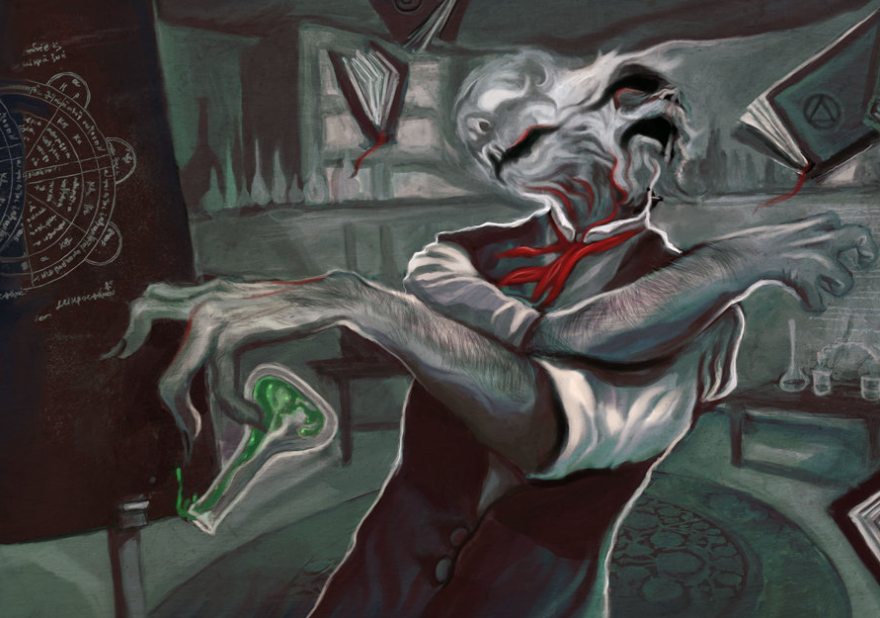
 Dr. Jekyll’s Transformation by Lorenzo Mastroianni

Have you ever felt like two selves are living inside you? Perhaps you present one version of yourself to the world—measured, capable, calm, and resilient—while another, hidden self emerges in moments of craving, impulse, self-sabotage, or collapse. This experience can feel bewildering, even frightening, as though something foreign has taken over.

Robert Louis Stevenson’s The Strange Case of Dr. Jekyll and Mr. Hyde is more than a gothic horror story. It is a profound allegory about the divided human psyche. Its enduring power lies in how vividly it captures the inner conflict between our socially acceptable self and our hidden impulses. For trauma survivors and those navigating addictions, this metaphor speaks with unsettling precision.

Philosophers have wrestled with the paradox of the divided self for millennia. From Plato’s tripartite soul, to St. Augustine’s confessions of inner conflict, to Nietzsche’s critique of repression, the tension between light and shadow has always been part of the human condition. What modern trauma research and somatic therapies like Peter Levine’s Waking the Tiger: Healing Trauma add is a new understanding: these divisions are not just moral or existential—they are embodied, physiological realities that live in our nervous systems.


The Duality Within: Trauma Splits as Inner Jekyll and Hyde

In Stevenson’s novella, Dr. Jekyll is a well-respected gentleman who longs to separate his virtuous self from his darker impulses. He creates a potion that allows him to become Mr. Hyde, a figure unrestrained by morality or social expectation. At first, Jekyll feels liberated. He believes he has found a way to keep his darker side hidden while maintaining his respectable life. But soon, Hyde grows stronger, more violent, and more uncontrollable. Eventually, Jekyll loses the ability to choose when the transformation happens—Hyde takes over at will.

This story resonates with what I’ve described in my blog on mild splits in sexual trauma survivors. When faced with overwhelming pain or violation, the psyche often protects itself by compartmentalizing. One part of the self continues to function, go to work, care for others, and present a socially acceptable image. Meanwhile, another part carries the unbearable weight—memories, emotions, shame, and survival impulses.

Like Jekyll’s potion, splitting can feel adaptive at first. It allows survivors to keep moving, to survive unbearable circumstances. But over time, these splits create instability. What is buried does not disappear—it festers. Eventually, it erupts in behaviors or symptoms that may feel alien, frightening, or destructive.

This dynamic echoes Plato’s tripartite model of the soul: reason, spirit, and appetite. Plato argued that harmony requires balance between these parts. When appetite dominates, chaos ensues; when it is entirely denied, it grows more dangerous. Stevenson’s Jekyll is Plato’s rational man trying to suppress appetite, only to have it return in monstrous form.

St. Augustine described the same paradox in his Confessions. Reflecting on his youth, he prayed: “Grant me chastity and continence, but not yet.” He wanted virtue, but also indulgence. This divided will mirrors Jekyll’s wish to be both saint and sinner at once, and it reflects the same psychic split trauma survivors often feel—wanting to appear intact while another part yearns for relief at any cost.


Repression, Shame, and the Cycle of Addiction

Jekyll’s downfall comes not from Hyde’s existence, but from his refusal to integrate him. He represses what he deems unacceptable and tries to sever it entirely. But as Nietzsche warned, what we repress doesn’t vanish. Instead, it grows in power and returns in distorted ways.

For survivors of trauma, repression often takes the form of silence and shame. They may tell themselves:

  • “If I let myself feel this grief or rage, I’ll fall apart.”
  • “If I show others this side of me, I won’t be loved or accepted.”

To survive, they push these parts underground. But what is exiled doesn’t disappear. It resurfaces in self-sabotaging choices, compulsions, and addictive patterns.

This is where Aristotle’s idea of akrasia—weakness of will—comes in. Aristotle asked why people act against their own better judgment. He observed that desire and impulse can overpower reason. Addiction is perhaps the most painful expression of this: knowing what is destructive yet being unable to stop, as though another part of the self has seized control.

We can see Jekyll’s progression mirrored in the cycle of addiction:

  1. Experimentation: A behavior begins as a way to feel relief or escape.
  2. Dependence: The behavior becomes the go-to coping mechanism.
  3. Loss of Control: The behavior takes on a life of its own, surfacing without conscious choice.
  4. Collapse: The self fragments under the strain.

This is Jekyll’s arc, but it is also the lived experience of many survivors. Addiction becomes Hyde—the shadow self breaking through, demanding release, regardless of cost.


The Body Speaks: Somatic Experiencing as the Path to Integration

While philosophers explored these dynamics in moral or existential terms, modern trauma therapy places them squarely in the body. Peter Levine’s Waking the Tiger revolutionized trauma healing by showing that trauma is not just a memory or story—it is energy trapped in the nervous system.

Animals in the wild endure constant threats, yet they rarely develop chronic trauma. Why? Because after a life-threatening event, they discharge the energy through shaking, trembling, or movement. Their bodies complete the survival cycle. Humans, however, often override this instinct. We freeze. We shut down. We hold it inside. The body never finishes the response, and the energy becomes trapped.

Over time, this stuck energy expresses itself as anxiety, depression, compulsions, or addictions. These are not failures of morality or willpower. They are the body’s desperate attempt to resolve what was never completed.

Here, Levine’s work intersects powerfully with Carl Jung’s concept of the shadow. Jung taught that the denied parts of the psyche must be faced and integrated, or they will sabotage us from the dark. Levine shows us how to do this somatically—by listening to the body, tracking sensations, and allowing discharge, we invite the shadowed parts back into wholeness.

Kierkegaard described despair as “the sickness unto death”—the condition of being out of alignment with oneself. This is exactly what trauma creates: a self divided against itself, fragments cut off from one another. Healing is not about destroying Hyde, but about reuniting Jekyll and Hyde into a single, embodied self.


Practical Ways to Heal the Split: Applying Levine’s Insights

Levine’s Somatic Experiencing (SE) offers practical tools for reintegration. Here are six accessible practices to begin exploring:

  1. Track the Felt Sense
    • Pause and notice what is happening in your body right now. Tingling? Heaviness? Warmth? Numbness?
    • Ask: Where in my body feels tense? Where feels calm or neutral?
    • Why it helps: Trauma cuts us off from body awareness. Tracking sensations reconnects us to the body’s subtle language, allowing us to catch activation before it escalates into destructive behavior.
  2. Pendulation
    • Focus gently on an activated place (tight chest, restless hands).
    • Then shift attention to a calmer place (feet, breath, or a hand resting on your lap).
    • Move awareness slowly between the two.
    • Why it helps: Instead of being stuck in repression (Jekyll) or overwhelm (Hyde), pendulation teaches the nervous system flexibility.
  3. Micro-Movements for Completion
    • Ask your body: What small movement do you need right now?
    • Allow your shoulders to roll, your legs to push lightly into the floor, or your body to tremble.
    • Welcome yawns, sighs, tears, or laughter.
    • Why it helps: These are signs of discharge—your body releasing stuck survival energy.
  4. Orienting to the Present
    • Slowly turn your head. Look around the room.
    • Let your eyes rest on objects, colors, or textures.
    • Whisper inwardly: I am here. I am safe now.
    • Why it helps: Trauma keeps us stuck in the past. Orienting gently re-engages the parasympathetic nervous system, grounding us in present safety.
  5. Resource with Safety Anchors
    • Bring to mind a safe person, place, or memory.
    • Notice how your body responds—softening, warmth, slowing of breath.
    • Why it helps: Resources provide the stability to face hidden parts without being overtaken.
  6. Allow Gentle Discharge
    • If trembling, warmth, or tears arise, let them flow.
    • These are not signs of weakness—they are signs of completion.
    • Why it helps: This is the body’s catharsis—release that restores balance.

Somatic Integration Exercise: Meeting Jekyll and Hyde Through the Body

Here is a full guided practice combining the Jekyll/Hyde metaphor, philosophical insight, and Levine’s body-based healing approach.

Step 1: Settle and Arrive

  • Sit or lie comfortably.
  • Look around and name a few colors or shapes.
  • Feel the support beneath you.
  • Ask: Right now, am I safe?

Step 2: Invite Both Selves

  • Imagine your Jekyll self—calm, capable, controlled.
  • Imagine your Hyde self—impulsive, hurting, craving.
  • Whisper inwardly: Both of you are welcome here.
  • Notice where each shows up in your body.

Step 3: Track the Felt Sense

  • Focus on tension or discomfort.
  • Then shift to a calm area.
  • Move gently between the two.

Step 4: Micro-Movement and Release

  • Ask your body what it needs. Allow shaking, stretching, or sighing.
  • Welcome any natural discharge.

Step 5: Anchor in Resources

  • Imagine a safe person, place, or memory.
  • Wrap both Jekyll and Hyde in this safety.

Step 6: Closing Reflection

  • Thank both parts for showing up.
  • Whisper inwardly: I am learning to be whole.
  • Reorient gently to your space.

This practice is not about erasing Hyde or clinging only to Jekyll. It is about learning to hold both, allowing the body to integrate what was once divided. Over time, this strengthens the nervous system’s capacity to be whole.


Healing Is Wholeness Through the Body

The tragedy of Jekyll was not that he had a shadow, but that he believed he could banish it. Philosophers from Plato to Kierkegaard warned that division within the self breeds despair. Nietzsche and Jung reminded us that denied parts always return. Levine shows us how the body carries this same truth: what is suppressed must eventually surface, and healing means allowing the body to complete what it never could.

Addictions and destructive behaviors are not moral failures. They are signals—Hyde’s way of demanding attention. They are the body’s attempt to release trapped energy, even if in distorted ways.

Healing comes not from repression, but from compassion. Not from silencing Hyde, but from listening to him. Not from erasing shadow, but from welcoming it back into the circle of self.


Final Reflection
Stevenson’s tale is a warning about repression. The philosophers give us language for divided wills and shadows. Levine gives us a somatic pathway home. Together, they remind us: wholeness is possible.

When we stop running from Hyde, we discover that he carries not only pain, but also vitality—the raw life force waiting to be reclaimed.


A Glimpse Into the Global Neural Network: Could Our Brains Be Interconnected?

Connected Minds by Joe Brokerhoff

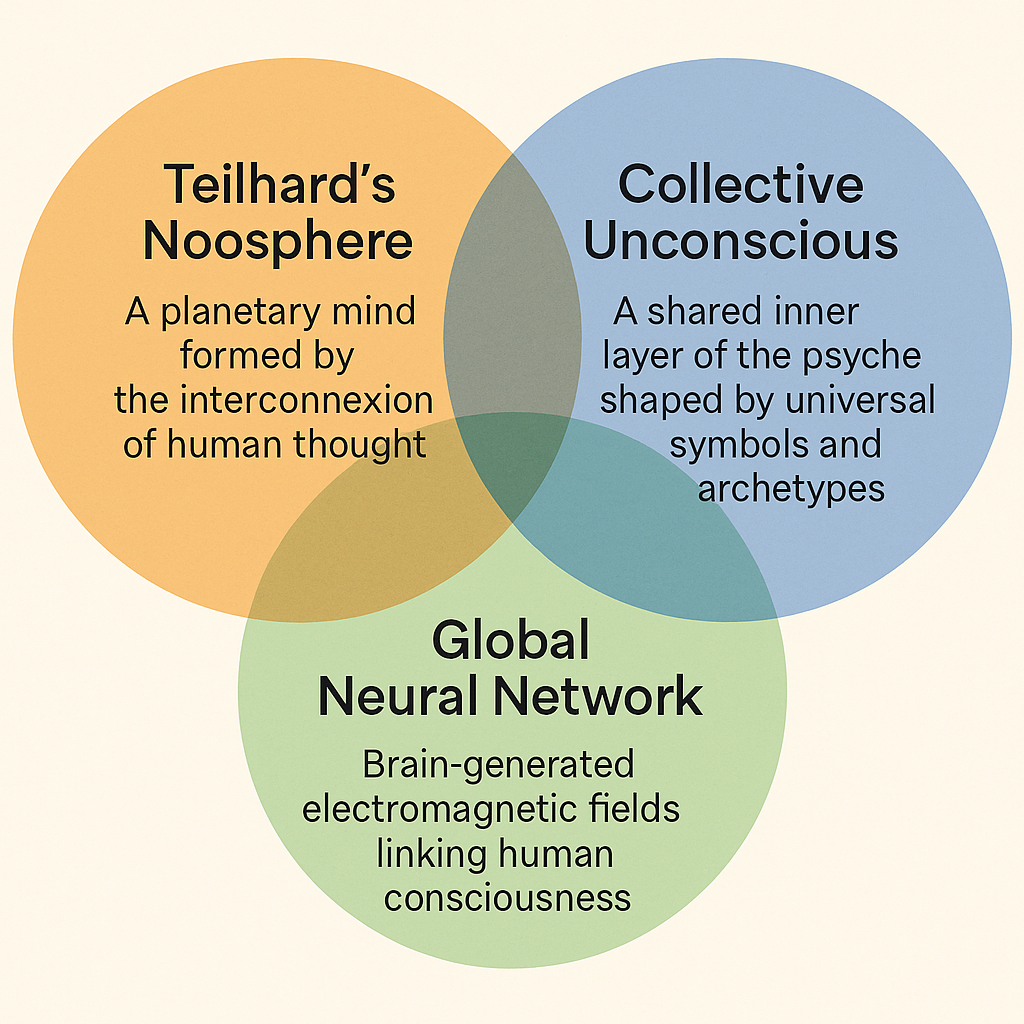
Recent reports have raised an extraordinary possibility: what if our brains are subtly connected through invisible electromagnetic threads? According to one popular summary, Princeton neuroscientists have used highly sensitive magnetometers to detect extremely low-frequency electromagnetic waves produced by the human brain. These patterns, the report suggests, are coherent and structured—and may even influence distant brains across thousands of kilometers.


What Neuroscience Actually Tells Us

While the Princeton claim remains unverified, there is a solid scientific basis confirming that the brain does emit electromagnetic fields. Techniques like magnetoencephalography (MEG) employ ultrasensitive magnetometers to map magnetic fields generated by neuronal currents in the brain. This is well-established technology used in both research and clinical settings.

These fields arise from synchronized activity of neurons—especially large groups firing together—and are detectable only with extremely sensitive equipment in controlled environments. Outside of specialized labs, ambient electromagnetic noise generally drowns them out.

There’s also emerging work on how extremely low-frequency (ELF) electromagnetic fields can influence neuronal processes. For example, exposure to ELF-EMF has been linked to changes in ion channel function and even neurogenesis in animal models.


Teilhard de Chardin’s Noosphere: A Planetary Mind

French philosopher and Jesuit priest Pierre Teilhard de Chardin (1881–1955) was both a theologian and a trained paleontologist, which gave him a unique lens to view human evolution—not just biologically, but spiritually and intellectually.

Teilhard proposed that evolution progresses through distinct layers:

  • The Geosphere – the physical, inanimate Earth.
  • The Biosphere – the layer of life, plants, and animals.
  • The Noosphere – a “thinking layer” that emerges once human consciousness and communication become complex enough to form a planetary web of thought.

In Teilhard’s view, the Noosphere is not metaphorical but a real, evolving stage of the planet’s development—an interconnected field created by the sum of human minds. As culture, technology, and communication advance, the Noosphere thickens, weaving tighter bonds between people across continents.

He envisioned this process culminating in the Omega Point—a state of ultimate unity in which human consciousness aligns with divine purpose, achieving maximum integration of knowledge, empathy, and awareness.

If today’s neuroscience is indeed showing that our brains create coherent electromagnetic fields that can interact over vast distances, Teilhard’s Noosphere could be seen as a philosophical precursor to the idea of a measurable “global neural network.” His work provides a spiritual and evolutionary map, while science may be revealing the wiring.


Carl Jung’s Collective Unconscious: A Shared Inner Landscape

Swiss psychiatrist Carl Jung (1875–1961) approached the question of interconnected minds from the inside out. He believed that beneath each person’s personal unconscious—which holds forgotten memories and repressed experiences—there is a collective unconscious, a shared psychic inheritance common to all humanity.

This collective unconscious contains archetypes—universal symbols and motifs such as the Mother, the Hero, the Shadow, and the Wise Old Man. These archetypes surface in myths, fairy tales, religious traditions, and dreams across cultures and time periods, even among people with no direct contact.

For Jung, this was evidence that human beings share a deep, pre-verbal layer of mind. It is not learned; it is innate. It shapes how we perceive, imagine, and respond to the world.

While Jung did not frame his theory in electromagnetic or physical terms, the overlap with today’s “global neural network” idea is striking. Jung saw our inner lives as partly communal, built on a shared psychological blueprint. If Teilhard’s Noosphere describes the outer, collective field of human thought, Jung’s collective unconscious describes the inner, symbolic content that moves within it.

In this way, modern neuroscience could be pointing to the biological infrastructure that allows both Jung’s and Teilhard’s visions to operate—not just as metaphors, but as lived human realities.


Why This Matters for Healing and Growth

In my own work as a counselor, coach, and educator, I have seen first-hand how human connection shapes personal transformation. Whether it’s in one-on-one sessions, group counseling, or community workshops, I help people tap into the deeper currents of their emotional and somatic experience—currents that may also resonate in the kind of global neural network scientists are beginning to imagine.

Through approaches like somatic breathwork, trauma-informed counseling, and creative expression, I guide clients in attuning to themselves and, by extension, to the subtle ways they are connected to others. When we align our inner rhythms, we often find more empathy, more clarity, and more courage to live authentically.

If science is pointing to a real, measurable link between our brains, it could explain why shared experiences—whether joyful, painful, or deeply transformative—can ripple outward and create change beyond the individual. It reinforces the truth I see every day: your healing is never just your own.


Let’s Explore This Together

If the idea of a connected human consciousness resonates with you, and you’re ready to explore your own healing and growth in a way that honors mind, body, and connection, I would love to work with you.

You can learn more about my services and schedule a consultation at www.dr-kat.org/work-with-dr-kat, or reach out directly by email at help@dr-kat.org.

Your journey may just be part of a much larger story—one that spans not only hearts and minds, but perhaps even the invisible waves that connect us all.

Dreams as Messengers: What Nighttime Narratives Reveal About Your Inner Life

Dream Time by Uttam Bhattacharya

What if the bizarre, vivid, or even distressing dreams you experience weren’t random at all—but were instead meaningful messengers, surfacing from the depths of your subconscious to guide, warn, or reveal? Across psychology, spirituality, and philosophy, dreams have long been viewed as more than nighttime entertainment—they are tools of insight, healing, and revelation.


The Brain’s Way of Working Things Out

From a neurological perspective, dreams are not aimless. Research suggests that during REM sleep, our brains continue to solve problems, regulate emotions, and consolidate memory. According to Carl Jung, dreams are a natural expression of the unconscious—the psyche’s effort to bring balance and understanding through symbolic communication. We might not be consciously aware of a dilemma, but our brains often are, and dreams are one of the ways our minds nudge us toward resolution.

That frustrating dream of being chased, failing an exam, or missing a flight? It may not be about the literal content at all, but a metaphor for stress, decision paralysis, or fear of failure that’s surfacing because your conscious mind is too overwhelmed or too distracted to process it during waking hours.


Messages in a Bottle: Montague Ullman’s Theory of Dreams

Montague Ullman (1916–2008) was a psychiatrist and psychoanalyst best known for his groundbreaking work in dream theory and group dreamwork. Ullman believed dreams were not merely products of the id or subconscious discharge but communicative acts—messages in a bottle sent from the self to the self. According to Ullman, dreams function as internal mail, offering emotional truth that bypasses our intellectual defenses.

He championed the idea that dream interpretation should be democratic and community-based. Through dream-sharing groups, Ullman emphasized the value of collective wisdom in decoding dreams. Rather than pathologizing or medicalizing them, he invited people to explore their dreams with curiosity and emotional honesty, viewing each dream as a meaningful commentary on one’s lived experience.


The Recurring Dream Loop

When dreams repeat—whether it’s being trapped, falling, or teeth crumbling—they’re like a psychological ping that something still needs attention. Recurring dreams often indicate unresolved conflict, trauma, or patterns that have yet to be integrated or addressed.

The 20th-century French philosopher Gaston Bachelard explored the poetic and recurring nature of dreams in The Poetics of Reverie. He believed dreams, especially recurring ones, served as invitations to revisit emotional truths hidden beneath surface awareness. Bachelard wrote that dreams are not only echoes of our past, but “images that ask to be born anew in consciousness.”

Processing a recurring dream involves journaling, emotional reflection, and noticing patterns across time. Ask yourself:

  • What emotions am I resisting in waking life?
  • What is the underlying fear or longing behind this dream?
  • Has anything about the dream changed since I last had it?

Bringing awareness to the dream’s emotional tone and symbolic content often softens its repetition. Recurring dreams rarely stop because we analyze them—they stop because we integrate what they’re trying to teach us.


Prophetic Dreams and the Role of Intuition

Some dreams seem to tap into something beyond time—an intuitive awareness of what is happening beneath the surface or even what is to come. This isn’t always about clairvoyance but rather the emergence of information not yet processed consciously.

Heart-based research supports the idea that the body—especially the heart—is a seat of intuitive knowing. According to the HeartMath Institute, the heart has its own intrinsic nervous system, sometimes called the “heart-brain,” which processes information independently of the cerebral brain. Studies have shown the heart responds to stimuli seconds before they appear, suggesting a form of intuitive foresight. In this sense, prophetic dreams may reflect the heart’s ability to sense subtle energy shifts in our relationships, environments, or health long before our conscious minds register them.


Trauma Revisited in the Dream Space

Unresolved trauma often finds its way into dreams, especially when waking life begins to feel safe enough to explore it. A woman who was cheated on may dream repeatedly of her spouse in new affairs, not because it’s happening again, but because her psyche is still trying to make sense of the betrayal, the loss of trust, and the fracturing of her identity.

Conversely, a man who has cheated and lost his wife as a result may experience nightmares of abandonment, rage, or seeing his family torn apart. These dreams aren’t about punishment but are a manifestation of unprocessed grief, shame, and guilt. The dream becomes a mirror—reflecting both what happened and what the dreamer still carries inside.

This scenario can also give rise to complex, layered dreams in which multiple timelines play out—alternate lives where the betrayal never happened, or where healing was possible. These parallel dream-worlds may point to the emotional ambivalence within the dreamer: regret, longing, and the wish to undo what cannot be undone.

Philosopher Søren Kierkegaard explored such internal conflict in relation to despair and the multiplicity of the self. He argued that part of being human is reconciling these opposing inner states—hope and regret, freedom and consequence. Dreams allow for this reconciliation to happen symbolically, playing out what the conscious mind cannot resolve.


Dreams in Addiction Recovery: Including Sexual Addiction

Freud famously interpreted dreams as wish fulfillment—a way for the unconscious to safely act out desires that the waking ego represses. In addiction recovery, dreams about using substances may reflect lingering cravings or guilt around past behaviors. But they are not signs of relapse. They are the psyche detoxing its internal landscape.

Carl Jung, in contrast, viewed dreams as part of the individuation process—a symbolic roadmap for the integration of the self. Jung would likely view dreams of relapse or destructive behaviors not as shameful, but as the unconscious presenting the shadow self, asking for attention, compassion, and transformation.

In recovery from sexual addiction, dreams may include imagery of past behaviors, unresolved desires, or even shame-inducing content. These are not regressions but reflections of healing-in-process. They may be an invitation to reclaim parts of the self that were numbed or fragmented during active addiction.

To process these dreams:

  • Reflect on what the dream may be trying to communicate about unmet needs or fears.
  • Practice self-compassion rather than shame.
  • Bring the dream into therapy or group work, where symbolic themes can be safely explored.

Philosophers on Dreams: Expanded Perspectives

  • Plato believed dreams were glimpses into the soul’s true desires. In The Republic, he described dreams as unchained expressions of inner impulses and argued that the just person could control dreams as a measure of moral integrity.
  • Aristotle, more empirical, saw dreams as physiological processes influenced by digestion and temperature, yet still acknowledged their capacity to reflect emotional states and signal bodily imbalance.
  • Descartes questioned the reliability of dreams entirely, using them to illustrate the fallibility of sensory experience and launching the philosophical query: How can we know we’re not dreaming now?
  • Nietzsche saw dreams as echoes of archaic human instinct. He believed dreams brought us in contact with primordial forces and the “Dionysian” side of the psyche—a vital counterbalance to rationality.
  • Krishnamurti held that dreams were a reflection of inner disorder and that true clarity arises only when the mind is silent, not cluttered with interpretation. He emphasized dream observation rather than analysis.

Each philosophical view adds nuance to the nature of dreams—whether as moral mirror, biological feedback, existential challenge, or spiritual insight.


How to Work with Dreams

Working with dreams begins in the present moment. Instead of chasing meaning, start where you are—with the feelings, symbols, or questions that arise when you wake.

Eckhart Tolle teaches the power of now—the idea that transformation begins when we fully inhabit the present moment. Dreams often point to the places where we’re not present—where we’re caught in old stories, regrets, or fears. Use them as anchors to return to yourself.

Tips:

  • Keep a dream journal by your bed and write as soon as you wake.
  • Look for patterns, symbols, and emotional themes over time.
  • Share dreams in trusted spaces—therapy, dream groups, or with a mentor.
  • Practice mindfulness to increase dream recall and integrate insight.

Dreams are not problems to solve. They are invitations—to feel, to remember, to imagine, and ultimately, to awaken. What messages are your dreams sending you tonight?