Recent reports have raised an extraordinary possibility: what if our brains are subtly connected through invisible electromagnetic threads? According to one popular summary, Princeton neuroscientists have used highly sensitive magnetometers to detect extremely low-frequency electromagnetic waves produced by the human brain. These patterns, the report suggests, are coherent and structured—and may even influence distant brains across thousands of kilometers.
What Neuroscience Actually Tells Us
While the Princeton claim remains unverified, there is a solid scientific basis confirming that the brain does emit electromagnetic fields. Techniques like magnetoencephalography (MEG) employ ultrasensitive magnetometers to map magnetic fields generated by neuronal currents in the brain. This is well-established technology used in both research and clinical settings.
These fields arise from synchronized activity of neurons—especially large groups firing together—and are detectable only with extremely sensitive equipment in controlled environments. Outside of specialized labs, ambient electromagnetic noise generally drowns them out.
There’s also emerging work on how extremely low-frequency (ELF) electromagnetic fields can influence neuronal processes. For example, exposure to ELF-EMF has been linked to changes in ion channel function and even neurogenesis in animal models.
Teilhard de Chardin’s Noosphere: A Planetary Mind
French philosopher and Jesuit priest Pierre Teilhard de Chardin (1881–1955) was both a theologian and a trained paleontologist, which gave him a unique lens to view human evolution—not just biologically, but spiritually and intellectually.
Teilhard proposed that evolution progresses through distinct layers:
The Geosphere – the physical, inanimate Earth.
The Biosphere – the layer of life, plants, and animals.
The Noosphere – a “thinking layer” that emerges once human consciousness and communication become complex enough to form a planetary web of thought.
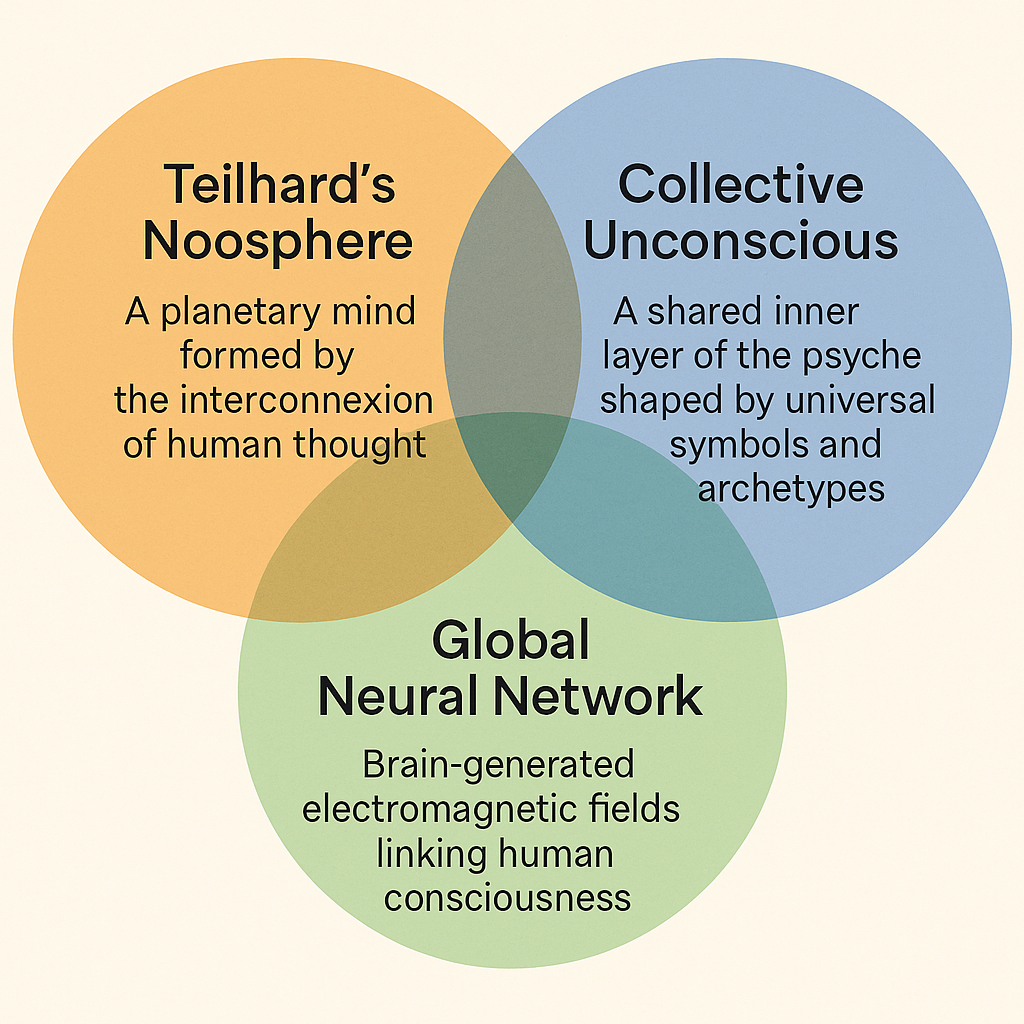
In Teilhard’s view, the Noosphere is not metaphorical but a real, evolving stage of the planet’s development—an interconnected field created by the sum of human minds. As culture, technology, and communication advance, the Noosphere thickens, weaving tighter bonds between people across continents.
He envisioned this process culminating in the Omega Point—a state of ultimate unity in which human consciousness aligns with divine purpose, achieving maximum integration of knowledge, empathy, and awareness.
If today’s neuroscience is indeed showing that our brains create coherent electromagnetic fields that can interact over vast distances, Teilhard’s Noosphere could be seen as a philosophical precursor to the idea of a measurable “global neural network.” His work provides a spiritual and evolutionary map, while science may be revealing the wiring.
Carl Jung’s Collective Unconscious: A Shared Inner Landscape
Swiss psychiatrist Carl Jung (1875–1961) approached the question of interconnected minds from the inside out. He believed that beneath each person’s personal unconscious—which holds forgotten memories and repressed experiences—there is a collective unconscious, a shared psychic inheritance common to all humanity.
This collective unconscious contains archetypes—universal symbols and motifs such as the Mother, the Hero, the Shadow, and the Wise Old Man. These archetypes surface in myths, fairy tales, religious traditions, and dreams across cultures and time periods, even among people with no direct contact.
For Jung, this was evidence that human beings share a deep, pre-verbal layer of mind. It is not learned; it is innate. It shapes how we perceive, imagine, and respond to the world.
While Jung did not frame his theory in electromagnetic or physical terms, the overlap with today’s “global neural network” idea is striking. Jung saw our inner lives as partly communal, built on a shared psychological blueprint. If Teilhard’s Noosphere describes the outer, collective field of human thought, Jung’s collective unconscious describes the inner, symbolic content that moves within it.
In this way, modern neuroscience could be pointing to the biological infrastructure that allows both Jung’s and Teilhard’s visions to operate—not just as metaphors, but as lived human realities.
Why This Matters for Healing and Growth
In my own work as a counselor, coach, and educator, I have seen first-hand how human connection shapes personal transformation. Whether it’s in one-on-one sessions, group counseling, or community workshops, I help people tap into the deeper currents of their emotional and somatic experience—currents that may also resonate in the kind of global neural network scientists are beginning to imagine.
Through approaches like somatic breathwork, trauma-informed counseling, and creative expression, I guide clients in attuning to themselves and, by extension, to the subtle ways they are connected to others. When we align our inner rhythms, we often find more empathy, more clarity, and more courage to live authentically.
If science is pointing to a real, measurable link between our brains, it could explain why shared experiences—whether joyful, painful, or deeply transformative—can ripple outward and create change beyond the individual. It reinforces the truth I see every day: your healing is never just your own.
Let’s Explore This Together
If the idea of a connected human consciousness resonates with you, and you’re ready to explore your own healing and growth in a way that honors mind, body, and connection, I would love to work with you.
Your journey may just be part of a much larger story—one that spans not only hearts and minds, but perhaps even the invisible waves that connect us all.
Are you tired of carrying around the weight of past negative experiences? It’s time to let go and start living in the now. Here l explore how mindfulness can help release negative energy from the past and bring a sense of peace and clarity to your life. Get ready to embrace the present moment and leave those old wounds behind for good.
Mindfulness and its Benefits
Mindfulness is a practice that has gained immense popularity in recent years, especially for its ability to help individuals release negative energy from the past and live in the present moment. But what exactly is mindfulness?
At its core, mindfulness is a state of active, open attention on the present moment. It involves purposely paying attention to our thoughts, feelings, sensations, and surroundings without judgment or distraction. This may seem simple enough, but in today’s fast-paced world where we are constantly bombarded with stimuli from technology and other distractions, it can be quite challenging to achieve.
In ancient philosophy, staying in the present moment was considered essential for achieving a state of inner peace and enlightenment. Mindfulness refers to the practice of being fully aware and focused on the present moment without judgment or attachment to the past or future. This concept can be traced back to various philosophical traditions such as Stoicism, Buddhism, and Taoism. For example, Stoic philosophers like Epictetus believed that by embracing the present moment and accepting things as they are, one could cultivate resilience and maintain emotional equilibrium in the face of adversity. Similarly, in Buddhist teachings, mindfulness meditation is seen as a way to develop awareness of one’s thoughts and emotions without getting caught up in them. By staying grounded in the present moment, individuals were able to let go of worries about the future or regrets about the past, thereby freeing themselves from unnecessary suffering and finding true contentment within themselves. Mindfulness has since been adapted and integrated into modern-day psychology and counseling as an effective tool for enhancing mental well-being.
So why should we make an effort to incorporate mindfulness into our daily lives? The answer lies in the numerous benefits it offers for both our physical and mental health.
Firstly, practicing mindfulness helps us become more self-aware. By intentionally directing our focus inward, we develop a better understanding of ourselves – our emotions, thoughts, behaviors – and how they impact us. This self-awareness allows us to catch negative thought patterns or behaviors before they spiral out of control.
Secondly, mindfulness can also lead to increased emotional regulation. Instead of reacting impulsively to situations or dwelling on past events that may bring about negative emotions such as anger or sadness, being mindful enables us to observe these feelings without judgment or attachment. We learn to acknowledge them and let them go instead of allowing them to consume us.
In addition to improving emotional well-being, mindfulness has also been associated with reduced stress levels. As mentioned earlier, by focusing on the present moment rather than worrying about the future or ruminating on the past, we are better able to handle stressful situations with calmness and resilience.
Moreover, potential physical health benefits have also been linked to mindfulness. Studies have shown that incorporating mindfulness into one’s daily routine can lead to improvements in blood pressure, heart rate, and immune system functioning.
Mindfulness is a powerful tool for promoting overall well-being. By learning to live in the present moment and releasing negative energy from the past, we can experience greater peace of mind, improved relationships, reduced stress levels, and potential physical health benefits.
Understanding Negative Energy from the Past
The past is a powerful force that can greatly influence our present moment. Good memories can bring us joy and happiness, while negative experiences from the past can leave us feeling drained and burdened. We carry this negative energy with us, often without even realizing it, and it seeps into our thoughts, emotions, and behaviors. This can lead to feelings of anxiety, anger, guilt, and regret in our daily lives.
But how exactly does this negative energy from the past affect us? And how can we release it? In order to effectively use mindfulness to live in the now and let go of this unhealthy baggage from the past, we must first understand the root of this negative energy.
To begin with, negative energy from the past is often created through unresolved issues or traumas that we have experienced. These could be childhood wounds, failed relationships or friendships, or any other event that left a mark on us emotionally. These experiences may have caused deep pain or hurt that we carry with us for years. Holding onto these feelings creates a constant cycle of negativity in our minds.
Moreover, dwelling on regrets about things we did or didn’t do in the past also contributes to this negative energy. We may find ourselves replaying certain events over and over again in our minds – thinking about what we could have done differently or how things would be if only certain decisions were made – but these thoughts only serve to keep us stuck in the past.
It’s important to note that carrying around this negativity not only affects our mental health but can also manifest physically in various ways such as headaches, stomach problems, muscle tension etcetera.
So how do we break free from this toxic cycle of holding onto past hurts? That’s where mindfulness comes into play. By being fully present in the now instead of living in either regretful memories or anxious future scenarios created by our mindsets towards those memories; we can release the negative energy from our past.
By practicing mindfulness, we are able to cultivate awareness of our thoughts and emotions without getting caught up in them. We can observe them, acknowledge them, and then let them pass by like clouds in the sky. This way, we can gradually let go of the attachment and power that these memories hold over us.
Understanding where this negative energy from the past comes from is crucial for being able to release it. By becoming mindful and focused on living in the present moment, we can break free from its grasp and create a brighter future for ourselves – one that is not influenced by the pain of our past experiences.
The Connection between the Mind and Body
The connection between the mind and body has long been a topic of interest and study in numerous fields such as psychology, medicine, and philosophy. From ancient spiritual practices to modern scientific research, there is undeniable evidence that our thoughts, emotions, beliefs, and physical well-being are deeply intertwined.
One example of this connection is seen in the effects of stress on both the mind and body. When we experience stress or negative emotions such as anger or anxiety, it triggers a physiological response in our body through the release of hormones like cortisol and adrenaline. These hormones prepare us for a fight-or-flight response by increasing heart rate, constricting blood vessels, and tensing muscles. This reaction is necessary for short-term survival but can become detrimental if prolonged.
Chronic stress can lead to various physical health problems such as high blood pressure, weakened immune system, digestive issues, headaches, chronic pain – just to name a few. On the other hand, unresolved emotional issues can manifest as physical symptoms like tension headaches or stomach pains.
Our thoughts and emotions can greatly influence our behaviors, habits, and lifestyle choices which in turn impact our physical health. For instance, someone with low self-esteem or negative self-image may engage in unhealthy behaviors such as overeating or substance abuse. These behaviors can have negative effects on their physical health in the long run.
On the other hand, those who have a positive attitude, perceive challenges as opportunities for growth, and practice mindfulness tend to lead healthier lifestyles and experience better physical health outcomes.
Research has also shown that mental health disorders like depression and anxiety can manifest as physical symptoms. For example, depression is often associated with chronic fatigue or unexplained pain while anxiety can manifest as stomach problems or muscle tension. This further illustrates how closely intertwined the mind and body are.
Reconditioning the Mind and Body through Mindfulness
Negative thoughts and emotions not only affect our mental state but also manifest physically in the form of stress, tension, and illness. Through mindfulness techniques, we can recondition our minds and bodies to let go of this negative energy from the past.
One of the key ways to recondition our mind through mindfulness is by shifting our focus to the present moment. Often, negative energy stems from dwelling on past regrets or worrying about future outcomes. By bringing our attention back to what is happening in the here-and-now, we can learn to let go of these destructive thought patterns. This can be done by practicing simple breathing exercises or using tools like meditation apps or guided meditations.
Another way to recondition our mind is by learning how to observe our thoughts without getting caught up in them. When we become aware of our thoughts as mere observations rather than absolute truths, we create space for more positive thinking patterns to emerge. This allows us to break free from self-limiting beliefs that may be holding us back.
In addition to focusing on the mind, mindfulness also encourages us to listen to our bodies’ cues. Negative energy from the past often manifests itself physically as tension or discomfort in certain parts of our body. By paying attention to these physical sensations with curiosity rather than judgment, we can tune into any underlying emotional issues that may need addressing.
Along with reconditioning the mind, mindfulness also has a direct impact on physical health. Studies have shown that regular mindfulness practices such as yoga or tai chi can reduce stress levels and improve physical health markers like blood pressure and heart rate.
Reconditioning the mind and body through mindfulness is a powerful way to release negative energy from the past. By staying present in the moment, learning to observe our thoughts without judgment, and listening to our bodies’ cues, we can create a healthier and more positive mindset. With regular practice, mindfulness can help us let go of the burdens of the past and live a more mindful, fulfilling life in the now.
Techniques for Letting Go of Negative Energy
One of the key components of living in the present and practicing mindfulness is letting go of negative energy from the past. This negative energy can come in various forms, such as regrets, grudges, hurtful memories, or unresolved conflicts. Holding onto these negative energies can hinder our ability to fully embrace and experience the present moment.
To truly live in the now and release any lingering negativity from our past, we must actively work on letting go. Here are some techniques that you can use to let go of negative energy:
Acknowledge your feelings: The first step towards releasing negative energy is acknowledging its presence and understanding how it affects us. Take a few moments to sit quietly and reflect on any emotions or memories that may be causing you distress. By recognizing and labeling these feelings, we can begin to address them.
Practice forgiveness: One powerful way to let go of negative energy is through forgiveness. This doesn’t mean forgetting or excusing what has happened but choosing to release anger, resentment, or blame towards ourselves or others involved FOR ONESELF. Forgiveness allows us to move forward without carrying emotional baggage from the past.
Use visualizations: Another effective technique for releasing negative energy is through visualization. Envision yourself surrounded by a bright white light that represents positivity and peace while exhaling out all the negativity within you with each breath out. You can also picture yourself letting go of heavy rocks symbolizing your burdens one by one.
Yoga or meditation: Mind-body practices like yoga and meditation offer various benefits, including helping us release stored up emotions and tension from our body-mind connection. Through mindful breathing techniques and challenging poses, we can physically feel ourselves letting go of any negative energy.
Journaling: Writing down our thoughts and feelings about a particular event or situation can provide clarity on how it has impacted us negatively while giving us an outlet for releasing these emotions. Journaling also allows us to reflect on our progress and recognize patterns in our behavior, helping us work towards breaking free from negative thought cycles.
Seek professional support: If your negative energy is deeply rooted or causing significant distress, it may be helpful to seek guidance from an experienced counselor who knows how to guide you through mindfulness practices. They can provide you with personalized techniques and support in navigating through this process.
Letting go of negative energy takes time and effort but is crucial for living in the now and practicing mindfulness. These techniques can help you release any emotional baggage from your past and move forward towards a more peaceful and fulfilling present. Remember to be patient with yourself, as each person’s journey towards letting go will differ. Taking small steps every day can lead to significant changes in your overall well-being.
Meditation
Meditation, a practice that has been around for centuries, has gained popularity in recent years as a way to promote overall well-being and release negative energy from the past. This powerful tool combines mindfulness and self-awareness techniques to help individuals gain control over their thoughts, emotions, and actions.
The concept of meditation is simple – it involves sitting quietly and focusing on the present moment, without any distractions or judgments. This allows us to disconnect from our busy lives and internal chatter and instead become more attuned to our inner selves.
One of the main benefits of meditation is its ability to release negative energy from the past. Many of us tend to hold onto painful memories or regrets from our past, which can weigh heavily on our minds and affect our daily lives. Through meditation, we can learn to let go of these negative thoughts and redirect our focus towards the present moment.
During meditation, we are encouraged to acknowledge these negative thoughts without judging them or getting caught up in them. By acknowledging their existence but not reacting emotionally to them, we can slowly detach ourselves from their power over us. Over time, this practice helps us develop resilience towards negative emotions from the past.
Moreover, regular meditation also allows us to cultivate a sense of gratitude for the present moment. By being fully present in the here and now, we can appreciate all that we have in our lives at this very moment rather than dwelling on what could have been or what should have been in the past.
Research has shown that those who incorporate meditation into their daily routine experience decreased levels of stress and anxiety while increasing feelings of positivity and well-being. As a result, they are better equipped to handle any challenges that may arise from past experiences.
There are various types of meditations that one can explore depending on personal preference – guided meditations with visualizations or mantras, body scan meditations for relaxation or mindfulness walking meditations for those who prefer movement-based activities. The key is to find a technique that resonates with you and incorporate it into your daily routine for maximum benefits.
Incorporating meditation into our lives can be an incredibly powerful tool to release negative energy from the past. By practicing mindfulness and focusing on the present moment, we can break free from the shackles of our past experiences and live more fully in the now. So why not give it a try? Your mind and body will thank you for it.
Gratitude Practice
Gratitude is a powerful tool for practicing mindfulness and releasing negative energy from the past. It is a way of focusing on what we have in the present moment, rather than dwelling on what we lack or what has happened in the past. Gratitude practice involves intentionally cultivating feelings of thankfulness and appreciation, which can help us shift our perspective towards positivity and contentment.
One way to incorporate gratitude into your daily routine is through writing in a gratitude journal. This involves taking time each day to reflect on all of the things you are grateful for, big or small. It can be as simple as being thankful for having a roof over your head or something more specific like receiving a compliment from a stranger. By acknowledging and appreciating these things, we are training our minds to focus on the positive aspects of our lives.
Another effective gratitude practice is expressing appreciation towards those around us. This could be telling someone you love them, thanking them for something they did, or simply letting them know how much they mean to you. Not only does this foster positive relationships with others, but it also cultivates feelings of love and joy within ourselves.
In addition to journaling and expressing gratitude towards others, incorporating acts of kindness into our daily lives also strengthens our overall sense of gratitude. This could be volunteering at a local charity, helping out a neighbor in need, or even just holding open doors for strangers. By doing kind acts without expecting anything in return, we become more aware of how fortunate we are and develop an attitude of generosity.
It’s important to note that gratitude practice doesn’t mean ignoring or denying negative experiences from the past. Instead, it’s about finding balance and not allowing those experiences to consume us. Through regular gratitude practice, we learn to accept both the good and bad aspects of life while focusing on what we do have rather than what we lack.
By incorporating these practices into our daily routines, we cultivate an attitude of gratitude and mindfulness. This helps us to release negative energy from the past as we learn to live in the present moment with a more positive outlook. So take some time each day to reflect on what you are grateful for, express appreciation towards those around you, and spread kindness wherever you go. Trust me, your mind will thank you!
Visualization Exercises
Visualization exercises are a powerful tool in mindfulness practice that can help us release negative energy from our past and live more fully in the present. These exercises involve intentionally imagining situations, events, or emotions, and can be a helpful way to process and let go of past experiences that may still be impacting us.
One popular visualization exercise is known as “leaves on a stream”. To begin, find a quiet and comfortable place to sit. Close your eyes and take a few deep breaths, allowing yourself to fully relax. Now imagine yourself sitting by a peaceful stream, watching leaves float along its surface. As thoughts or memories from your past come up, picture them as individual leaves floating by. Acknowledge each one without judgement or attachment and then allow it to gently drift away down the stream. Keep going with this exercise for several minutes until you feel lighter and more at peace.
Another visualization exercise that can be beneficial for releasing negative energy is the “butterfly release”. Start by again finding a calm space to sit down comfortably. Close your eyes and visualize yourself standing in an open field with butterflies flying around you. Each butterfly represents an emotion or memory that you are holding onto from the past. Take a deep breath in, focusing on one specific butterfly representing a negative thought or feeling, then exhale while visualizing it flying off into the distance until it disappears completely. Repeat this process for each butterfly until all of your grievances have been released into the open air.
A variation of this exercise is called “balloon release”, where instead of using butterflies, you imagine placing each negative thought into balloons and releasing them into the sky as if they were drifting away forever.
Visualization exercises can also include guided meditations focused on healing and letting go of old wounds. These meditations typically lead you through various parts of your mind and body to identify sources of tension or pain related to past experiences, then guide you through visualizing healing and releasing those areas. Alternatively, you can create your own personalized visualizations that are specific to your unique experiences and emotions.
Regularly practicing visualization exercises can help us to release the grip of past negative emotions and traumas, allowing us to live more fully in the present moment. As always, remember to approach these exercises with patience and self-compassion, as it can take time to fully let go of deep-rooted negative energy. With consistency and mindfulness, you can gradually break free from the past and embrace a more peaceful and fulfilled present.
Journaling
Journaling is a powerful tool that can help us release negative energy from the past and live more mindfully in the present. It involves writing down our thoughts, feelings, and experiences in a private journal or diary. Journaling allows us to reflect on our lives and gain insights into ourselves, which can ultimately lead to personal growth and healing.
One of the main benefits of journaling is that it helps us process our emotions. When we hold onto negative emotions from the past, they can weigh us down and prevent us from living in the present moment. By writing about these emotions, we are able to acknowledge and validate them, rather than suppressing them. This acknowledgement can bring about a sense of release and allow us to move forward with a clearer mind.
Moreover, journaling also provides an opportunity for self-reflection. Through consistent journaling practice, we are able to identify patterns in our thoughts and behaviors that may be hindering our ability to let go of negative energy. By recognizing these patterns, we can then work towards changing them in order to cultivate more positive habits.
In addition to processing emotions and self-reflection, journaling also serves as a form of mindfulness practice itself. Mindfulness is about being fully present in the current moment without judgment or attachment. By writing down our thoughts as they arise during journaling sessions, we are essentially practicing mindfulness by staying in the present moment and not dwelling on past events or worries about the future.
Furthermore, keeping a gratitude journal is another beneficial aspect of journaling for release of negative energy. Focusing on what we are grateful for shifts our perspective from negative to positive thinking. When we actively express gratitude through writing it down daily, we train our minds to concentrate on all the good things happening around us instead of getting caught up in negativity.
It’s important to note that there isn’t one specific way or format for journaling – everyone has their own unique style that works for them. Some people prefer to write in bullet points, others may write full paragraphs, and some may even draw or use other forms of creative expression. The key is to find a style that resonates with you and allows your thoughts to flow freely onto the page.
Journaling can be a powerful tool in releasing negative energy from the past and living more mindfully in the now. Whether it’s processing emotions, self-reflection, mindfulness practice, or gratitude journaling, the act of writing provides an outlet for our thoughts and feelings. Make journaling a part of your daily routine and watch as it helps you let go of the weight from the past and embrace the present moment with open arms.
Cultivating a Positive Mindset for the Present Moment
One of the most powerful tools we have to release negative energy from our past is by cultivating a positive mindset for the present moment. By consciously focusing on fostering positivity in our minds, we can begin to shift away from dwelling on the past and instead embrace living in the now.
Often, when we dwell on negative experiences from our past, we do it with a critical or self-deprecating attitude. However, through mindfulness practices such as meditation or breathing exercises, we can learn to observe our thoughts without judgment and let them pass by like clouds in the sky.
Another way to cultivate a positive mindset is through gratitude. It’s easy to get caught up in negative thoughts about what could have gone differently in our lives or what mistakes we’ve made. By shifting our focus towards gratitude for what we currently have and appreciate in life, it helps us stay grounded in the present moment and decreases rumination about the past.
Self-compassion is also crucial when trying to adopt a positive mindset. Often when we think back on past events that were unfavorable or had an impact on us negatively; it’s common to feel shame or guilt about how we reacted or handled things at that time. However, practicing self-compassion involves treating ourselves with kindness and understanding rather than being harshly self-critical. Through this practice, we can learn to accept ourselves fully for who we are despite any imperfections from our past.
Additionally, surrounding ourselves with positivity is instrumental in cultivating a positive mindset for the present moment. This includes both physical environments such as decluttering our space and creating peaceful surroundings but also extends to the people we choose to spend our time with. When we have a supportive and positive circle of friends, family, or colleagues, it helps us stay uplifted and focused on the present rather than dwelling on past mistakes or regrets.
Cultivating a positive mindset for the present moment is an integral part of living in the now and releasing negative energy from our past. By practicing mindfulness, gratitude, self-compassion, and surrounding ourselves with positivity, we can learn to let go of worries about the past and embrace each day with an open mind and heart. Remember that it takes time, patience, and effort to cultivate a positive mindset but through consistent practice; you will begin to see significant changes in your overall well-being. So take a deep breath and focus on the now – because that is all we truly have control over.
Importance of Self-Care in Releasing Negative Energy
When we experience stressful situations or difficult emotions, it is common for us to hold onto negative energy. This can manifest in various ways such as physical tension, racing thoughts, and feelings of anxiety or depression. Over time, if left unresolved, this negative energy can weigh us down and hinder our ability to live in the present moment.
This is where self-care plays a crucial role in releasing negative energy. It involves intentionally taking care of ourselves physically, mentally, emotionally, and spiritually. Self-care allows us to nurture our well-being and replenish our inner resources so that we can face life’s challenges with greater resilience.
Firstly, practicing self-care helps us become more aware of our own needs and boundaries. When we are mindful of how certain situations affect us, we have the power to modify them or remove ourselves from them entirely. For example, if attending large social events drains our energy and causes stress, setting personal boundaries by only attending when desired can help protect our mental health.
Additionally, engaging in self-care activities enables us to release pent-up negative emotions constructively. This could include journaling about difficult experiences or seeking support from loved ones through open communication. By acknowledging and expressing these emotions rather than suppressing them, we allow ourselves to heal and move forward rather than carrying the weight of these feelings with us.
Moreover, incorporating mindfulness practices into daily self-care routines can significantly aid in releasing negative energy from past experiences. By focusing on the present moment without judgment or attachment to thoughts or emotions from the past – as taught in Mindfulness Based Stress Reduction (MBSR) programs – we learn to let go of unhelpful thinking patterns that may be keeping us stuck in negativity.
Self-care also helps cultivate positive habits that promote emotional well-being. These could include regular exercise for physical health benefits as well as mindfulness practices like yoga or meditation for calming the mind and creating space for positive thoughts to arise.
By taking intentional and consistent steps to care for ourselves, we can cultivate a healthy relationship with our emotions and foster a more positive mindset. Ultimately, living in the now and letting go of the past allows us to embrace life’s present moments with a lighter heart and a clearer mind.
Are you ready to embark on a transformative adventure that will awaken your inner strength and unlock the limitless possibilities within you? Look no further than a vision quest – an ancient practice that has been used for centuries to guide individuals towards their true purpose. Join me as I delve into the mystical realms of self-discovery, shedding light on how this sacred journey can unveil your full potential and ignite a fire within your soul. Get ready to step out of your comfort zone, embrace the unknown, and unleash the power hidden deep within you.
Introduction to Vision Quests and their Significance in Various Cultures
A vision quest is a powerful and transformative journey undertaken by individuals seeking spiritual guidance, clarity, and direction. It involves disconnecting from the distractions of daily life and immersing oneself in nature for a period of time, usually several days or weeks. This ancient practice has been a part of many indigenous cultures for centuries and continues to be embraced by individuals from all walks of life.
The concept of a vision quest can be found in various cultures across the world, including Native American tribes, Australian Aboriginal groups, African communities, and even ancient civilizations like the Celts and Vikings. While each culture may have its own specific rituals and practices associated with vision quests, they all share a common purpose – to connect with one’s inner wisdom and gain insight into one’s purpose in life.
In Native American traditions, a vision quest is known as hanblecheya (crying for a vision) among the Lakota people or hanblecia (to cry out) among the Cheyenne tribe. It is seen as an essential rite of passage for young men or women who are seeking guidance on their path towards adulthood. The individual embarks on this journey alone without food or water while praying and meditating to receive visions that will guide them towards their destiny.
Similarly, Australian Aboriginal groups also have their version of vision quests known as walkabouts. These journeys involve traveling through the vast outback alone for extended periods while relying solely on nature’s provisions. The goal is to deepen one’s connection with the land and its spirits while receiving insights into one’s purpose in life.
African cultures also have various forms of vision quests that are often used for healing purposes. For instance, among some tribes in South Africa, young boys must complete ngoma (initiation ceremonies) which involve isolation in nature to gain knowledge about traditional medicine and spiritual practices.
The significance of vision quests in these cultures goes beyond personal transformation. They are also seen as a way to connect with one’s ancestors, community, and the natural world. By embarking on this journey, individuals can gain a deeper understanding of their role in the larger web of life and their connection to all living beings. Vision quests hold great significance in various cultures as a means for spiritual growth, self-discovery, and connecting with one’s purpose.
What is a Vision Quest?
At its core, a vision quest is about stepping out of one’s comfort zone and immersing oneself in the unknown. It allows individuals to disconnect from their everyday lives and enter into a space of stillness and reflection. This sacred journey typically involves spending time alone in nature without food or water for several days, although the specifics may vary depending on cultural traditions.
The purpose of a vision quest is to seek answers, visions, or messages from the spiritual world. By detaching from external distractions, individuals are able to tune into their inner wisdom and receive guidance from their higher selves or spirit guides. The experience can be intense as it requires facing one’s fears, doubts, and vulnerabilities. However, it also presents an opportunity for growth and transformation.
During a vision quest, individuals may engage in various rituals like fasting, meditation, prayer, journaling or connecting with nature through ceremonies such as sweat lodges or medicine wheel teachings. These practices are meant to deepen the connection with oneself and the natural world while creating space for insights to arise.
One key aspect of a vision quest is setting clear intentions before embarking on the journey. This helps focus one’s energy towards what they hope to achieve during their time alone in nature. Intentions could range from seeking clarity on life decisions or gaining perspective on personal challenges.
Upon completion of the quest, participants return back to society with newfound insights and purpose. They often feel more connected to themselves and the world around them. This experience can bring about positive changes in relationships with others as well as deeper understanding of one’s own potential.
It’s important to note that while a vision quest is a powerful and transformative experience, it should not be taken lightly. It requires proper preparation, guidance, and support to ensure the safety and well-being of the individual. By unplugging from external distractions and immersing oneself in nature, one can gain clarity, insight, and guidance towards unleashing their full potential.
How can a Vision Quest help you realize your full potential?
So how exactly can a Vision Quest help you realize your full potential? Let’s explore some key ways:
Disconnecting from Technology and Daily Life
In today’s fast-paced world, we are constantly bombarded with technology and distractions that keep us disconnected from our true selves. A Vision Quest provides an opportunity to disconnect from all external stimuli, allowing us to focus solely on our inner thoughts and feelings. Being alone in nature without any external influences allows for deep introspection and reflection.
Connecting with Nature
Nature has a way of grounding us and reminding us of our place in the world. When we are surrounded by tall buildings, busy streets, and concrete jungles, it’s easy to forget about our connection to the natural world. The wilderness offers a sense of peace, stillness, and beauty that can be deeply healing for our mind, body, and soul.
Tapping into Intuition
During a Vision Quest, we are encouraged to rely on our intuition rather than logic or reason. This allows us to tap into our innate wisdom that often gets overshadowed by societal norms or expectations. Trusting our intuition can guide us towards making decisions that align with our true desires and goals.
Facing Challenges
The vision quest experience is not meant to be easy; it requires participants to face challenges both physically and mentally. These challenges push individuals out of their comfort zones and force them to confront their fears or limitations head-on. Through this process, individuals can discover their inner strength and resilience, which are key components in realizing one’s full potential.
Seeking Guidance and Clarity
A Vision Quest is a spiritual journey that often involves seeking guidance from the higher power or the universe. In this state of solitude and vulnerability, individuals may receive insights, visions, or messages that provide clarity and direction in life. These revelations can be powerful tools for unlocking one’s full potential.
A Vision Quest offers a unique opportunity to disconnect from external influences, connect with nature, tap into intuition, face challenges, and seek guidance – all of which can help individuals realize their full potential. So if you’re feeling stuck or searching for clarity and purpose in your life, embarking on a sacred journey through a Vision Quest may be just what you need.
The four stages of a Vision Quest: Preparation, Separation, Initiation, Incorporation
The Vision Quest is a powerful and transformative journey that has been practiced by indigenous cultures for centuries. It involves embarking on a sacred journey into the wilderness, disconnecting from the distractions of everyday life, and connecting with oneself and the natural world. The quest is meant to facilitate personal growth, self-discovery, and spiritual awakening. While every individual’s experience may be unique, there are four common stages that one goes through during a Vision Quest: Preparation, Separation, Initiation, and Incorporation.
Preparation: The first stage of a Vision Quest is preparation. This stage involves mental and physical preparation for the challenges that lie ahead. Mentally, it requires setting intentions and goals for the quest while also mentally preparing for solitude and introspection. Physically, it may involve fasting or following certain dietary restrictions to purify the body before entering into the sacred space of nature.
Separation: The second stage of a Vision Quest is separation from society and all its distractions. This can be seen as leaving behind one’s old self in search of transformation and renewal. The separation usually takes place at the edge of civilization where one leaves behind their modern comforts such as technology, social media, and material possessions. In some traditions, this stage also includes rituals like cutting ties to one’s past or receiving blessings from elders.
Initiation: The initiation stage marks the beginning of deep introspection and connection with nature. This is when an individual enters into solitude in nature for an extended period – typically three to four days – without any food or shelter except what they bring with them on their quest. During this time alone in nature, individuals engage in various activities like meditation, prayer, journaling or communing with spirits through vision quests or dream work.
Incorporation: After completing the initiation phase comes incorporation – integration back into society with renewed perspectives gained during introspection in isolation. Many people experience profound insights during this time, gaining a deeper understanding of their purpose and potential. As they return to society, they are welcomed back with a newfound sense of self-awareness, inner strength, and clarity.
The four stages of the Vision Quest – Preparation, Separation, Initiation and Incorporation – provide a framework for understanding this transformational journey. Each stage brings its unique challenges and rewards, ultimately leading to personal growth and self-discovery. Embracing these stages fully can help individuals unveil their full potential and embark on a sacred journey towards a more fulfilled life.
Rituals and practices during a Vision Quest
One of the main elements of a vision quest is the use of ceremonies and rituals to create a sacred space for reflection. These rituals may vary depending on cultural traditions, but they all serve the purpose of setting intentions and creating an atmosphere conducive to spiritual growth. In Native American cultures, for example, smudging with sage or other herbs is often used to cleanse individuals’ minds, bodies, and spirits before embarking on their vision quest.
Once the individual has entered this sacred space, there are various practices that can be incorporated into their journey to deepen their connection with themselves and nature. One common practice is meditation or prayer. This allows individuals to quiet their minds and focus on their intentions for the quest. It also enables them to tune into nature’s rhythms and receive guidance from higher powers.
Another important aspect of a vision quest is fasting. Fasting can take different forms – some people choose not to eat any food during their quest while others may only consume water or specific plant-based foods. The act of fasting serves as a physical cleansing but also helps individuals detach from material desires and focus solely on spiritual growth.
During this time in solitude, many people also engage in activities such as journaling, creating art pieces, or building altars with natural materials found in the wilderness. These creative expressions help individuals connect with nature’s beauty while also serving as tools for self-reflection.
As the days go by during a vision quest, many participants report experiencing visions or receiving messages from nature through dreams or signs in the physical world. These experiences can provide profound insights into one’s purpose in life or offer guidance towards making necessary changes for personal growth.
Once the quest is completed, participants typically return to their communities with a newfound sense of clarity and purpose. The integration of these experiences into daily life is crucial and often involves sharing stories with loved ones, practicing self-care, and continuing spiritual practices learned during the vision quest.
Rituals and practices are essential elements of a vision quest that help individuals connect with nature, themselves, and higher powers. These activities facilitate introspection, spiritual growth, and clarity about one’s life path. By incorporating these practices into our lives, we can continue to unveil our full potential long after the vision quest has ended.
Benefits of embarking on a Vision Quest
Embarking on a Vision Quest is a powerful and transformative experience that has been practiced by indigenous cultures for centuries. It involves journeying into nature, often alone, to seek guidance, clarity, and purpose in life. This ancient practice has gained popularity in modern times as individuals are seeking deeper meaning and connection in their lives.
There are numerous benefits of embarking on a Vision Quest, both physical and spiritual. Let’s explore some of them:
Connection with Nature: In today’s fast-paced world, we often lose touch with the natural world and its rhythms. Going on a Vision Quest gives us an opportunity to disconnect from technology and immerse ourselves in the beauty of nature. This connection allows us to tap into our primal instincts, connect with the earth and gain a deeper understanding of our place in the universe.
Self-Discovery: The solitude and silence of a Vision Quest provide an ideal environment for introspection and self-reflection. Away from distractions, we have the time and space to look within ourselves, confront our fears, doubts, desires, and discover our true selves.
3.Deeper Understanding of Life Purpose: Many people embark on a Vision Quest because they feel uncertain about their life’s purpose or direction. During this sacred journey, through meditation and reflection in nature’s stillness; one can gain insight into their unique gifts, passions, values that can guide them towards fulfilling their life purpose.
4.Increased Clarity & Focus: With the constant stimulation of technology around us; it can be challenging to quiet our minds enough to listen to our inner voice clearly. A Vision Quest provides us with an opportunity to tune out external noise so that we can hear our intuition more clearly without any distractions or interruptions.
5.Healing & Renewal: The peacefulness of being immersed in nature coupled with deep self-reflection during a Vision Quest allows for emotional healing from past traumas or negative patterns held within. The experience can be deeply cathartic, freeing us from emotional baggage and renewing our mind, body, and spirit.
Connection with Spirit: A Vision Quest is a spiritual journey that allows us to connect with the divine or higher power in whatever form we believe in. Through this connection, we can gain profound insights and guidance for our lives.
Embarking on a Vision Quest is a powerful tool for self-discovery, healing, and personal growth. It provides an opportunity to disconnect from the modern world’s chaos and reconnect with ourselves, nature, and the divine. By going on this sacred journey, we can unveil our full potential and live a more purposeful and fulfilling life.
Tips for a successful Vision Quest experience
Embarking on a Vision Quest is a powerful and transformative experience. It is a sacred journey that allows you to connect with your inner wisdom, explore your true purpose, and unveil your full potential. However, like any other journey, it requires preparation and guidance to make the most out of this transformational experience.
Here are some tips for a successful Vision Quest experience:
Set Your Intentions: Before embarking on your Vision Quest, take some time to reflect on what you hope to gain from this experience. What are your intentions? What do you want to learn about yourself? Setting clear intentions will guide your journey and help you stay focused throughout the process.
Find the Right Guide: A Vision Quest is not something that can or should be done alone. It is essential to have an experienced guide who can provide support, guidance, and protection during your quest. Look for someone who has been through their own quest and has proper training in leading others through this process.
Prepare Physically: The physical aspect of the Vision Quest cannot be overlooked. You will spend several days in nature without food or shelter, so it is crucial to prepare yourself physically beforehand by building up stamina and endurance through exercise and proper nutrition.
Clear Your Mind: In our daily lives, we are bombarded with distractions that prevent us from connecting with our true selves. Before going on your Vision Quest, take some time to clear your mind through meditation or any other practice that helps you quiet the noise within.
Trust the Process: During the Vision Quest, you may face challenges both physical and emotional as you confront aspects of yourself that may have been buried deep inside. Trust in the process and allow yourself to fully immerse in all experiences without judgment or resistance.
Embrace Solitude: The essence of a Vision Quest lies in solitude – being alone with oneself without any external distractions or influences. Embrace this solitude and use it to your advantage to explore your inner world and connect with nature.
Stay Open and Curious: This journey is about self-discovery, so approach it with an open mind and heart. Be curious about what you will learn and experience, without any preconceived notions or expectations.
Remember that the success of your Vision Quest lies in your willingness to surrender, let go of control, and trust in the process. Embrace the unknown, be open to whatever comes your way, and allow yourself to be transformed by this sacred journey.
Reflection and integration after completing a Vision Quest
Reflection and integration are crucial aspects of completing a Vision Quest, as they allow for the transformational experiences gained during the journey to be fully integrated into one’s life. After spending time in solitude and connecting with the natural world, it is important to take time to reflect on the insights and lessons learned.
One of the first steps in reflecting after a Vision Quest is to find a quiet and peaceful space where you can sit comfortably. Close your eyes and allow yourself to fully relax, taking deep breaths to ground yourself in the present moment. Now, bring your attention to your inner experience during the quest – what thoughts, feelings, and sensations did you encounter? What issues or patterns came up for you?
As you explore these questions, try not to judge or analyze your experiences. Simply observe them with curiosity and openness. This allows for a deeper understanding of oneself and can reveal hidden beliefs or emotions that may have been blocking personal growth.
Once you have reflected on your inner experience, turn your attention outward towards nature. Remember any significant moments or encounters with animals or elements of nature during your quest. These can hold symbolic meaning that may offer further insight into your personal journey.
After reflection comes integration – finding ways to incorporate the lessons learned from the Vision Quest into daily life. This can be done through various practices such as journaling, meditation, artistic expression, or simply setting new intentions for how you want to live moving forward.
It is also important to share your experiences with others who understand or support your spiritual journey. Talking about our experiences helps solidify them in our minds and allows us to gain perspective from different viewpoints.
However, it is equally important not to force immediate change upon returning from a Vision Quest. Integration takes time and patience; allow yourself time to adjust back into regular routines while staying connected with newfound insights.
Remember that each individual’s experience on a Vision Quest will be unique; there is no right way or timeline for reflecting and integrating. Trust in your own process and allow yourself to be guided by the lessons learned during the journey.
Reflection and integration are essential steps towards fully embodying the transformational experiences gained from a Vision Quest. By taking time to reflect on our inner and outer experiences, we can gain deeper insight into ourselves and find ways to integrate these insights into our daily lives. Remember to trust in your own process and have patience as you continue on your sacred journey of self-discovery.
Alternatives to a traditional Vision
The traditional concept of a vision quest involves going out into nature and spending time alone in order to gain clarity, insight, and direction for one’s life. While this can be a powerful and transformative experience, it may not be accessible or appealing to everyone. Fortunately, there are alternative approaches to embarking on a sacred journey and uncovering your full potential.
Meditation and mindfulness practices: One way to tap into your inner wisdom and connect with your true purpose is through meditation and mindfulness practices. These techniques allow you to quiet the mind, become more present in the moment, and tune in to your intuition. You can do this anywhere at any time, making it a convenient option for those who cannot take extended time away from their daily responsibilities.
Journaling: Writing down your thoughts, feelings, desires, and goals can help you gain clarity on what truly matters to you. By regularly journaling about your dreams and aspirations, you can start to identify patterns or themes that reveal what you are meant to do with your life.
Creative expression: Engaging in creative activities such as painting, drawing, writing poetry or music can also serve as a form of self-discovery. These forms of self-expression allow you to tap into your subconscious mind and access parts of yourself that may be hidden or suppressed.
Retreats or workshops: If going off on a solo vision quest is not feasible for you at the moment, consider attending a retreat or workshop focused on personal growth and development. These programs often provide structured activities designed to help participants gain greater awareness of themselves and their purpose.
Seeking guidance from mentors or coaches: Sometimes we need an outside perspective or support from someone who has already embarked on their own journey towards self-discovery. Working with a mentor or coach can offer valuable insights and tools for unlocking our full potential.
Ultimately, what matters most is finding an approach that resonates with you and fits into your lifestyle. The important thing is to set aside time for self-exploration and reflection, whether it’s through a traditional vision quest or one of these alternative practices. By embarking on a sacred journey and connecting with your inner wisdom, you can uncover your full potential and create a more purposeful and fulfilling life.
Mini-Vision Quest Activity
The following exercise incorporates some of these features. It is not a recreation of such vision quest practices, but it incorporates some of the basic elements. Here are the guidelines for the exercise:
1. For a period of at least 4 hours, leave your room or home and go out somewhere, anywhere. Don’t plan ahead as to where you will go or what you will do. Don’t do anything in particular (e.g., don’t go bowling, to the movies, to visit friends, etc.) Just go where your instincts tell you to go. Let your “intuition” carry you. Just wander (of course, don’t do anything dangerous).
Do this alone. This is very important! If you meet people you know, you may talk to them for a few minutes, but no longer than that. Continue on your way.
2. While you wander, concentrate on some question about yourself, something you want to know about yourself, or some problem you have been experiencing in your life. You could simply focus on the question “Who am I?” or any similar question. Think, reflect, ponder this question – but also let your mind “drift.”
3. The whole time keep in mind that you are on a “quest.” You are looking, waiting, expecting something. Something will happen. There will be a sign that will give you an insight into the question. It could be something that happens to you, something you see or hear. The world out there will give you the sign!
4. Take along a notebook or some paper, and a pen. Every half hour sit down and write. Note the time, the place, and what has happened. Write about your reactions to what is happening to you. Write about your thoughts, feelings, and insights. During the exercise, if you’re anxious, frustrated, or bored, ask yourself “why” and write about it. If nothing important has happened, think and write about why that is so. How could you make the exercise more effective?



 Philosophical Healing