From Power to Presence: How Men Can Relearn to See Women — and Themselves — with Love

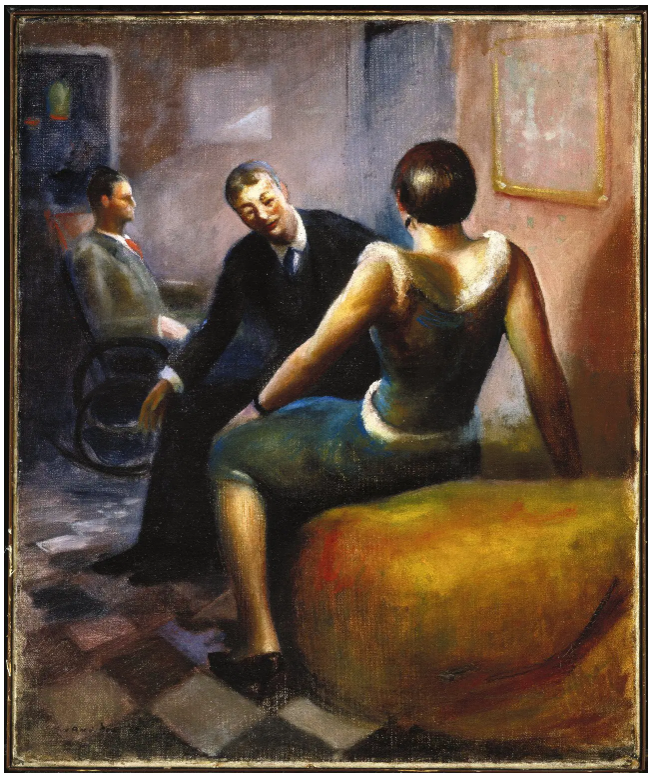
Evening by Guy Pène du Bois

There is a quiet courage in the work of re-seeing the world.
For many men, this work begins not with guilt or accusation, but with awakening — an honest recognition that much of what they were taught about love, success, and worth was filtered through lenses they never consciously chose.

Those lenses shape how they see women, how they see each other, and how they see themselves. To begin to notice those patterns is not weakness; it is the beginning of freedom.

This reflection is not about blame. It’s about understanding how culture shapes perception — and how men can reclaim their humanity by learning to see others, and themselves, more clearly.


The Inherited Lens: Hierarchy as Habit

Every man inherits a framework before he ever chooses one. From childhood, subtle messages define strength as dominance, emotion as fragility, and control as competence. These are not personal flaws; they are the scaffolding of culture itself.

Simone de Beauvoir described how societies often define men as the default — the doers, the decision-makers — while women are cast as the context, the mirror, or the support. This hierarchy doesn’t only limit women; it quietly confines men too. It isolates them from tenderness, empathy, and interdependence. It makes vulnerability feel like exposure rather than connection.

You can see this everywhere: in the workplace meeting where a man feels pressure to speak with certainty even when unsure; in the father who provides materially but hides his own exhaustion; in the friendship where warmth is replaced by banter because sincerity feels unsafe. These are learned reflexes, not truths about manhood.

Recognizing them isn’t self-criticism — it’s awareness. Hierarchy was never chosen; it was absorbed. Seeing through it becomes the act of rewriting it.


Objectification and the Loss of Depth

Objectification begins as a survival strategy — a way of managing complexity by reducing it to something we can control. It is not born from cruelty but from fear: fear of vulnerability, of rejection, of emotional overwhelm. For many men, objectification has been the only safe way to relate in a culture that punishes emotional openness.

From an early age, boys are taught to notice beauty before they are taught to notice humanity. They are rewarded for pursuit, praised for conquest, and rarely shown how to look at another person without desire or evaluation. This conditioning trains the eye to flatten — to turn the infinite depth of a person into a surface that can be categorized.

In this sense, objectification is not merely about sex. It’s a perceptual habit, a narrowing of sight. It can show up in how a man views women, but also in how he views himself — as a role, a provider, a performer — anything but a being.

Simone de Beauvoir called this “the reduction of the Other.” The woman becomes not an equal subject but a mirror for male identity. Yet in doing this, the man also becomes diminished. He trades intimacy for control, authenticity for image.

Maurice Merleau-Ponty’s philosophy of perception helps us see why this is so damaging. When the gaze becomes detached, it severs the relationship between body and soul, between self and world. The person looking loses the capacity for connection — not because he is incapable of love, but because his way of seeing has been trained to avoid depth.

To unlearn objectification, a man must learn to look longer — to see the human being behind his reflexes. This doesn’t mean rejecting attraction; it means letting attraction coexist with respect, curiosity, and wonder. It means learning to feel without possessing.

When he does, something shifts. What once felt like temptation becomes tenderness. What once triggered guilt becomes gratitude. He begins to understand that seeing another person as whole is not restraint — it is freedom.


Seeing as Participation — Merleau-Ponty and the Embodied Gaze

Maurice Merleau-Ponty taught that perception is not passive — it is participatory. To see something or someone is to be in relationship with it. We don’t look at the world; we look with it. The gaze itself is a form of contact.

When men begin to realize how their perception has been shaped — by media, by trauma, by cultural training — it can feel unsettling. Yet that very realization reveals the possibility of transformation. Because if perception is learned, it can also be relearned.

In a digital world, where images flash faster than empathy can form, men are taught to evaluate rather than encounter. Pornography, advertising, and social media train the eye to scan for desirability or power, not humanity. But something shifts when a man looks longer — when he pauses to really see a person instead of a projection. A simple act of attention can reawaken empathy, restoring depth where habit had flattened it.

Merleau-Ponty reminds us that to look with awareness is to engage ethically. The gaze can wound, but it can also heal. Every time a man chooses to see with curiosity rather than consumption, he reclaims the living quality of perception itself.


From Performance to Presence — Buber’s Call to Meeting

Martin Buber believed that all real living is meeting. He described two modes of relationship: I–It and I–Thou. In the I–It mode, people and things are treated as objects — useful, measurable, and often disposable. In the I–Thou mode, we encounter others as full beings, not categories.

Most men are conditioned to live in the I–It world. The culture of performance rewards decisiveness and control. A man learns to evaluate rather than experience — to measure his life by outcomes rather than intimacy. But this comes at a cost.

He might find himself sitting across from his partner but thinking about work; scrolling his phone instead of connecting at dinner; performing competence instead of expressing care. These are not failures of character — they are symptoms of disconnection.

When presence replaces performance, the dynamic changes. Listening becomes more powerful than solving. Eye contact becomes more healing than explanation. A man who learns to meet others without agenda steps into what Buber called the sacred space of encounter. In that space, both people are transformed.


Levinas and the Responsibility of Seeing

Emmanuel Levinas argued that ethics begins not in law but in encounter — in the face of another person. The face of the Other calls us to responsibility simply by existing. To truly see someone is to recognize their inherent dignity.

For men, this offers relief as much as responsibility. It removes the pressure to dominate or fix and replaces it with the invitation to care. Seeing becomes moral participation.

You can feel this difference in small, ordinary moments — choosing to stay in a difficult conversation rather than withdraw; recognizing the humanity in someone suffering on the street instead of looking away; responding to conflict with curiosity rather than defense.

Levinas reminds us that the eyes are ethical organs. To look at another human being and allow yourself to be moved by their vulnerability is not weakness; it’s moral strength. Presence itself becomes a form of protection — both for the other and for one’s own integrity.


The Desire to Care — From Protection to Partnership

Many men carry a sincere and beautiful desire to care for women — to protect, to support, and to make life easier for those they love. At its root, this impulse is not domination but devotion. It grows from empathy, loyalty, and the instinct to safeguard what matters most. Yet in a culture that confuses care with control, this tenderness can become distorted.

Protection can quietly slip into paternalism. Support can become substitution. Even when motivated by love, men may find themselves doing for women rather than walking with them — making decisions, offering advice, or solving problems in ways that unintentionally overlook or undervalue women’s insight and capability.

This isn’t cruelty; it’s conditioning. For generations, men were taught that their worth lay in their ability to provide, to lead, and to fix. Women, by contrast, were often expected to accommodate, nurture, and defer. When those scripts meet, imbalance hides beneath the surface of affection. The woman’s competence and wisdom can go underrecognized, while the man’s care goes unacknowledged for its sincerity. Both feel unseen.

As Simone de Beauvoir observed, inequality often persists not through open conflict but through subtle assumptions. The deeper problem isn’t overprotection; it’s under-crediting.

True care, as bell hooks reminds us, is not hierarchical. Love that liberates gives as much as it listens. It allows women’s voices to lead as often as men’s and recognizes that strength belongs to both.

Buber’s I–Thou relationship captures this transformation. In the I–It mode, care becomes management — an effort to ensure safety or order. In the I–Thou mode, care becomes communion — a willingness to stand beside another person, not above them.

Levinas would add that genuine responsibility honors the other’s autonomy. The face of another does not ask to be guided, but to be recognized. The ethical act is not to decide for her, but to stand with her — to affirm her full humanity.

When men care in this way, they do not lose their protective nature; they refine it. Care becomes partnership, protection becomes reverence, and love becomes equality embodied. This is not the end of masculinity — it is its maturity.

Fatherhood and the Protector Reflex

In family life, the desire to protect often reveals itself most vividly in moments of conflict. A father might hear his child speak sharply to their mother and instinctively raise his voice: “Don’t talk to your mother like that!”
On the surface, this seems noble — a defense of respect and love. Beneath it, though, is a deeper question about how protection and partnership coexist.

When a father steps in this way, he is often not defending his wife as a fragile being but defending the sacredness of respect itself. Yet when that defense takes the form of control — of correcting through dominance rather than connection — the message subtly shifts from “Respect your mother” to “Your mother needs my protection.”

This difference matters.
Children quickly internalize who holds authority, empathy, and voice in a home. When protection overshadows partnership, the mother’s authority can be unintentionally undermined — as though she cannot stand in her own strength.

True partnership looks different. It sounds like a father who, rather than commanding silence, models presence: “Hey, something feels tense here — let’s all take a breath.” It’s standing with his partner rather than over her. It’s backing her up without eclipsing her.

bell hooks wrote that love requires mutual recognition of power, not its suppression. In family life, this means protection transforms into respect when both parents’ voices carry equal weight.
Children learn best not from being silenced but from witnessing emotional integrity — a father’s capacity to protect without overpowering, to model firmness without hierarchy.

When a man learns to pause before stepping in — to ask whether his action preserves connection or reinforces control — he redefines protection itself. It becomes not an act of defense but of devotion. He is no longer guarding his partner; he is honoring her.


Love as Liberation — bell hooks and the Courage to Feel

bell hooks described love as “the practice of freedom.” She saw love not as sentimentality but as the daily discipline of seeing others as whole, autonomous beings rather than extensions of one’s ego.

For men, this redefines power entirely. Love becomes an act of courage — the strength to stay open, even when the world tells you to harden. It’s not about losing control, but about letting go of control as the measure of worth.

You can see this transformation in the father who learns to express affection that once felt awkward; in the friend who admits fear instead of hiding it behind humor; in the partner who listens without defensiveness and recognizes that understanding, not winning, is what restores connection.

Love, in this sense, is a way of seeing — an attention that liberates both the one who looks and the one who is seen. When men love in this conscious way, they don’t lose their strength; they deepen it. They move from protection to partnership, from guarding to giving.


Inheritance and Healing: The Work of Unlearning

Many men grew up in environments where tenderness was conditional, where strength meant silence, and where love was tangled with control. Those lessons don’t disappear with age; they live quietly in the nervous system, shaping how men relate to others and themselves.

To unlearn that inheritance is not to reject one’s past — it is to reinterpret it. Healing means understanding that discipline is not the same as distance, that leadership does not require hierarchy, and that emotional expression is not weakness but maturity.

In the workplace, this healing might look like leading through listening instead of intimidation. In fatherhood, it might look like gentleness that coexists with structure. In friendship, it might look like vulnerability that builds trust rather than shame.

When men begin to integrate these truths, they reclaim parts of themselves that were never lost — only hidden. They become whole enough to love without fear.


Practices for Embodied Change: How Men Can Relearn the Art of Seeing

Insight without practice can become another form of avoidance.
To truly shift from hierarchy to empathy, from performance to presence, men must not only think differently but live differently.
Change happens not through shame or pressure but through embodied, repeatable habits that retrain perception, soften the nervous system, and make love practical.

1. Begin with Awareness, Not Judgment

Pause before reacting. Notice the impulse — the tightening in the chest, the scanning eyes, the urge to control. That moment of recognition is not failure; it’s awakening. Ask yourself, What am I protecting right now — my image or my connection? Let awareness replace self-criticism.

2. Reclaim the Body as an Ally

Presence begins in the body. Practice somatic grounding: place a hand on your chest or abdomen and breathe deeply before responding. Movement and mindfulness reconnect emotion and embodiment, restoring empathy.

3. Practice “I–Thou” Encounters

Make eye contact in conversation. Listen to understand, not to fix. Replace performance with presence — say, “I don’t know” or “I care.” Each small act of genuine meeting resists dehumanization.

4. Expand the Lens

Ask, Who or what am I overlooking? Notice when hierarchy hides in habits — when you value voices like your own more than those that differ. This questioning is the essence of ethics.

5. Redefine Strength

True strength is emotional honesty. Practice admitting fear, confusion, or tenderness. Share one emotion daily that you’d normally suppress. Vulnerability builds, rather than weakens, trust.

6. Practice Gratitude for Growth

At day’s end, name one moment you chose connection over control. Transformation happens in these micro-movements of awareness and care.

7. Seek Dialogue and Mentorship

Healing thrives in community. Find other men committed to inner work. Speak the truth aloud. Brotherhood grounded in honesty is one of the most radical forms of resistance.

8. See Through Love

Love is a practice of perception. When you see someone, choose appreciation over possession, witness over withdrawal. Love with your attention — that’s how seeing becomes healing.


The Heart of It

Objectification is not hatred; it is disconnection. It’s the cultural habit of narrowing our vision until others — and we ourselves — become smaller than we are. But men are not bound to that way of seeing. They are capable of extraordinary empathy once they remember that to see is to touch, to meet, to love.

To see through Merleau-Ponty’s eyes is to know the world as living and responsive.
To see through Beauvoir’s critique is to notice how power distorts perception.
To meet through Buber’s lens is to rediscover the sacred in relationship.
To answer Levinas’s call is to let compassion become the first reflex.
And to love as bell hooks urged is to live with open eyes and an unguarded heart.

The opposite of objectification is not shame — it is presence.
And presence, practiced daily, is how men learn to see — and live — with love.


Author’s Note:
bell hooks styled her name in lowercase letters to emphasize the message over the self — a symbolic act of humility and a rejection of hierarchy. The lowercase “bell hooks” honors that intention and keeps focus on the spirit of her work: to center love, liberation, and consciousness over ego.


References

Beauvoir, Simone de. (2011). The Second Sex (C. Borde & S. Malovany-Chevallier, Trans.). Vintage Books. (Original work published 1949)

Buber, Martin. (1970). I and Thou (W. Kaufmann, Trans.). Scribner. (Original work published 1923)

hooks, bell. (2000). All About Love: New Visions. William Morrow and Company.

Levinas, Emmanuel. (1969). Totality and Infinity: An Essay on Exteriority (A. Lingis, Trans.). Duquesne University Press. (Original work published 1961)

Merleau-Ponty, Maurice. (1962). Phenomenology of Perception (C. Smith, Trans.). Routledge & Kegan Paul. (Original work published 1945)


Suggested Reading for Further Reflection

Gilligan, Carol. (1982). In a Different Voice: Psychological Theory and Women’s Development. Harvard University Press.

Noddings, Nel. (2013). Caring: A Relational Approach to Ethics and Moral Education (2nd ed.). University of California Press.

Young, Iris Marion. (1990). Throwing Like a Girl and Other Essays in Feminist Philosophy and Social Theory. Indiana University Press.

Katz, Jackson. (2013). The Macho Paradox: Why Some Men Hurt Women and How All Men Can Help. Sourcebooks.

Maté, Gabor. (2022). The Myth of Normal: Trauma, Illness, and Healing in a Toxic Culture. Avery.

Dr. Jekyll, Mr. Hyde, and the Hidden Splits of Trauma and Addiction—Releasing Through the Body

 Dr. Jekyll’s Transformation by Lorenzo Mastroianni

Have you ever felt like two selves are living inside you? Perhaps you present one version of yourself to the world—measured, capable, calm, and resilient—while another, hidden self emerges in moments of craving, impulse, self-sabotage, or collapse. This experience can feel bewildering, even frightening, as though something foreign has taken over.

Robert Louis Stevenson’s The Strange Case of Dr. Jekyll and Mr. Hyde is more than a gothic horror story. It is a profound allegory about the divided human psyche. Its enduring power lies in how vividly it captures the inner conflict between our socially acceptable self and our hidden impulses. For trauma survivors and those navigating addictions, this metaphor speaks with unsettling precision.

Philosophers have wrestled with the paradox of the divided self for millennia. From Plato’s tripartite soul, to St. Augustine’s confessions of inner conflict, to Nietzsche’s critique of repression, the tension between light and shadow has always been part of the human condition. What modern trauma research and somatic therapies like Peter Levine’s Waking the Tiger: Healing Trauma add is a new understanding: these divisions are not just moral or existential—they are embodied, physiological realities that live in our nervous systems.


The Duality Within: Trauma Splits as Inner Jekyll and Hyde

In Stevenson’s novella, Dr. Jekyll is a well-respected gentleman who longs to separate his virtuous self from his darker impulses. He creates a potion that allows him to become Mr. Hyde, a figure unrestrained by morality or social expectation. At first, Jekyll feels liberated. He believes he has found a way to keep his darker side hidden while maintaining his respectable life. But soon, Hyde grows stronger, more violent, and more uncontrollable. Eventually, Jekyll loses the ability to choose when the transformation happens—Hyde takes over at will.

This story resonates with what I’ve described in my blog on mild splits in sexual trauma survivors. When faced with overwhelming pain or violation, the psyche often protects itself by compartmentalizing. One part of the self continues to function, go to work, care for others, and present a socially acceptable image. Meanwhile, another part carries the unbearable weight—memories, emotions, shame, and survival impulses.

Like Jekyll’s potion, splitting can feel adaptive at first. It allows survivors to keep moving, to survive unbearable circumstances. But over time, these splits create instability. What is buried does not disappear—it festers. Eventually, it erupts in behaviors or symptoms that may feel alien, frightening, or destructive.

This dynamic echoes Plato’s tripartite model of the soul: reason, spirit, and appetite. Plato argued that harmony requires balance between these parts. When appetite dominates, chaos ensues; when it is entirely denied, it grows more dangerous. Stevenson’s Jekyll is Plato’s rational man trying to suppress appetite, only to have it return in monstrous form.

St. Augustine described the same paradox in his Confessions. Reflecting on his youth, he prayed: “Grant me chastity and continence, but not yet.” He wanted virtue, but also indulgence. This divided will mirrors Jekyll’s wish to be both saint and sinner at once, and it reflects the same psychic split trauma survivors often feel—wanting to appear intact while another part yearns for relief at any cost.


Repression, Shame, and the Cycle of Addiction

Jekyll’s downfall comes not from Hyde’s existence, but from his refusal to integrate him. He represses what he deems unacceptable and tries to sever it entirely. But as Nietzsche warned, what we repress doesn’t vanish. Instead, it grows in power and returns in distorted ways.

For survivors of trauma, repression often takes the form of silence and shame. They may tell themselves:

  • “If I let myself feel this grief or rage, I’ll fall apart.”
  • “If I show others this side of me, I won’t be loved or accepted.”

To survive, they push these parts underground. But what is exiled doesn’t disappear. It resurfaces in self-sabotaging choices, compulsions, and addictive patterns.

This is where Aristotle’s idea of akrasia—weakness of will—comes in. Aristotle asked why people act against their own better judgment. He observed that desire and impulse can overpower reason. Addiction is perhaps the most painful expression of this: knowing what is destructive yet being unable to stop, as though another part of the self has seized control.

We can see Jekyll’s progression mirrored in the cycle of addiction:

  1. Experimentation: A behavior begins as a way to feel relief or escape.
  2. Dependence: The behavior becomes the go-to coping mechanism.
  3. Loss of Control: The behavior takes on a life of its own, surfacing without conscious choice.
  4. Collapse: The self fragments under the strain.

This is Jekyll’s arc, but it is also the lived experience of many survivors. Addiction becomes Hyde—the shadow self breaking through, demanding release, regardless of cost.


The Body Speaks: Somatic Experiencing as the Path to Integration

While philosophers explored these dynamics in moral or existential terms, modern trauma therapy places them squarely in the body. Peter Levine’s Waking the Tiger revolutionized trauma healing by showing that trauma is not just a memory or story—it is energy trapped in the nervous system.

Animals in the wild endure constant threats, yet they rarely develop chronic trauma. Why? Because after a life-threatening event, they discharge the energy through shaking, trembling, or movement. Their bodies complete the survival cycle. Humans, however, often override this instinct. We freeze. We shut down. We hold it inside. The body never finishes the response, and the energy becomes trapped.

Over time, this stuck energy expresses itself as anxiety, depression, compulsions, or addictions. These are not failures of morality or willpower. They are the body’s desperate attempt to resolve what was never completed.

Here, Levine’s work intersects powerfully with Carl Jung’s concept of the shadow. Jung taught that the denied parts of the psyche must be faced and integrated, or they will sabotage us from the dark. Levine shows us how to do this somatically—by listening to the body, tracking sensations, and allowing discharge, we invite the shadowed parts back into wholeness.

Kierkegaard described despair as “the sickness unto death”—the condition of being out of alignment with oneself. This is exactly what trauma creates: a self divided against itself, fragments cut off from one another. Healing is not about destroying Hyde, but about reuniting Jekyll and Hyde into a single, embodied self.


Practical Ways to Heal the Split: Applying Levine’s Insights

Levine’s Somatic Experiencing (SE) offers practical tools for reintegration. Here are six accessible practices to begin exploring:

  1. Track the Felt Sense
    • Pause and notice what is happening in your body right now. Tingling? Heaviness? Warmth? Numbness?
    • Ask: Where in my body feels tense? Where feels calm or neutral?
    • Why it helps: Trauma cuts us off from body awareness. Tracking sensations reconnects us to the body’s subtle language, allowing us to catch activation before it escalates into destructive behavior.
  2. Pendulation
    • Focus gently on an activated place (tight chest, restless hands).
    • Then shift attention to a calmer place (feet, breath, or a hand resting on your lap).
    • Move awareness slowly between the two.
    • Why it helps: Instead of being stuck in repression (Jekyll) or overwhelm (Hyde), pendulation teaches the nervous system flexibility.
  3. Micro-Movements for Completion
    • Ask your body: What small movement do you need right now?
    • Allow your shoulders to roll, your legs to push lightly into the floor, or your body to tremble.
    • Welcome yawns, sighs, tears, or laughter.
    • Why it helps: These are signs of discharge—your body releasing stuck survival energy.
  4. Orienting to the Present
    • Slowly turn your head. Look around the room.
    • Let your eyes rest on objects, colors, or textures.
    • Whisper inwardly: I am here. I am safe now.
    • Why it helps: Trauma keeps us stuck in the past. Orienting gently re-engages the parasympathetic nervous system, grounding us in present safety.
  5. Resource with Safety Anchors
    • Bring to mind a safe person, place, or memory.
    • Notice how your body responds—softening, warmth, slowing of breath.
    • Why it helps: Resources provide the stability to face hidden parts without being overtaken.
  6. Allow Gentle Discharge
    • If trembling, warmth, or tears arise, let them flow.
    • These are not signs of weakness—they are signs of completion.
    • Why it helps: This is the body’s catharsis—release that restores balance.

Somatic Integration Exercise: Meeting Jekyll and Hyde Through the Body

Here is a full guided practice combining the Jekyll/Hyde metaphor, philosophical insight, and Levine’s body-based healing approach.

Step 1: Settle and Arrive

  • Sit or lie comfortably.
  • Look around and name a few colors or shapes.
  • Feel the support beneath you.
  • Ask: Right now, am I safe?

Step 2: Invite Both Selves

  • Imagine your Jekyll self—calm, capable, controlled.
  • Imagine your Hyde self—impulsive, hurting, craving.
  • Whisper inwardly: Both of you are welcome here.
  • Notice where each shows up in your body.

Step 3: Track the Felt Sense

  • Focus on tension or discomfort.
  • Then shift to a calm area.
  • Move gently between the two.

Step 4: Micro-Movement and Release

  • Ask your body what it needs. Allow shaking, stretching, or sighing.
  • Welcome any natural discharge.

Step 5: Anchor in Resources

  • Imagine a safe person, place, or memory.
  • Wrap both Jekyll and Hyde in this safety.

Step 6: Closing Reflection

  • Thank both parts for showing up.
  • Whisper inwardly: I am learning to be whole.
  • Reorient gently to your space.

This practice is not about erasing Hyde or clinging only to Jekyll. It is about learning to hold both, allowing the body to integrate what was once divided. Over time, this strengthens the nervous system’s capacity to be whole.


Healing Is Wholeness Through the Body

The tragedy of Jekyll was not that he had a shadow, but that he believed he could banish it. Philosophers from Plato to Kierkegaard warned that division within the self breeds despair. Nietzsche and Jung reminded us that denied parts always return. Levine shows us how the body carries this same truth: what is suppressed must eventually surface, and healing means allowing the body to complete what it never could.

Addictions and destructive behaviors are not moral failures. They are signals—Hyde’s way of demanding attention. They are the body’s attempt to release trapped energy, even if in distorted ways.

Healing comes not from repression, but from compassion. Not from silencing Hyde, but from listening to him. Not from erasing shadow, but from welcoming it back into the circle of self.


Final Reflection
Stevenson’s tale is a warning about repression. The philosophers give us language for divided wills and shadows. Levine gives us a somatic pathway home. Together, they remind us: wholeness is possible.

When we stop running from Hyde, we discover that he carries not only pain, but also vitality—the raw life force waiting to be reclaimed.


The Key to Transforming Toxic Relationships into Harmonious Ones: Ho’oponopono

In a world where relationships often teeter on the brink of chaos, finding harmony can feel like an elusive dream. Have you ever found yourself stuck in a cycle of conflict, resentment, or misunderstanding with someone you care about? What if I told you that there’s an ancient Hawaiian practice that holds the potential to heal and transform even the most toxic connections into nurturing bonds? Enter Ho’oponopono—a powerful technique rooted in forgiveness, love, and personal responsibility.

The History and Origins of Ho’oponopono

Ho’oponopono has its roots in ancient Hawaiian culture. It was traditionally practiced by families as a way to resolve conflicts and restore harmony. The term itself means “to make right” or “to correct.”

Historically, it involved a community gathering where individuals would share grievances. This collective approach fostered healing within relationships and the communal spirit.

The practice was formalized by Morrnah Nalamaku Simeona in the 20th century. She adapted traditional methods for modern use, emphasizing personal responsibility and self-healing.

Today, Ho’oponopono transcends cultural boundaries. Its principles resonate with those seeking peace in their lives. By letting go of blame, practitioners can cultivate compassion and understanding—not just toward others but also themselves.

Understanding the Concept of Cleaning

At the heart of Ho’oponopono lies a unique concept known as “cleaning.” This process is about clearing away negative thoughts, emotions, and memories that cloud our relationships.

When we talk about cleaning, we’re not referring to physical tidying up. Instead, it’s an inner cleansing of emotional baggage that impacts how we connect with others. Each thought and feeling carries energy—some positive, some toxic.

By engaging in cleaning through Ho’oponopono practices, individuals learn to recognize their role in conflicts. It’s a profound acknowledgment that healing begins within oneself rather than blaming others or external circumstances.

This approach emphasizes self-responsibility and encourages letting go of harmful patterns. As one cleanses these energies, they create space for love and harmony to flourish in relationships once marred by negativity. The process invites transformation on both personal and relational levels without needing external validation or approval from anyone else.

How to Apply Ho’oponopono in Your Relationships

Identifying toxic relationships is the first step. Take a moment to reflect on your connections. Which ones drain your energy?

Once you’ve pinpointed these dynamics, it’s time to embrace Ho’oponopono’s transformative power. Start with the four key phrases: “I’m sorry,” “Please forgive me,” “Thank you,” and “I love you.” These words act as healing tools.

Practice saying them silently or aloud during moments of conflict or emotional disconnect. They help foster understanding and compassion.

Letting go of expectations can be challenging but essential. Accept that not every relationship will transform overnight. Release any desire for control over how others respond.

Focus instead on your own healing journey through this philosophy. By doing so, you’re paving the way for a more harmonious connection with yourself and those around you, even in difficult circumstances.

– Identifying Toxic Relationships

Identifying toxic relationships can be challenging. Often, they start off with charm and excitement. Over time, however, red flags begin to emerge.

Pay attention to how you feel after interacting with someone. Do you often feel drained or anxious? A healthy relationship should uplift you, not leave you feeling depleted.

Another indicator is communication patterns. In a toxic dynamic, conversations may turn into blame games or constant criticism. This creates an environment of fear rather than support.

Trust your instincts; if something feels off, it probably is. Healthy relationships foster respect and understanding. If these elements are consistently absent, take note.

Look for control issues as well. Does the person seek to manipulate situations for their benefit? Recognizing these behaviors early on can pave the way for change through Ho’oponopono practices later on.

– The Four Key Phrases of Ho’oponopono

The core of Ho’oponopono revolves around four key phrases. Each phrase serves as a powerful tool for healing and reconciliation.

The first phrase, “I’m sorry,” opens the door to taking responsibility. It acknowledges pain and wrongdoing, whether it’s yours or someone else’s.

Next comes “Please forgive me.” This expression is about humility and understanding. It asks for forgiveness not just from others but also from yourself.

“I love you” follows closely behind. These words carry immense weight, radiating compassion and connection. They foster an environment of love that can mend even the most fractured relationships.

Lastly, we have “Thank you.” This simple affirmation expresses gratitude for the process of healing itself and reinforces positivity in your interactions.

Together, these phrases create a holistic approach to transforming toxic dynamics into spaces filled with respect and harmony.

– Letting Go of Expectations and Control

Letting go of expectations can be challenging. We often cling to how we think things should unfold in our relationships. This desire for control creates stress and tension.

When applying Ho’oponopono, it’s vital to release these attachments. Expectations restrict the flow of love and understanding between people. Embracing uncertainty opens up new possibilities.

Instead of focusing on outcomes, shift your attention inward. Reflect on your feelings and beliefs without judgment. Acknowledge what you need to heal within yourself first.

This inner work lays a foundation for healthier connections. As you practice forgiveness through Ho’oponopono’s phrases, allow space for others to evolve too.

Trust that by letting go, you’ll create an environment where genuine harmony can thrive naturally, free from pressure or preconceived notions about how things ought to be.

Real-Life Example of Ho’oponopono in Action

Dr. Len’s journey at the Hawaii State Hospital began in the early 1980s. Tasked with treating patients deemed criminally insane, he faced immense challenges every day. The environment was heavy, filled with despair and hopelessness.

Instead of conventional methods, Dr. Len turned to Ho’Oponopono, an ancient Hawaiian practice of reconciliation and forgiveness. He believed that healing starts from within and extended outward.

As he applied these principles, remarkable changes unfolded around him. Rather than focusing solely on his patients’ misdeeds or traumas, he took responsibility for their suffering as part of a collective consciousness.

With time and dedication, the hospital transformed into a more peaceful space. Patients who once displayed violent behaviors showed signs of recovery and compassion. The shift was nothing short of miraculous—a testament to the power of love and forgiveness in action amidst challenging circumstances.

Incorporate Ho’Oponopono into Your Life for Healing

Incorporating Ho’Oponopono into your daily life can be a transformative experience. Start with simple affirmations: “I’m sorry, please forgive me, thank you, I love you.” These phrases hold profound meaning and can create emotional release.

Make it a ritual. Dedicate quiet moments each day to reflect on your feelings and relationships. Acknowledge the hurt, but also remember the healing power of forgiveness.

Visualization works wonders too. Picture yourself surrounded by light as you repeat these mantras. Imagine releasing negative energies while welcoming peace and love into your heart.

Journaling is another effective tool. Write down what troubles you or who needs forgiveness in your life. This practice not only clarifies emotions but serves as an outlet for healing thoughts.

Connect with nature during this journey if possible. Nature has its own way of grounding us, amplifying our intentions toward inner peace and self-love through Ho’Oponopono principles.

As more people learn about these transformative principles, there’s hope that the cycle of pain can be broken. Healing hearts takes time, patience, and commitment; however, by applying Dr. Len’s techniques into daily life, we all have the potential to contribute to this beautiful journey towards wholeness.

Let us carry forward his message: We are responsible for what happens around us through our thoughts and actions. Embracing this mindset allows each one of us to become agents of change—one heart at a time.

Uncovering the Root Cause: Tracing Feelings and Thoughts to Kick Destructive Behaviors

Do you ever find yourself engaging in destructive behaviors without fully understanding why? It’s time to dig deep and uncover the root cause behind those harmful actions. In this blog post, we’ll explore how tracing your feelings and thoughts can lead you to kick those destructive habits for good. Get ready to unravel the mystery of your behavior and take control of your life once and for all!

Introduction to the concept of tracing feelings and thoughts to kick destructive behaviors

In today’s fast-paced world, it can be easy to fall into the trap of destructive behaviors. These behaviors can range from unhealthy coping mechanisms like binge eating or substance abuse to harmful actions towards ourselves or others. While these behaviors may offer temporary relief or release, they often have long-lasting consequences that can negatively impact our lives.

It is important to understand that destructive behaviors are not just physical actions; they are rooted in our feelings and thoughts. This concept may seem daunting at first, but by tracing our feelings and thoughts, we can uncover the root cause of our destructive behaviors and kick them for good.

What is tracing feelings and thoughts?

Tracing feelings and thoughts involves taking a step back from our actions and examining the emotions and thought patterns behind them. It requires us to go beyond surface-level reactions and delve deeper into the underlying triggers for our behavior.

For example, someone who constantly engages in self-harm may initially attribute it to stress or anxiety. However, by tracing their feelings and thoughts, they may realize that underlying insecurities or past traumas are contributing factors.

Why is tracing feelings and thoughts important?

Understanding the root cause of destructive behaviors is crucial because it allows us to address the core issue rather than just treating symptoms. By identifying the emotions and thought patterns fueling these behaviors, we gain insight into ourselves and what drives us to engage in harmful actions.

Moreover, tracing feelings and thoughts enables us to develop healthier coping mechanisms that address the root cause instead of resorting to quick fixes that only offer temporary relief. It empowers us to take control of our own well-being by recognizing patterns in our behavior and making conscious changes towards positive growth.

What is the root cause of destructive behaviors?

Destructive behaviors can manifest in various forms, such as self-sabotage, aggression, addiction, and even harmful thoughts and beliefs. These behaviors not only harm ourselves but also those around us, causing damage to our relationships and overall well-being. Identifying the root cause of these destructive patterns is crucial in order to break free from their grip.

Stress and unresolved trauma have been found to be major contributing factors to destructive behaviors. When we experience stress or traumatic events in our lives, it triggers our fight or flight response. This natural response causes a surge of adrenaline and cortisol hormones which prepare us for danger. However, when this response is frequently activated due to ongoing stress or past trauma, it can have long-term effects on our behavior. We may become more impulsive, aggressive or engage in addictive behaviors as a coping mechanism.

Another common factor is learned behavior from early childhood experiences. Our childhood experiences shape our beliefs about ourselves and the world around us. If we grew up in an environment where destructive behaviors were normalized or witnessed them in a primary caregiver or family member, we are likely to imitate these behaviors as adults without realizing why.

Moreover, low self-esteem and negative self-talk can also play a significant role in perpetuating destructive tendencies. Negative thoughts about ourselves often stem from past experiences where we were made to feel inadequate or unworthy by others or internalizing societal expectations and standards of perfectionism.

Furthermore, unaddressed emotional issues like anger, fear, guilt or shame can drive us towards engaging in destructive behaviors as a means of escape or numbness. Many individuals turn to substances like alcohol and drugs as a way of masking their painful feelings instead of confronting them head-on.

It’s important to note that there is no single root cause for all types of destructive behaviors as each individual’s journey is unique. It could be a combination or a singular factor that triggers these behaviors. However, identifying the root cause is the first step towards breaking free from its hold and creating positive change in our lives.

How can understanding the trigger or urge help combat destructive behaviors?

Firstly, it is important to define what we mean by triggers and urges. Triggers refer to the external factors that prompt an emotional response or behavior. They could be events, situations, people, or even objects that evoke certain feelings in us. Urges, on the other hand, are internal impulses that push us to act in a certain way. For example, someone may have a trigger of feeling rejected when they are not invited to a social event, which then leads to an urge to isolate themselves.

By understanding our triggers and urges, we gain awareness of our emotional responses and behaviors. This self-awareness allows us to recognize patterns and tendencies within ourselves that lead to destructive behaviors. We can then take proactive steps towards managing these triggers and urges before they escalate into harmful actions.

Moreover, understanding our triggers and urges helps us uncover the deeper reasons behind our destructive behaviors. These reasons could stem from past traumas or unprocessed emotions like anger or shame. By tracing back these feelings and thoughts related to our triggers and urges, we can start addressing the underlying issues instead of just suppressing them with destructive actions.

Additionally, knowing our triggers and urges can also help in developing healthier coping mechanisms. Often times, people turn towards destructive behaviors as a way of dealing with difficult emotions or stressors in their lives. However, by identifying specific triggers that lead us towards such behaviors – whether it’s anxiety-fueled binge eating or excessive drinking during periods of loneliness – we can find alternative ways of managing those emotions without resorting to harmful actions.

Gaining insight into our triggers and urges is essential for combatting destructive behaviors. It allows us to identify patterns, uncover root causes, and develop healthier coping mechanisms. By understanding our triggers and urges, we can break the cycle of destructive behaviors and move towards lasting change and growth.

Common emotions and thoughts that lead to destructive behaviors

One of the most common emotions that can lead to destructive behaviors is anger. When we feel angry, we may lash out at others or engage in impulsive and aggressive actions. This could result in harm to ourselves or those around us. Anger can be triggered by a variety of factors such as feeling frustrated, threatened, or even feeling powerless. It often stems from a sense of injustice or perceived wrongdoing.

Another emotion that can lead to destructive behaviors is fear. When we feel afraid, our natural response is to protect ourselves. However, this fear can manifest as irrational behaviors such as avoiding situations altogether or becoming overly controlling and aggressive towards others. Fear can also be influenced by previous experiences or trauma, causing individuals to react in harmful ways.

Jealousy is another emotion that has been known to cause destructive behaviors within relationships. The feeling of jealousy often arises when one feels threatened by the attention given to someone else. This could result in possessive behavior, controlling tendencies, and obsessive thoughts and actions.

Sadness is another powerful emotion that may lead to self-destructive behaviors such as overeating or substance abuse as a means of coping with the pain. It can also manifest as withdrawal from social interactions, isolating oneself from loved ones who could potentially provide support during difficult times.

Guilt and shame are two additional emotions that often contribute to destructive behaviors. These feelings may stem from past mistakes or perceived flaws in oneself leading individuals down a path of self-sabotage and self-harm.

Our thoughts also play a crucial role in our behavior patterns. Negative thinking patterns such as low self-esteem,self-doubt,and negative self-talk have been linked to destructive behaviors such as self-harm and substance abuse. These thoughts can often stem from childhood experiences, societal pressures, or comparisons to others.

It is crucial to understand that our emotions and thoughts are closely tied to our behaviors. To identify the root cause of destructive behaviors, we must acknowledge and address these underlying emotions and unhealthy thought patterns. By doing so, we can learn healthy coping mechanisms and develop a better understanding of our triggers, enabling us to break free from destructive behaviors and lead fulfilling lives.

Identifying patterns and recurring triggers

To identify these patterns and triggers, we must first become more mindful of our thoughts and feelings. This means paying attention to the internal dialogue we have with ourselves on a daily basis. What kind of thoughts do we have about ourselves? How do we react to certain situations or people? By becoming more self-aware, we can start to recognize any negative thought patterns that may be contributing to our destructive behaviors.

In addition, it is important to pay attention to external triggers as well. These are events or people in our environment that tend to evoke strong emotional responses within us. For example, consistently feeling anxious or stressed when interacting with a particular family member or friend could be a recurring trigger for engaging in self-destructive behavior such as binge eating or substance abuse.

Another way to identify patterns and triggers is by keeping track of your actions through journaling or using a mood tracker app. By recording your moods throughout the day and any related behaviors you engaged in, you may start noticing certain trends that could point towards potential triggers for your destructive behavior.

It is also helpful to examine any past experiences or traumas that may have led to these thought patterns and emotional triggers. Sometimes, unresolved issues from our past can manifest in harmful ways without us realizing it.

Additionally, seeking feedback from those close to us can also provide valuable insights into our behavioral patterns. Ask trusted family members or friends if they have noticed any specific situations or emotions that tend to precede your destructive behaviors.

Once you have identified the recurring patterns and triggers associated with your destructive behaviors, you can begin addressing them head-on. This may involve seeking therapy or counseling to work through past traumas, learning healthy coping mechanisms to manage emotions, and actively challenging negative thought patterns.

Identifying patterns and recurring triggers is an essential step in uncovering the root cause of destructive behaviors. By becoming more self-aware and seeking outside perspectives, we can gain valuable insights into the underlying issues that contribute to our harmful actions. With this understanding, we can take steps towards healing and breaking free from destructive habits.

Replacing negative behaviors with healthier alternatives

The first step in replacing negative behaviors is identifying them. It can be challenging to recognize our own self-destructive patterns, as they may have become ingrained over time. One way to do this is by keeping a journal or seeking support from a therapist or trusted friend who can provide an outside perspective. Once identified, it’s important to explore the underlying emotions and thoughts that trigger these behaviors.

Understanding the root cause of our negative behaviors is essential for implementing long-term changes. It requires us to be honest with ourselves and examine any past traumas, unresolved issues, or unhelpful beliefs that may be contributing to our behavior. This process may be uncomfortable and even painful at times, but it is necessary for personal growth and overcoming destructive habits.

After identifying the root cause of our negative behaviors, one can replace them with healthier alternatives. This involves finding new ways to cope with difficult emotions and thoughts in a more positive manner. For example, instead of turning to alcohol or drugs as a way to numb sadness or anxiety, one could try practicing relaxation techniques such as deep breathing or mindfulness meditation.

Another effective strategy for replacing negative behaviors can be creating new habits that align with our values and goals. If someone’s goal is to improve their physical health but struggles with binge eating junk food when stressed, they could try engaging in exercise as a stress-relieving activity instead. By focusing on building positive habits rather than trying not to engage in negative ones, we shift our energy towards something meaningful and beneficial for ourselves.

But beware…it is often not enough to really kick a destructive habit. Why? The neural pathway of avoidance may be fired in both cases….keep reading…

The pitfalls of simply replacing negative behaviors with healthier alternatives

It’s no secret that navigating our emotions can be a tricky business. While more positive coping mechanisms are certainly beneficial in managing our feelings, sometimes even the most uplifting behaviors can still trigger familiar neural pathways. This phenomenon occurs because both positive and negative behaviors serve the same purpose: to avoid experiencing unpleasant emotions. So, whether we’re indulging in a favorite hobby or reaching for an unhealthy snack, our brains may interpret these actions in a similar light – as a way to escape discomfort.

It’s important to recognize this tendency within ourselves and strive to cultivate self-awareness instead when it comes to how we handle our emotions. By acknowledging the potential for overlap between positive and negative coping strategies, we can begin to make more intentional choices about how we respond to challenging feelings. After all, understanding the intricate workings of our minds is key to fostering growth and emotional well-being.

Self-awareness is key

Self-awareness is the key to unlocking real change in our lives. It is only through understanding and acknowledging our unconscious, dysfunctional egoic behavior that we can truly begin to make lasting improvements. Trying to defeat these behaviors head-on is like trying to fight a shadow – it will always find a way to evade us. The more we try to attack or resist these negative patterns, the stronger they become. This is where the importance of mindfulness comes into play. By becoming aware of our thoughts, emotions, and actions without judgment or resistance, we can start to unravel the root causes of our behavior and make conscious choices for positive change. When we stop fighting against ourselves and instead embrace self-awareness with compassion and curiosity, that is when transformation truly begins.

By embracing the concept of presence and detaching from our ego-driven thoughts, we can begin to see ourselves as separate from our minds. This shift in perspective allows us to view our thoughts, emotions, and experiences with a sense of detachment and clarity. The keyword here is “presence,” the importance of living in the present moment rather than getting caught up in past regrets or future worries. Through practices such as deep breathing, meditation, and simply observing our thoughts without judgment, we can learn to cultivate inner peace and stillness.

As we become more attuned to the observer within us, we start to realize that we are not defined by our thoughts or external circumstances but rather by our ability to witness them with compassion and acceptance. In this way, we are guided towards a deeper understanding of ourselves and the world around us, ultimately leading us towards greater fulfillment and spiritual awakening.

Steps for managing triggers and urges in the moment

Managing triggers and urges can be a challenging task, especially in the heat of the moment. It is important to have strategies in place to deal with these feelings so that we can avoid falling into destructive behaviors. Here are some tips for managing triggers and urges in the moment:

1. Identify Your Triggers: The first step towards managing a trigger or urge is to identify what triggers them. Think of it as uncovering hidden clues in a mystery novel – only by piecing together the puzzle can you solve the case. Start by paying close attention to your emotions and physical sensations when the trigger arises. Take note of how your body responds, whether it’s a racing heart, sweaty palms, or a knot in your stomach. This awareness will serve as your compass, guiding you towards understanding the root cause of these triggers. Once you have pinpointed the feeling, take a trip down memory lane and reflect on past situations where you have felt this way before. Were there specific events or people involved? What were the circumstances surrounding those moments? By delving into your past experiences, you can gain valuable insights into why certain triggers hold power over you today because the feelings you often feel from a trigger are old feelings and not relevant to your present state or situation.

2. Practice Self-Awareness: Once you know your trigger, it is important to practice self-awareness in those moments when they arise. This means being mindful of your thoughts and feelings without judgment. When the keyword “self-awareness” pops into your head, imagine yourself taking a step back from the situation and observing your emotions as if you were an outsider looking in. Notice how being the observer allows you to disconnect from any immediate reactions or impulses that may be driven by your trigger. Take a moment to breathe deeply and ground yourself in the present moment, acknowledging that these feelings are temporary and will eventually pass. By cultivating this level of awareness, you empower yourself to choose how you respond rather than reacting impulsively based on old patterns or habits.

    3. Learn To Pause: When you become self-aware of a trigger that stems from an old feeling, you have essentially planted a cognitive bookmark in your mind. This bookmark serves as a reminder to pause before reacting, granting yourself the time needed to reflect on your emotions and make more rational decisions rather than impulsive ones. By recognizing the old feeling associated with the trigger, you are able to take control of your reactions and responses. This act of pausing allows you to delve deeper into why certain feelings are arising and how they may be influencing your behavior. Ultimately, this heightened awareness leads to greater introspection and personal growth as you navigate through life’s challenges with a newfound sense of emotional intelligence.

    5. Reflect On Past Behaviors: When we examine the question of whether our behaviors truly address the negative emotions we experience, it becomes evident that this is often not the case. Take for instance, when we resort to isolation as a means of coping with anxiety. This action may seem like a solution in the moment, but upon closer inspection, it becomes clear that isolating ourselves does not bring about the desired outcome. In fact, isolation only serves to perpetuate feelings of loneliness and further exacerbate our anxiety. It’s important to recognize that our instinctual responses to negative emotions are not always aligned with what will ultimately lead to resolution and healing.

    6. Embrace Discomfort and Do Something Different: With the keyword “discomfort” in mind, it’s important to recognize that the brain is wired for comfort rather than happiness. This means that making positive changes in your life can initially feel quite uncomfortable. When you start moving towards what you truly want, you are essentially saying goodbye to your old ways and embracing a new path. It’s natural to resist change because it disrupts our routines and challenges our familiar patterns. However, if you want to break free from destructive behaviors and toxic habits, doing something different is essential. Embrace the discomfort as a sign of growth and transformation, knowing that true happiness lies on the other side of those initial feelings of unease.

      Conclusion

      Remember that managing triggers and urges takes time and practice. Be patient with yourself and celebrate small victories along the way. It’s crucial to practice self-compassion throughout this process. Replacing negative behaviors is not an easy task and may involve setbacks. It’s important to be patient and kind to ourselves, celebrate progress, and learn from mistakes along the way.

      It’s also essential to surround ourselves with supportive people who encourage healthy habits rather than enabling destructive ones. Building a strong social network can provide a sense of accountability and help us stay on track with our goals.

      By identifying root causes, creating new habits, building a supportive network, and practicing self-compassion, we can successfully replace harmful actions with positive ones that align with our values and lead us towards a happier and more fulfilling life.

      By understanding how our thoughts and feelings can lead to destructive behaviors, we can take control of our actions and make positive changes in our lives. It is important to identify the root cause of these negative behaviors and address them instead of just trying to change surface-level habits. With awareness and self-reflection, it is possible to break free from destructive patterns and create a happier, healthier life for ourselves. Let’s start by examining our thoughts and emotions with intentionality, so that we may live more authentically and purposefully.