From Power to Presence: How Men Can Relearn to See Women — and Themselves — with Love

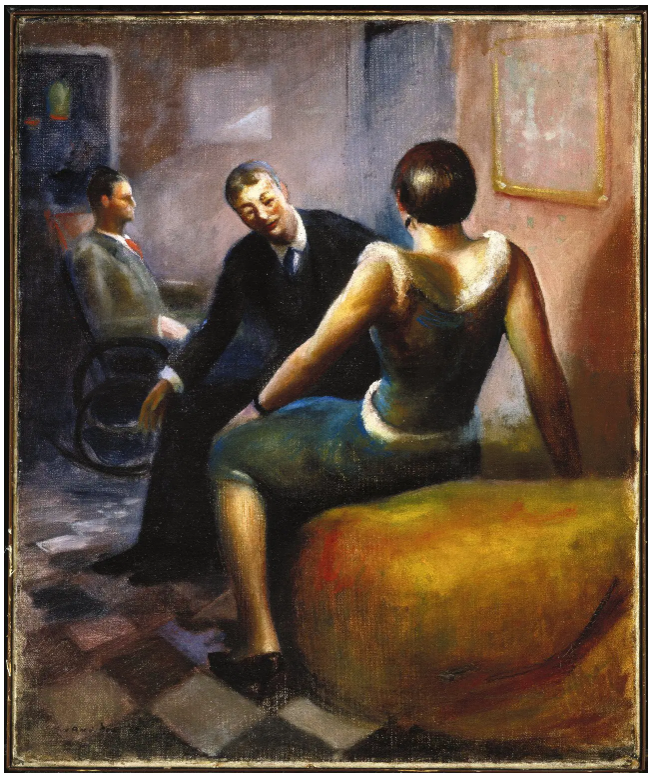
Evening by Guy Pène du Bois

There is a quiet courage in the work of re-seeing the world.
For many men, this work begins not with guilt or accusation, but with awakening — an honest recognition that much of what they were taught about love, success, and worth was filtered through lenses they never consciously chose.

Those lenses shape how they see women, how they see each other, and how they see themselves. To begin to notice those patterns is not weakness; it is the beginning of freedom.

This reflection is not about blame. It’s about understanding how culture shapes perception — and how men can reclaim their humanity by learning to see others, and themselves, more clearly.


The Inherited Lens: Hierarchy as Habit

Every man inherits a framework before he ever chooses one. From childhood, subtle messages define strength as dominance, emotion as fragility, and control as competence. These are not personal flaws; they are the scaffolding of culture itself.

Simone de Beauvoir described how societies often define men as the default — the doers, the decision-makers — while women are cast as the context, the mirror, or the support. This hierarchy doesn’t only limit women; it quietly confines men too. It isolates them from tenderness, empathy, and interdependence. It makes vulnerability feel like exposure rather than connection.

You can see this everywhere: in the workplace meeting where a man feels pressure to speak with certainty even when unsure; in the father who provides materially but hides his own exhaustion; in the friendship where warmth is replaced by banter because sincerity feels unsafe. These are learned reflexes, not truths about manhood.

Recognizing them isn’t self-criticism — it’s awareness. Hierarchy was never chosen; it was absorbed. Seeing through it becomes the act of rewriting it.


Objectification and the Loss of Depth

Objectification begins as a survival strategy — a way of managing complexity by reducing it to something we can control. It is not born from cruelty but from fear: fear of vulnerability, of rejection, of emotional overwhelm. For many men, objectification has been the only safe way to relate in a culture that punishes emotional openness.

From an early age, boys are taught to notice beauty before they are taught to notice humanity. They are rewarded for pursuit, praised for conquest, and rarely shown how to look at another person without desire or evaluation. This conditioning trains the eye to flatten — to turn the infinite depth of a person into a surface that can be categorized.

In this sense, objectification is not merely about sex. It’s a perceptual habit, a narrowing of sight. It can show up in how a man views women, but also in how he views himself — as a role, a provider, a performer — anything but a being.

Simone de Beauvoir called this “the reduction of the Other.” The woman becomes not an equal subject but a mirror for male identity. Yet in doing this, the man also becomes diminished. He trades intimacy for control, authenticity for image.

Maurice Merleau-Ponty’s philosophy of perception helps us see why this is so damaging. When the gaze becomes detached, it severs the relationship between body and soul, between self and world. The person looking loses the capacity for connection — not because he is incapable of love, but because his way of seeing has been trained to avoid depth.

To unlearn objectification, a man must learn to look longer — to see the human being behind his reflexes. This doesn’t mean rejecting attraction; it means letting attraction coexist with respect, curiosity, and wonder. It means learning to feel without possessing.

When he does, something shifts. What once felt like temptation becomes tenderness. What once triggered guilt becomes gratitude. He begins to understand that seeing another person as whole is not restraint — it is freedom.


Seeing as Participation — Merleau-Ponty and the Embodied Gaze

Maurice Merleau-Ponty taught that perception is not passive — it is participatory. To see something or someone is to be in relationship with it. We don’t look at the world; we look with it. The gaze itself is a form of contact.

When men begin to realize how their perception has been shaped — by media, by trauma, by cultural training — it can feel unsettling. Yet that very realization reveals the possibility of transformation. Because if perception is learned, it can also be relearned.

In a digital world, where images flash faster than empathy can form, men are taught to evaluate rather than encounter. Pornography, advertising, and social media train the eye to scan for desirability or power, not humanity. But something shifts when a man looks longer — when he pauses to really see a person instead of a projection. A simple act of attention can reawaken empathy, restoring depth where habit had flattened it.

Merleau-Ponty reminds us that to look with awareness is to engage ethically. The gaze can wound, but it can also heal. Every time a man chooses to see with curiosity rather than consumption, he reclaims the living quality of perception itself.


From Performance to Presence — Buber’s Call to Meeting

Martin Buber believed that all real living is meeting. He described two modes of relationship: I–It and I–Thou. In the I–It mode, people and things are treated as objects — useful, measurable, and often disposable. In the I–Thou mode, we encounter others as full beings, not categories.

Most men are conditioned to live in the I–It world. The culture of performance rewards decisiveness and control. A man learns to evaluate rather than experience — to measure his life by outcomes rather than intimacy. But this comes at a cost.

He might find himself sitting across from his partner but thinking about work; scrolling his phone instead of connecting at dinner; performing competence instead of expressing care. These are not failures of character — they are symptoms of disconnection.

When presence replaces performance, the dynamic changes. Listening becomes more powerful than solving. Eye contact becomes more healing than explanation. A man who learns to meet others without agenda steps into what Buber called the sacred space of encounter. In that space, both people are transformed.


Levinas and the Responsibility of Seeing

Emmanuel Levinas argued that ethics begins not in law but in encounter — in the face of another person. The face of the Other calls us to responsibility simply by existing. To truly see someone is to recognize their inherent dignity.

For men, this offers relief as much as responsibility. It removes the pressure to dominate or fix and replaces it with the invitation to care. Seeing becomes moral participation.

You can feel this difference in small, ordinary moments — choosing to stay in a difficult conversation rather than withdraw; recognizing the humanity in someone suffering on the street instead of looking away; responding to conflict with curiosity rather than defense.

Levinas reminds us that the eyes are ethical organs. To look at another human being and allow yourself to be moved by their vulnerability is not weakness; it’s moral strength. Presence itself becomes a form of protection — both for the other and for one’s own integrity.


The Desire to Care — From Protection to Partnership

Many men carry a sincere and beautiful desire to care for women — to protect, to support, and to make life easier for those they love. At its root, this impulse is not domination but devotion. It grows from empathy, loyalty, and the instinct to safeguard what matters most. Yet in a culture that confuses care with control, this tenderness can become distorted.

Protection can quietly slip into paternalism. Support can become substitution. Even when motivated by love, men may find themselves doing for women rather than walking with them — making decisions, offering advice, or solving problems in ways that unintentionally overlook or undervalue women’s insight and capability.

This isn’t cruelty; it’s conditioning. For generations, men were taught that their worth lay in their ability to provide, to lead, and to fix. Women, by contrast, were often expected to accommodate, nurture, and defer. When those scripts meet, imbalance hides beneath the surface of affection. The woman’s competence and wisdom can go underrecognized, while the man’s care goes unacknowledged for its sincerity. Both feel unseen.

As Simone de Beauvoir observed, inequality often persists not through open conflict but through subtle assumptions. The deeper problem isn’t overprotection; it’s under-crediting.

True care, as bell hooks reminds us, is not hierarchical. Love that liberates gives as much as it listens. It allows women’s voices to lead as often as men’s and recognizes that strength belongs to both.

Buber’s I–Thou relationship captures this transformation. In the I–It mode, care becomes management — an effort to ensure safety or order. In the I–Thou mode, care becomes communion — a willingness to stand beside another person, not above them.

Levinas would add that genuine responsibility honors the other’s autonomy. The face of another does not ask to be guided, but to be recognized. The ethical act is not to decide for her, but to stand with her — to affirm her full humanity.

When men care in this way, they do not lose their protective nature; they refine it. Care becomes partnership, protection becomes reverence, and love becomes equality embodied. This is not the end of masculinity — it is its maturity.

Fatherhood and the Protector Reflex

In family life, the desire to protect often reveals itself most vividly in moments of conflict. A father might hear his child speak sharply to their mother and instinctively raise his voice: “Don’t talk to your mother like that!”
On the surface, this seems noble — a defense of respect and love. Beneath it, though, is a deeper question about how protection and partnership coexist.

When a father steps in this way, he is often not defending his wife as a fragile being but defending the sacredness of respect itself. Yet when that defense takes the form of control — of correcting through dominance rather than connection — the message subtly shifts from “Respect your mother” to “Your mother needs my protection.”

This difference matters.
Children quickly internalize who holds authority, empathy, and voice in a home. When protection overshadows partnership, the mother’s authority can be unintentionally undermined — as though she cannot stand in her own strength.

True partnership looks different. It sounds like a father who, rather than commanding silence, models presence: “Hey, something feels tense here — let’s all take a breath.” It’s standing with his partner rather than over her. It’s backing her up without eclipsing her.

bell hooks wrote that love requires mutual recognition of power, not its suppression. In family life, this means protection transforms into respect when both parents’ voices carry equal weight.
Children learn best not from being silenced but from witnessing emotional integrity — a father’s capacity to protect without overpowering, to model firmness without hierarchy.

When a man learns to pause before stepping in — to ask whether his action preserves connection or reinforces control — he redefines protection itself. It becomes not an act of defense but of devotion. He is no longer guarding his partner; he is honoring her.


Love as Liberation — bell hooks and the Courage to Feel

bell hooks described love as “the practice of freedom.” She saw love not as sentimentality but as the daily discipline of seeing others as whole, autonomous beings rather than extensions of one’s ego.

For men, this redefines power entirely. Love becomes an act of courage — the strength to stay open, even when the world tells you to harden. It’s not about losing control, but about letting go of control as the measure of worth.

You can see this transformation in the father who learns to express affection that once felt awkward; in the friend who admits fear instead of hiding it behind humor; in the partner who listens without defensiveness and recognizes that understanding, not winning, is what restores connection.

Love, in this sense, is a way of seeing — an attention that liberates both the one who looks and the one who is seen. When men love in this conscious way, they don’t lose their strength; they deepen it. They move from protection to partnership, from guarding to giving.


Inheritance and Healing: The Work of Unlearning

Many men grew up in environments where tenderness was conditional, where strength meant silence, and where love was tangled with control. Those lessons don’t disappear with age; they live quietly in the nervous system, shaping how men relate to others and themselves.

To unlearn that inheritance is not to reject one’s past — it is to reinterpret it. Healing means understanding that discipline is not the same as distance, that leadership does not require hierarchy, and that emotional expression is not weakness but maturity.

In the workplace, this healing might look like leading through listening instead of intimidation. In fatherhood, it might look like gentleness that coexists with structure. In friendship, it might look like vulnerability that builds trust rather than shame.

When men begin to integrate these truths, they reclaim parts of themselves that were never lost — only hidden. They become whole enough to love without fear.


Practices for Embodied Change: How Men Can Relearn the Art of Seeing

Insight without practice can become another form of avoidance.
To truly shift from hierarchy to empathy, from performance to presence, men must not only think differently but live differently.
Change happens not through shame or pressure but through embodied, repeatable habits that retrain perception, soften the nervous system, and make love practical.

1. Begin with Awareness, Not Judgment

Pause before reacting. Notice the impulse — the tightening in the chest, the scanning eyes, the urge to control. That moment of recognition is not failure; it’s awakening. Ask yourself, What am I protecting right now — my image or my connection? Let awareness replace self-criticism.

2. Reclaim the Body as an Ally

Presence begins in the body. Practice somatic grounding: place a hand on your chest or abdomen and breathe deeply before responding. Movement and mindfulness reconnect emotion and embodiment, restoring empathy.

3. Practice “I–Thou” Encounters

Make eye contact in conversation. Listen to understand, not to fix. Replace performance with presence — say, “I don’t know” or “I care.” Each small act of genuine meeting resists dehumanization.

4. Expand the Lens

Ask, Who or what am I overlooking? Notice when hierarchy hides in habits — when you value voices like your own more than those that differ. This questioning is the essence of ethics.

5. Redefine Strength

True strength is emotional honesty. Practice admitting fear, confusion, or tenderness. Share one emotion daily that you’d normally suppress. Vulnerability builds, rather than weakens, trust.

6. Practice Gratitude for Growth

At day’s end, name one moment you chose connection over control. Transformation happens in these micro-movements of awareness and care.

7. Seek Dialogue and Mentorship

Healing thrives in community. Find other men committed to inner work. Speak the truth aloud. Brotherhood grounded in honesty is one of the most radical forms of resistance.

8. See Through Love

Love is a practice of perception. When you see someone, choose appreciation over possession, witness over withdrawal. Love with your attention — that’s how seeing becomes healing.


The Heart of It

Objectification is not hatred; it is disconnection. It’s the cultural habit of narrowing our vision until others — and we ourselves — become smaller than we are. But men are not bound to that way of seeing. They are capable of extraordinary empathy once they remember that to see is to touch, to meet, to love.

To see through Merleau-Ponty’s eyes is to know the world as living and responsive.
To see through Beauvoir’s critique is to notice how power distorts perception.
To meet through Buber’s lens is to rediscover the sacred in relationship.
To answer Levinas’s call is to let compassion become the first reflex.
And to love as bell hooks urged is to live with open eyes and an unguarded heart.

The opposite of objectification is not shame — it is presence.
And presence, practiced daily, is how men learn to see — and live — with love.


Author’s Note:
bell hooks styled her name in lowercase letters to emphasize the message over the self — a symbolic act of humility and a rejection of hierarchy. The lowercase “bell hooks” honors that intention and keeps focus on the spirit of her work: to center love, liberation, and consciousness over ego.


References

Beauvoir, Simone de. (2011). The Second Sex (C. Borde & S. Malovany-Chevallier, Trans.). Vintage Books. (Original work published 1949)

Buber, Martin. (1970). I and Thou (W. Kaufmann, Trans.). Scribner. (Original work published 1923)

hooks, bell. (2000). All About Love: New Visions. William Morrow and Company.

Levinas, Emmanuel. (1969). Totality and Infinity: An Essay on Exteriority (A. Lingis, Trans.). Duquesne University Press. (Original work published 1961)

Merleau-Ponty, Maurice. (1962). Phenomenology of Perception (C. Smith, Trans.). Routledge & Kegan Paul. (Original work published 1945)


Suggested Reading for Further Reflection

Gilligan, Carol. (1982). In a Different Voice: Psychological Theory and Women’s Development. Harvard University Press.

Noddings, Nel. (2013). Caring: A Relational Approach to Ethics and Moral Education (2nd ed.). University of California Press.

Young, Iris Marion. (1990). Throwing Like a Girl and Other Essays in Feminist Philosophy and Social Theory. Indiana University Press.

Katz, Jackson. (2013). The Macho Paradox: Why Some Men Hurt Women and How All Men Can Help. Sourcebooks.

Maté, Gabor. (2022). The Myth of Normal: Trauma, Illness, and Healing in a Toxic Culture. Avery.

The Transformative Power of Empathy

Empathy is a cornerstone of human connection, yet it is often misunderstood or diluted in everyday discourse. Far more than simply “feeling for” another person, empathy is the profound capacity to enter into the lived experience of someone else, to perceive their emotions and reality from their own perspective—not filtered through our own. This complex process requires a cultivated awareness, emotional maturity, and deep inner work. The 20th-century philosopher and phenomenologist Edith Stein (also known as St. Teresa Benedicta of the Cross) offered one of the most precise and psychologically rich frameworks for understanding empathy—one that remains profoundly relevant today.

Do I Have Empathy?

The question, “Do I have empathy?” may seem simple, but it invites introspection. True empathy involves more than passive listening or an instinctual reaction to another’s suffering. According to Edith Stein, empathy is an intentional act of consciousness—a means of perceiving another’s experience as separate from our own, yet real in its own right. Unlike emotional contagion, where we mirror another’s feelings unconsciously, empathy is an aware, reflective experience of the other.

Empathy, then, is not something we either “have” or “don’t have,” but rather a human capacity that can be developed, deepened, and refined over time. It involves not only emotional availability but cognitive and moral engagement. It requires us to become still enough within ourselves to perceive what is not immediately visible: the emotional landscape of another being.

Empathy, Compassion, and Sympathy: What’s the Difference?

While often used interchangeably, empathy, compassion, and sympathy are distinct. Sympathy involves feeling for someone—often accompanied by pity or sorrow. Compassion includes a desire to alleviate suffering and is often tied to action. But empathy, as Stein described, is the process of perceiving and feeling the experiences of another without merging them into our own. It’s a kind of “emotional seeing”—a relational experience that honors the otherness of the other.

Unlike sympathy, which may create distance through pity, or compassion, which may involve a power differential (I act to help you), empathy levels the relational field. It demands that we see others as equal in their humanity, worthy of being understood, not fixed. It brings both humility and strength, as it requires us to be vulnerable enough to truly see and be affected by another’s truth.

How to Develop Empathy

Empathy can be cultivated with intentional practice. First, it requires a slowing down of our mental and emotional reactivity. When we’re truly present, we can begin to sense not only what a person is saying, but what they are feeling. Stein emphasized the importance of phenomenological openness—setting aside our biases and assumptions to encounter the other as they truly are.

Strategies for developing empathy include:

  • Active listening without the urge to interrupt, advise, or relate.
  • Mindfulness to notice our internal reactions and quiet them.
  • Reflective questions: What might this person be feeling beneath their words? What is their lived context?
  • Reading literature or engaging in narrative work, which trains us to see from multiple perspectives.

In therapeutic and educational settings, role-play and guided reflection can help participants recognize how their own experiences shape the way they interpret others’ emotions. Journaling and meditation practices aimed at compassion and curiosity can also increase empathy by building emotional resilience and perspective-taking.

How to Step Into Someone Else’s Shoes

“Stepping into someone else’s shoes” is often cited as a metaphor for empathy, but it is more than imagining how we would feel in their situation. Edith Stein clarified that true empathy is not projecting our own emotions onto another but recognizing their unique experience as distinct from our own.

To step into someone else’s shoes:

  • Suspend judgment. Assume you don’t know what it’s like to be them.
  • Inquire gently. Ask open-ended questions to explore their perspective.
  • Feel with, not for. Stay attuned to their emotional tone without overshadowing it with your own.

This capacity to co-experience the other while maintaining psychological boundaries is essential in any relational or helping profession. It allows us to be fully present without becoming enmeshed, to accompany without overpowering, and to validate without losing ourselves.

Empathy’s Challenge to Narcissism and Codependency

Empathy, properly practiced, acts as a corrective to both narcissism and codependency. Narcissism denies the reality of others’ emotional worlds, while codependency blurs the boundaries between self and other. Empathy challenges narcissism by inviting us to look beyond ourselves, and it challenges codependency by asking us to feel alongside another without becoming lost in them.

Stein’s philosophy insists on the preservation of selfhood even in empathic connection. We do not become the other—we resonate with them while staying rooted in our own being. This is the delicate balance where healing relationships can flourish. Moreover, empathy does not ask us to abandon our truth to validate someone else’s; rather, it invites us to be strong enough to witness pain without absorbing or denying it.

In a narcissistic culture that prioritizes individualism and self-promotion, empathy stands as a counter-cultural force. In relationships plagued by codependent patterns, empathy restores a sense of self while maintaining connection. It is a bridge between independence and intimacy.

The Role of Discomfort and Trauma in Blocking Empathy

Many people struggle with empathy because their own unprocessed trauma or emotional discomfort gets in the way. If another’s emotions mirror our own unresolved pain, we may shut down or become overwhelmed. Conversely, if their experience challenges our worldview, we may become defensive.

To cultivate empathy, we must do our own inner work. This means:

  • Acknowledging how past wounds influence our current perceptions.
  • Learning emotional regulation skills to remain grounded in the presence of others’ pain.
  • Seeking therapy or support when our history limits our capacity to be present.

Stein believed that empathy was not simply a mental skill, but a spiritual and moral development—an unfolding of the human person toward deeper understanding and communion. She argued that empathy was fundamental to the experience of love and relationship, not because it allows us to feel everything others feel, but because it affirms their reality as valid and worth knowing.

When we are trapped in unresolved grief, shame, or rage, empathy feels dangerous. It asks us to open a door we have kept shut. But in doing so, it also offers us healing—the chance to rewrite the inner scripts that keep us isolated.

Conclusion

Empathy is not merely an interpersonal tool—it is a way of being in the world, a mode of perception that calls for attentiveness, courage, and humility. Through Edith Stein’s lens, we see that empathy is not about merging or fixing, but about witnessing the other with reverence and clarity. In a world marked by disconnection and polarization, the practice of empathy remains a radical and healing act—one that honors both self and other in the fullest sense.

Whether in our families, communities, classrooms, or professional lives, empathy is the bridge that allows us to cross into another’s world without losing sight of our own. It is, ultimately, an ethical invitation to live more fully human lives.

Beyond Active Listening: Cultivating Genuine Understanding in Your Conversations

In a world buzzing with constant chatter and digital distractions, the art of conversation often gets lost amidst the noise. Many of us pride ourselves on being active listeners—nodding along, making appropriate responses, but how many truly grasp the essence of genuine understanding? Imagine transforming every dialogue into a powerful exchange where both parties not only hear words but connect on a deeper level. Here, I explore how to go beyond mere listening and dive into cultivating authentic understanding in your interactions. Get ready to enhance your communication skills and unlock richer relationships that foster empathy, trust, and insight like never before!

Introduction to the idea of genuine understanding in communication

Have you ever walked away from a conversation feeling unheard, even after both parties had their say? It’s frustrating, isn’t it? Many of us pride ourselves on being active listeners, nodding along and maintaining eye contact. Yet somehow, genuine understanding slips through the cracks.

In this practice of understanding, where one person is conveying information while the other is embracing a receptive role, we unlock the true essence of connection through active listening and empathy. Imagine a vibrant conversation unfolding like an intricate dance; as one partner leads with their thoughts and feelings, the other adapts fluidly, absorbing every nuance and emotion.

This dynamic creates a rich tapestry of interaction that goes beyond mere words—it’s about resonating with another’s experience on a profound level. By remaining open-hearted and flexible in our approach, each exchange becomes an opportunity for deeper insight. When you allow yourself to fully engage without preconceived notions or defensive walls, you invite the speaker’s truth into your very being.

In such moments of genuine understanding, barriers dissolve, revealing shared humanity amidst diversity—a powerful reminder that at our core lies an innate desire to connect meaningfully with others through authentic communication. When we aim for true understanding rather than mere acknowledgment, we open the door to richer conversations and stronger relationships.

The limitations of active listening and how it can lead to argumentative conversations

Active listening is often heralded as the gold standard in communication. However, it has its limitations.

Many people equate active listening with merely hearing the words being spoken. They focus intently on responding rather than truly understanding. This can create a cycle of miscommunication.

When one party listens only to counter-argue, conversations transform into debates. Participants may feel pressured to defend their viewpoints instead of exploring deeper meanings or emotions.

This dynamic can thwart open dialogue and stifle genuine connection. Instead of fostering collaboration, discussions become battlegrounds where winning takes precedence over understanding.

Moreover, an emphasis on active listening might lead to surface-level engagement. Listeners could miss underlying feelings or complexities that require more than just attentiveness; they need empathy and patience too.

Why understanding should be the goal in communication

Understanding transforms communication from mere exchange to a meaningful connection. When we prioritize understanding, conversations become more than just words; they evolve into shared experiences.Genuine understanding fosters empathy and compassion, allowing us to appreciate others’ perspectives.

Jacques Lacan posits that understanding serves as the cornerstone of effective communication; it’s a realm where there is no room for debate. This notion invites us to reflect on how our unconscious desires shape what we convey and perceive in dialogue.

According to Lacanian theory, language isn’t merely a tool for expression but rather a complex structure through which we navigate our relationships with others and ourselves. When we embrace the idea that true understanding can unlock deeper meanings within our conversations, we begin to see how essential it is to grasp not just words but also the subtle layers of emotion and intention behind them.

Each exchange becomes an opportunity for revelation—where misunderstandings arise from unacknowledged desires or societal influences, they can also be transformed into moments of profound clarity when approached with genuine curiosity and empathy. In this dynamic landscape shaped by Lacan’s insights, understanding transcends mere agreement; it’s about diving into the depths of meaning that often lie hidden beneath surface-level chatter.

When we aim for comprehension rather than confrontation, it opens the door to collaboration after the understanding emerges. In essence, the solution comes naturally out of the authentic understanding of the other. It also allows individuals to explore ideas together rather than opposing each other, promoting trust and encouraging open dialogue.

Moreover, seeking understanding creates space for vulnerability and honesty—elements crucial for deeper connections with others. In a world where miscommunication is rampant, championing genuine understanding becomes not just beneficial but essential in nurturing harmonious interactions.

How to cultivate genuine understanding in your conversations

Cultivating genuine understanding starts with listening without judgment. Clear your mind of preconceived notions. Approach each conversation as a blank slate. This openness allows for authentic dialogue.

Next, ask clarifying questions instead of making assumptions. Questions like “Can you elaborate on that?” show interest and invite deeper insight into the other person’s thoughts.

Empathy plays a crucial role too. Try to step into their shoes and see things from their perspective. Acknowledging their feelings fosters trust and connection.

Finally, reflect back what you’ve understood during the exchange. Phrases such as “So what I hear you saying is…” can reinforce clarity and demonstrate your commitment to truly grasping their message.

And most importantly, you stay in the role of trying to understand. In each session, there is no shift to “now I get to say what I need to say” or any room to defend oneself or correct the one speaking. Understanding is the only goal. Whether you agree with what is said is irrelevant. The goal is to step into their world and leave yours behind in that particular session of listening and understanding.

By embracing these practices, conversations become more enriching experiences rather than mere exchanges of words. Here are the steps…

  • Listening without judgment or preconceived notions

Listening without judgment requires a conscious effort. It means setting aside your own views and biases when engaging in conversation.

When we listen with preconceived notions, we often filter what’s being said through our personal beliefs. This can lead to misinterpretations or dismissive attitudes toward the speaker’s thoughts.

Approach each conversation with an open mind. Remind yourself that every individual has their unique experiences and perspectives worth exploring. Try to focus solely on the words being spoken, rather than formulating your response prematurely.

This practice creates space for authenticity. When others feel safe from judgment, they are more likely to share openly.

You might be surprised at how enriching these exchanges become when you place understanding above agreement. Listening without judgment invites deeper insights into another person’s world while fostering trust and connection between both parties.

  • Asking clarifying questions rather than assumptions

Asking clarifying questions is a powerful tool in any conversation. It encourages deeper dialogue and demonstrates genuine interest. Instead of jumping to conclusions, seek to understand the other person’s perspective.

When you ask for clarification, it shows that you value what they are saying. This approach can eliminate misunderstandings before they escalate into bigger issues. Rather than assuming intent or meaning, invite them to share more.

For instance, if someone expresses frustration about a project, rather than assuming they’re upset with you personally, ask open-ended questions like, “Can you tell me more about what’s bothering you?” This not only fosters trust but also opens the door for meaningful discussion.

Clarification shifts the focus from being defensive to being curious. It creates an atmosphere where the person speaking feels safe expressing his or her thoughts without fear of judgment or misinterpretation.

  • Empathizing with the other person’s perspective

Imagine hearing someone share their struggles or joys. Instead of responding immediately with your own experiences, pause for a moment. Feel what they feel. What emotions might be swirling beneath the surface?

By empathizing, you not only validate their feelings but also create space for deeper engagement. This connection fosters trust and openness.

When people sense that you’re truly trying to understand them, they are more likely to reciprocate. It shifts the conversation from mere exchange of words into an enriching dialogue where both parties feel heard and valued.

  • Reflecting back what you’ve understood

Reflecting back what you’ve understood creates a bridge between you and the other person. It shows that you’re not just hearing words but genuinely processing them.

This technique involves paraphrasing or summarizing what the speaker has shared. For instance, saying, “So, you feel frustrated about your workload,” can validate their emotions and encourage deeper dialogue.

When you reflect, it opens up space for clarification. The speaker might elaborate on points you missed or correct any misunderstandings. This interaction fosters trust.

Moreover, it signals to others that their thoughts matter to you. By actively engaging in this way, conversations become more meaningful and less transactional.

Practicing reflection strengthens bonds over time as both parties recognize they are truly being heard and valued in the exchange of ideas. It’s a simple yet powerful way to enhance communication depth.

  • A Solution Emerges Naturally

When you seek to understand instead of defending yourself or correcting the other person, there is no room for arguing and the solution naturally comes at the end. This transformative approach is akin to opening a door to a sunlit garden rather than barricading oneself behind an impenetrable wall of stubbornness.

As you listen intently, recognizing not just words but emotions woven into them, misunderstandings begin to unravel like old yarns pulled from a sweater. The chatter fades away as connection takes precedence over contention, creating fertile ground for collaborative solutions to sprout effortlessly.

In this harmonious exchange, ego recedes into the background while understanding emerges as the guiding light leading both individuals toward common ground—a journey marked by respect and shared insight rather than conflict.

Resolving conflicts simply becomes less daunting. By focusing on understanding rather than winning an argument, solutions emerge more organically. This naturally creates a collaborative environment instead of one fraught with tension.

People tend to feel more at ease when they see how similar their goals may be. In this atmosphere of mutual respect, solutions become far easier to reach. The focus shifts from winning the argument to finding a resolution that benefits everyone involved.

Additional tips for improving communication and fostering genuine understanding

Enhancing communication goes beyond techniques. It starts with being present. When engaged in a conversation, remove distractions. Put down your phone and maintain eye contact. This simple act shows respect and attentiveness.

Open-mindedness is key too. Embrace different viewpoints without immediate judgment. Allow yourself to explore unfamiliar ideas; it enriches the dialogue.

Flexibility matters as well. Conversations can take unexpected turns, so be willing to adapt your perspective if new insights arise. It fosters an environment where others feel safe to share openly.

Practice patience during discussions, especially when emotions run high. Taking deep breaths before responding helps maintain clarity and composure.

Notice non-verbal cues as well—their tone, body language, and facial expressions provide valuable context. Being present isn’t just about hearing; it’s about understanding the full spectrum of communication happening right before you.

Remember that communication is not just about conveying information; it’s also about connection. In this practice of understanding only one person is conveying information while the other is understanding. By remaining receptive and adaptable, you enhance your ability to understand the other on a profound level.

As you strive to cultivate genuine understanding in your conversations, keep these principles close at heart. The effort will transform not only how you communicate but also how deeply you connect with those around you.