From Power to Presence: How Men Can Relearn to See Women — and Themselves — with Love

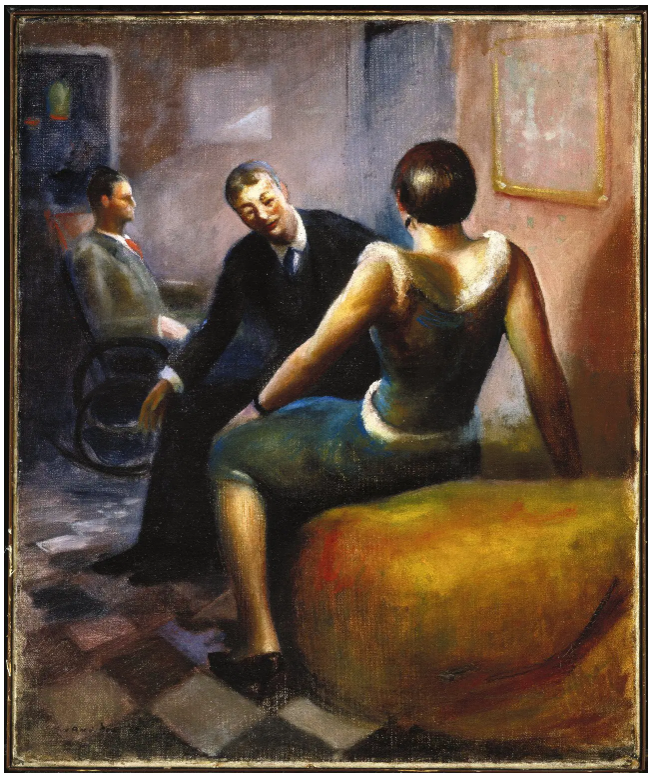
Evening by Guy Pène du Bois

There is a quiet courage in the work of re-seeing the world.
For many men, this work begins not with guilt or accusation, but with awakening — an honest recognition that much of what they were taught about love, success, and worth was filtered through lenses they never consciously chose.

Those lenses shape how they see women, how they see each other, and how they see themselves. To begin to notice those patterns is not weakness; it is the beginning of freedom.

This reflection is not about blame. It’s about understanding how culture shapes perception — and how men can reclaim their humanity by learning to see others, and themselves, more clearly.


The Inherited Lens: Hierarchy as Habit

Every man inherits a framework before he ever chooses one. From childhood, subtle messages define strength as dominance, emotion as fragility, and control as competence. These are not personal flaws; they are the scaffolding of culture itself.

Simone de Beauvoir described how societies often define men as the default — the doers, the decision-makers — while women are cast as the context, the mirror, or the support. This hierarchy doesn’t only limit women; it quietly confines men too. It isolates them from tenderness, empathy, and interdependence. It makes vulnerability feel like exposure rather than connection.

You can see this everywhere: in the workplace meeting where a man feels pressure to speak with certainty even when unsure; in the father who provides materially but hides his own exhaustion; in the friendship where warmth is replaced by banter because sincerity feels unsafe. These are learned reflexes, not truths about manhood.

Recognizing them isn’t self-criticism — it’s awareness. Hierarchy was never chosen; it was absorbed. Seeing through it becomes the act of rewriting it.


Objectification and the Loss of Depth

Objectification begins as a survival strategy — a way of managing complexity by reducing it to something we can control. It is not born from cruelty but from fear: fear of vulnerability, of rejection, of emotional overwhelm. For many men, objectification has been the only safe way to relate in a culture that punishes emotional openness.

From an early age, boys are taught to notice beauty before they are taught to notice humanity. They are rewarded for pursuit, praised for conquest, and rarely shown how to look at another person without desire or evaluation. This conditioning trains the eye to flatten — to turn the infinite depth of a person into a surface that can be categorized.

In this sense, objectification is not merely about sex. It’s a perceptual habit, a narrowing of sight. It can show up in how a man views women, but also in how he views himself — as a role, a provider, a performer — anything but a being.

Simone de Beauvoir called this “the reduction of the Other.” The woman becomes not an equal subject but a mirror for male identity. Yet in doing this, the man also becomes diminished. He trades intimacy for control, authenticity for image.

Maurice Merleau-Ponty’s philosophy of perception helps us see why this is so damaging. When the gaze becomes detached, it severs the relationship between body and soul, between self and world. The person looking loses the capacity for connection — not because he is incapable of love, but because his way of seeing has been trained to avoid depth.

To unlearn objectification, a man must learn to look longer — to see the human being behind his reflexes. This doesn’t mean rejecting attraction; it means letting attraction coexist with respect, curiosity, and wonder. It means learning to feel without possessing.

When he does, something shifts. What once felt like temptation becomes tenderness. What once triggered guilt becomes gratitude. He begins to understand that seeing another person as whole is not restraint — it is freedom.


Seeing as Participation — Merleau-Ponty and the Embodied Gaze

Maurice Merleau-Ponty taught that perception is not passive — it is participatory. To see something or someone is to be in relationship with it. We don’t look at the world; we look with it. The gaze itself is a form of contact.

When men begin to realize how their perception has been shaped — by media, by trauma, by cultural training — it can feel unsettling. Yet that very realization reveals the possibility of transformation. Because if perception is learned, it can also be relearned.

In a digital world, where images flash faster than empathy can form, men are taught to evaluate rather than encounter. Pornography, advertising, and social media train the eye to scan for desirability or power, not humanity. But something shifts when a man looks longer — when he pauses to really see a person instead of a projection. A simple act of attention can reawaken empathy, restoring depth where habit had flattened it.

Merleau-Ponty reminds us that to look with awareness is to engage ethically. The gaze can wound, but it can also heal. Every time a man chooses to see with curiosity rather than consumption, he reclaims the living quality of perception itself.


From Performance to Presence — Buber’s Call to Meeting

Martin Buber believed that all real living is meeting. He described two modes of relationship: I–It and I–Thou. In the I–It mode, people and things are treated as objects — useful, measurable, and often disposable. In the I–Thou mode, we encounter others as full beings, not categories.

Most men are conditioned to live in the I–It world. The culture of performance rewards decisiveness and control. A man learns to evaluate rather than experience — to measure his life by outcomes rather than intimacy. But this comes at a cost.

He might find himself sitting across from his partner but thinking about work; scrolling his phone instead of connecting at dinner; performing competence instead of expressing care. These are not failures of character — they are symptoms of disconnection.

When presence replaces performance, the dynamic changes. Listening becomes more powerful than solving. Eye contact becomes more healing than explanation. A man who learns to meet others without agenda steps into what Buber called the sacred space of encounter. In that space, both people are transformed.


Levinas and the Responsibility of Seeing

Emmanuel Levinas argued that ethics begins not in law but in encounter — in the face of another person. The face of the Other calls us to responsibility simply by existing. To truly see someone is to recognize their inherent dignity.

For men, this offers relief as much as responsibility. It removes the pressure to dominate or fix and replaces it with the invitation to care. Seeing becomes moral participation.

You can feel this difference in small, ordinary moments — choosing to stay in a difficult conversation rather than withdraw; recognizing the humanity in someone suffering on the street instead of looking away; responding to conflict with curiosity rather than defense.

Levinas reminds us that the eyes are ethical organs. To look at another human being and allow yourself to be moved by their vulnerability is not weakness; it’s moral strength. Presence itself becomes a form of protection — both for the other and for one’s own integrity.


The Desire to Care — From Protection to Partnership

Many men carry a sincere and beautiful desire to care for women — to protect, to support, and to make life easier for those they love. At its root, this impulse is not domination but devotion. It grows from empathy, loyalty, and the instinct to safeguard what matters most. Yet in a culture that confuses care with control, this tenderness can become distorted.

Protection can quietly slip into paternalism. Support can become substitution. Even when motivated by love, men may find themselves doing for women rather than walking with them — making decisions, offering advice, or solving problems in ways that unintentionally overlook or undervalue women’s insight and capability.

This isn’t cruelty; it’s conditioning. For generations, men were taught that their worth lay in their ability to provide, to lead, and to fix. Women, by contrast, were often expected to accommodate, nurture, and defer. When those scripts meet, imbalance hides beneath the surface of affection. The woman’s competence and wisdom can go underrecognized, while the man’s care goes unacknowledged for its sincerity. Both feel unseen.

As Simone de Beauvoir observed, inequality often persists not through open conflict but through subtle assumptions. The deeper problem isn’t overprotection; it’s under-crediting.

True care, as bell hooks reminds us, is not hierarchical. Love that liberates gives as much as it listens. It allows women’s voices to lead as often as men’s and recognizes that strength belongs to both.

Buber’s I–Thou relationship captures this transformation. In the I–It mode, care becomes management — an effort to ensure safety or order. In the I–Thou mode, care becomes communion — a willingness to stand beside another person, not above them.

Levinas would add that genuine responsibility honors the other’s autonomy. The face of another does not ask to be guided, but to be recognized. The ethical act is not to decide for her, but to stand with her — to affirm her full humanity.

When men care in this way, they do not lose their protective nature; they refine it. Care becomes partnership, protection becomes reverence, and love becomes equality embodied. This is not the end of masculinity — it is its maturity.

Fatherhood and the Protector Reflex

In family life, the desire to protect often reveals itself most vividly in moments of conflict. A father might hear his child speak sharply to their mother and instinctively raise his voice: “Don’t talk to your mother like that!”
On the surface, this seems noble — a defense of respect and love. Beneath it, though, is a deeper question about how protection and partnership coexist.

When a father steps in this way, he is often not defending his wife as a fragile being but defending the sacredness of respect itself. Yet when that defense takes the form of control — of correcting through dominance rather than connection — the message subtly shifts from “Respect your mother” to “Your mother needs my protection.”

This difference matters.
Children quickly internalize who holds authority, empathy, and voice in a home. When protection overshadows partnership, the mother’s authority can be unintentionally undermined — as though she cannot stand in her own strength.

True partnership looks different. It sounds like a father who, rather than commanding silence, models presence: “Hey, something feels tense here — let’s all take a breath.” It’s standing with his partner rather than over her. It’s backing her up without eclipsing her.

bell hooks wrote that love requires mutual recognition of power, not its suppression. In family life, this means protection transforms into respect when both parents’ voices carry equal weight.
Children learn best not from being silenced but from witnessing emotional integrity — a father’s capacity to protect without overpowering, to model firmness without hierarchy.

When a man learns to pause before stepping in — to ask whether his action preserves connection or reinforces control — he redefines protection itself. It becomes not an act of defense but of devotion. He is no longer guarding his partner; he is honoring her.


Love as Liberation — bell hooks and the Courage to Feel

bell hooks described love as “the practice of freedom.” She saw love not as sentimentality but as the daily discipline of seeing others as whole, autonomous beings rather than extensions of one’s ego.

For men, this redefines power entirely. Love becomes an act of courage — the strength to stay open, even when the world tells you to harden. It’s not about losing control, but about letting go of control as the measure of worth.

You can see this transformation in the father who learns to express affection that once felt awkward; in the friend who admits fear instead of hiding it behind humor; in the partner who listens without defensiveness and recognizes that understanding, not winning, is what restores connection.

Love, in this sense, is a way of seeing — an attention that liberates both the one who looks and the one who is seen. When men love in this conscious way, they don’t lose their strength; they deepen it. They move from protection to partnership, from guarding to giving.


Inheritance and Healing: The Work of Unlearning

Many men grew up in environments where tenderness was conditional, where strength meant silence, and where love was tangled with control. Those lessons don’t disappear with age; they live quietly in the nervous system, shaping how men relate to others and themselves.

To unlearn that inheritance is not to reject one’s past — it is to reinterpret it. Healing means understanding that discipline is not the same as distance, that leadership does not require hierarchy, and that emotional expression is not weakness but maturity.

In the workplace, this healing might look like leading through listening instead of intimidation. In fatherhood, it might look like gentleness that coexists with structure. In friendship, it might look like vulnerability that builds trust rather than shame.

When men begin to integrate these truths, they reclaim parts of themselves that were never lost — only hidden. They become whole enough to love without fear.


Practices for Embodied Change: How Men Can Relearn the Art of Seeing

Insight without practice can become another form of avoidance.
To truly shift from hierarchy to empathy, from performance to presence, men must not only think differently but live differently.
Change happens not through shame or pressure but through embodied, repeatable habits that retrain perception, soften the nervous system, and make love practical.

1. Begin with Awareness, Not Judgment

Pause before reacting. Notice the impulse — the tightening in the chest, the scanning eyes, the urge to control. That moment of recognition is not failure; it’s awakening. Ask yourself, What am I protecting right now — my image or my connection? Let awareness replace self-criticism.

2. Reclaim the Body as an Ally

Presence begins in the body. Practice somatic grounding: place a hand on your chest or abdomen and breathe deeply before responding. Movement and mindfulness reconnect emotion and embodiment, restoring empathy.

3. Practice “I–Thou” Encounters

Make eye contact in conversation. Listen to understand, not to fix. Replace performance with presence — say, “I don’t know” or “I care.” Each small act of genuine meeting resists dehumanization.

4. Expand the Lens

Ask, Who or what am I overlooking? Notice when hierarchy hides in habits — when you value voices like your own more than those that differ. This questioning is the essence of ethics.

5. Redefine Strength

True strength is emotional honesty. Practice admitting fear, confusion, or tenderness. Share one emotion daily that you’d normally suppress. Vulnerability builds, rather than weakens, trust.

6. Practice Gratitude for Growth

At day’s end, name one moment you chose connection over control. Transformation happens in these micro-movements of awareness and care.

7. Seek Dialogue and Mentorship

Healing thrives in community. Find other men committed to inner work. Speak the truth aloud. Brotherhood grounded in honesty is one of the most radical forms of resistance.

8. See Through Love

Love is a practice of perception. When you see someone, choose appreciation over possession, witness over withdrawal. Love with your attention — that’s how seeing becomes healing.


The Heart of It

Objectification is not hatred; it is disconnection. It’s the cultural habit of narrowing our vision until others — and we ourselves — become smaller than we are. But men are not bound to that way of seeing. They are capable of extraordinary empathy once they remember that to see is to touch, to meet, to love.

To see through Merleau-Ponty’s eyes is to know the world as living and responsive.
To see through Beauvoir’s critique is to notice how power distorts perception.
To meet through Buber’s lens is to rediscover the sacred in relationship.
To answer Levinas’s call is to let compassion become the first reflex.
And to love as bell hooks urged is to live with open eyes and an unguarded heart.

The opposite of objectification is not shame — it is presence.
And presence, practiced daily, is how men learn to see — and live — with love.


Author’s Note:
bell hooks styled her name in lowercase letters to emphasize the message over the self — a symbolic act of humility and a rejection of hierarchy. The lowercase “bell hooks” honors that intention and keeps focus on the spirit of her work: to center love, liberation, and consciousness over ego.


References

Beauvoir, Simone de. (2011). The Second Sex (C. Borde & S. Malovany-Chevallier, Trans.). Vintage Books. (Original work published 1949)

Buber, Martin. (1970). I and Thou (W. Kaufmann, Trans.). Scribner. (Original work published 1923)

hooks, bell. (2000). All About Love: New Visions. William Morrow and Company.

Levinas, Emmanuel. (1969). Totality and Infinity: An Essay on Exteriority (A. Lingis, Trans.). Duquesne University Press. (Original work published 1961)

Merleau-Ponty, Maurice. (1962). Phenomenology of Perception (C. Smith, Trans.). Routledge & Kegan Paul. (Original work published 1945)


Suggested Reading for Further Reflection

Gilligan, Carol. (1982). In a Different Voice: Psychological Theory and Women’s Development. Harvard University Press.

Noddings, Nel. (2013). Caring: A Relational Approach to Ethics and Moral Education (2nd ed.). University of California Press.

Young, Iris Marion. (1990). Throwing Like a Girl and Other Essays in Feminist Philosophy and Social Theory. Indiana University Press.

Katz, Jackson. (2013). The Macho Paradox: Why Some Men Hurt Women and How All Men Can Help. Sourcebooks.

Maté, Gabor. (2022). The Myth of Normal: Trauma, Illness, and Healing in a Toxic Culture. Avery.

The Hidden Curriculum: How Sitcoms, Family Films, and Pornography Groom Us Into Objectification

Expression in Eyes by Yue Minjun

The sound of television laughter shaped a generation. It was the laugh track of Friends, filling the silences after Joey Tribbiani leaned across the counter and said, “How you doin’?” It was the canned chuckles in Home Improvement when Tim “The Tool Man” Taylor grunted at his attractive assistant. It was the live audience roaring in Married… with Children as Al Bundy mocked his wife and ogled other women.

We didn’t think of it as teaching. It was background noise — something to relax to after school or share with family after dinner. But it was teaching.

The laughter told us more than when to find something funny. It told us what to accept. It told us that men’s wandering eyes were natural, that women’s role was to endure, and that objectification was not a problem but a punchline.

That is grooming. Not grooming in the narrow sense of one predator and one victim, but grooming on a cultural scale. Slowly, steadily, we were desensitized. Boundaries were tested. Harm was reframed as humor. And all of it was rewarded with laughter and belonging.

By the time pornography appeared, it didn’t feel like a rupture. It felt like the natural extension of everything we had already been taught. And the most insidious part of this grooming is how it convinced us that porn use wasn’t just common — it was inevitable.


Sitcoms: Our First Classroom in Desire

Sitcoms, those bright, 22-minute slices of life, were more than entertainment. They were classrooms in desire, constantly rehearsing scripts about men, women, and relationships.

In Friends, Joey was the charming predator — always chasing, never remembering names. Chandler was the man who mocked intimacy with sarcasm. Ross was the jealous boyfriend whose possessiveness was coded as love. For women, Rachel was valuable because she was beautiful, Monica because she was desperate to be chosen, and Phoebe because her quirks were made charming by her attractiveness.

The Simpsons offered Homer, the bumbling father who ogled other women while his wife Marge sighed with weary tolerance. Lisa, the intellectual daughter, was mocked for being “too serious,” teaching audiences that female intellect was acceptable only if it didn’t interfere with male fun.

Home Improvement carried the same script. Tim Taylor’s gaze lingered on his assistant, and his wife Jill’s role was to absorb his immaturity. Pamela Anderson’s early role as Lisa, the “Tool Time Girl,” existed for spectacle, not dialogue.

Married… with Children dispensed with subtlety altogether. Al Bundy’s misogyny was the show’s central joke. Peg was sexually needy but unattractive; Kelly was sexualized and ridiculed for stupidity. The laughter was constant, instructing us to find humor in degradation.

Later comedies recycled these dynamics in new clothes. The Office made Michael Scott’s inappropriate remarks tolerable because he was “clueless.” Modern Family turned Phil Dunphy’s awkward attraction to his daughter’s friends into running gags. The Big Bang Theory romanticized Leonard’s pursuit of Penny and reduced her to the neighbor-turned-prize.

Across decades, across genres, the lesson was the same. Men were appetites. Women were spectacles. Tolerance was mandatory. And laughter sealed the deal.


Family Films: Fairy Tales with a Hidden Script

Even the films we thought were innocent were teaching the same lessons.

In The Little Mermaid, Ariel gives up her voice — her agency — in exchange for legs. Ursula makes the bargain clear: beauty is enough, speech unnecessary. Children absorb the message that women’s worth lies in appearance, not in self-expression.

Shrek pretended to parody fairy tales, but Fiona was still valued as an image first. Lord Farquaad lusted after her photo before he met her. Even Shrek’s love for her hinged on whether he could accept her “true form.”

Transformers gave us the famous Megan Fox car scene — the camera’s slow worship of her body making her less a character than a spectacle. For boys, it was instruction in how to look. For girls, it was instruction in how to be looked at.

Even Frozen, hailed for progress, carried remnants of the old scripts. Anna’s instant attraction to Hans was mocked as naïve, but Elsa and Anna’s designs still reflected impossible standards. Even in rebellion, the mold persisted.

These films weren’t side notes. They were blockbusters. They were replayed endlessly, embedding lessons in the very fabric of childhood.


The Male Gaze: Seeing Through Someone Else’s Eyes

Film theorist Laura Mulvey put words to this dynamic in her essay Visual Pleasure and Narrative Cinema (1975). Mulvey argued that cinema trains us to adopt the male gaze — to see women as objects of vision and desire rather than as subjects of their own stories.

Think of how Transformers introduces Megan Fox, not through dialogue but through a camera crawling across her body. Think of how Ariel’s seashell bra or Jasmine’s bare midriff are exaggerated for audience pleasure, not narrative necessity. Think of Joey in Friends, scanning women with his eyes while the camera lingers just long enough for us to see as he sees.

Mulvey also noted how women’s stories in film resolve only in relation to male desire: the good woman is rewarded with love, the “bad” woman is punished. Sitcoms and rom-coms alike replicate this pattern. Even when women are central, their arcs hinge on male approval.

The power of Mulvey’s insight is this: the gaze is not neutral. It doesn’t just show us women. It trains us to see them through men’s eyes — and for women to internalize that gaze upon themselves. That is grooming at the level of perception itself.


Cultivation: When Repetition Becomes Reality

Media scholar George Gerbner called this cultivation. See something enough times, and it stops being story — it becomes reality.

Watch enough sitcoms, and you stop thinking Homer’s lust is unusual. You assume that’s just how men are. Watch enough films where women are loved for beauty and forgiven endlessly, and you begin to expect women to behave that way.

So when a teenager encounters porn, it doesn’t feel like a leap. It feels like the next stage in a story he has already been told a thousand times.

And that expectation — that of course every boy will watch porn, of course every man will desire constantly — is itself the outcome of grooming. It was never natural. It was cultivated.


Grooming in Culture: How It Works

Grooming follows a familiar pattern, whether between predator and child or culture and audience.

First comes desensitization. What feels wrong at first — a husband ogling another woman — becomes tolerable when laughter reframes it as funny.

Then comes boundary testing. Michael Scott in The Office crosses lines, but the show excuses him as ignorant. Each push extends the boundaries of tolerance.

Next comes reframing. Harassment becomes humor. Disrespect becomes charm. Objectification becomes “boys being boys.”

Finally comes reward. Each laugh, each moment of arousal, each porn climax delivers dopamine. The brain learns that objectification equals pleasure.

This is why grooming is so effective: it hides its harm behind entertainment, and it rewards compliance until it feels natural.


The Brain as Student

Neuroscience explains why grooming sticks.

At first, the amygdala may fire an alarm when boundaries are crossed — discomfort, unease. But repetition dampens the signal. The laugh track smooths over resistance.

Meanwhile, the reward system — the striatum and nucleus accumbens — fires with each joke and each cue of attraction. The brain wires objectification to pleasure.

In adolescence, the prefrontal cortex is still developing, leaving self-regulation fragile. Cultural grooming exploits this window, wiring in appetites before reflection can catch up.

The result: many men say they never “chose” porn, it just happened. And they’re right — it “just happened” because they were trained to expect it.


The Cult of “Boys Will Be Boys”

At the heart of grooming lies a creed: boys will be boys.

It functions like a cult doctrine. It excuses harmful behavior by calling it natural. It silences women by labeling resistance as uptight. It convinces men they lack agency, that desire is destiny.

Inside the cult, it feels normal. Everyone laughs, everyone agrees. Outside, it looks absurd — like waking from the Matrix and suddenly seeing the wires. The inevitability of porn, the normalization of objectification, the mantra of “boys will be boys” — all revealed as programming.

This is what awakening feels like: the realization that inevitability was always the lie that kept grooming alive.


The Double Bind: Everyone Trapped

Cultural grooming harms both men and women, locking them into impossible double binds.

Women are trained to be beautiful but not too sexual, desirable but not desiring, endlessly forgiving but never resistant. Their script is endurance.

Men are trained to desire constantly or risk their masculinity, to pursue without reflection, to mock tenderness and embrace appetite. Their script is immaturity.

Neither script leads to freedom. Both diminish humanity. Pornography doesn’t break these binds; it deepens them, reducing women further to objects and men further to compulsions.


Philosophy as Compass Out

Philosophy offers a way to name illusions and reclaim freedom.

Simone de Beauvoir showed that women are made “the Other,” defined only in relation to men. Naming this pattern allows us to see sitcom wives and girlfriends not as natural archetypes, but as cultural inventions that can be resisted.

Søren Kierkegaard warned of the despair in living only for aesthetic pleasure — chasing novelty, stimulation, and conquest. Joey’s endless pursuit of women is Kierkegaard’s aesthetic life in sitcom form, and porn is its hypercharged version. Kierkegaard knew that despair is the end of such a path, and that true life requires a leap into responsibility and purpose.

Michel Foucault revealed that power works through norms, not just laws. The laugh track is power; the inevitability of porn is power. To resist is to unmask norms, to refuse inevitability, to reject the cult’s doctrine.

Viktor Frankl insisted that between stimulus and response lies freedom. Grooming collapses this space, turning stimulus into reflex: see body → desire → consume. Recovery is reclaiming the space, choosing intimacy over objectification, meaning over reflex.

Plato’s Allegory of the Cave is another map. Sitcoms, films, and porn are shadows on the wall, mistaken for reality. Awakening is painful, but it reveals that the shadows were never truth.

Nietzsche warned of the herd — of following the crowd’s laughter, the cult’s slogans. Grooming is herd training. Freedom is the courage to stand apart, to revalue what the herd has taught.

Together, these thinkers form a compass: naming “the Other,” exposing despair, unmasking power, reclaiming freedom, leaving the cave, resisting the herd. Philosophy does not free us by itself — but it helps us see the illusions clearly enough to choose a different path.


Beyond the Matrix

Leaving grooming feels disorienting. Old shows lose their innocence. Jokes sting. Porn, once “normal,” reveals itself as a chain. But this discomfort is a sign of freedom — the bright light after years in the cave.

Like Neo waking in The Matrix, the moment of recognition is shocking: what you thought was reality was programming. Boys will be boys was not truth, it was the cult’s mantra. Porn was not inevitable, it was the outcome of cultural grooming.

Awakening means writing new scripts. Men as more than appetites. Women as subjects, not spectacles. Desire as intimacy, not compulsion. Pleasure as rooted in meaning, not reflex.


Conclusion: Naming Grooming as Resistance

The grooming worked because we didn’t name it. Sitcoms felt harmless. Family films felt innocent. Porn felt inevitable.

But naming is the beginning of resistance. When we name grooming, we see it for what it is: training, conditioning, manipulation. And once seen, it cannot be unseen.

The laugh track loses its power. The gaze is unmasked. The cult doctrine collapses.

And in that clarity, humanity returns — for men and women alike. Because inevitability was never real. It was only the story we were taught to believe.

And stories, once recognized, can be rewritten.


References

Beauvoir, S. de. (1949/2011). The second sex (C. Borde & S. Malovany-Chevallier, Trans.). Vintage.

Foucault, M. (1977). Discipline and punish: The birth of the prison (A. Sheridan, Trans.). Vintage.

Frankl, V. E. (2006). Man’s search for meaning. Beacon Press.

Gerbner, G., Gross, L., Morgan, M., & Signorielli, N. (1986). Living with television: The dynamics of the cultivation process. In J. Bryant & D. Zillmann (Eds.), Perspectives on media effects (pp. 17–40). Lawrence Erlbaum.

Kierkegaard, S. (1843/1987). Either/Or (H. V. Hong & E. H. Hong, Trans.). Princeton University Press.

Mulvey, L. (1975). Visual pleasure and narrative cinema. Screen, 16(3), 6–18.

Nietzsche, F. (1887/1998). On the genealogy of morals (M. Clark & A. J. Swensen, Trans.). Hackett.

Plato. (ca. 380 BCE/2007). The Republic (R. Waterfield, Trans.). Oxford University Press.

Dr. Jekyll, Mr. Hyde, and the Hidden Splits of Trauma and Addiction—Releasing Through the Body

 Dr. Jekyll’s Transformation by Lorenzo Mastroianni

Have you ever felt like two selves are living inside you? Perhaps you present one version of yourself to the world—measured, capable, calm, and resilient—while another, hidden self emerges in moments of craving, impulse, self-sabotage, or collapse. This experience can feel bewildering, even frightening, as though something foreign has taken over.

Robert Louis Stevenson’s The Strange Case of Dr. Jekyll and Mr. Hyde is more than a gothic horror story. It is a profound allegory about the divided human psyche. Its enduring power lies in how vividly it captures the inner conflict between our socially acceptable self and our hidden impulses. For trauma survivors and those navigating addictions, this metaphor speaks with unsettling precision.

Philosophers have wrestled with the paradox of the divided self for millennia. From Plato’s tripartite soul, to St. Augustine’s confessions of inner conflict, to Nietzsche’s critique of repression, the tension between light and shadow has always been part of the human condition. What modern trauma research and somatic therapies like Peter Levine’s Waking the Tiger: Healing Trauma add is a new understanding: these divisions are not just moral or existential—they are embodied, physiological realities that live in our nervous systems.


The Duality Within: Trauma Splits as Inner Jekyll and Hyde

In Stevenson’s novella, Dr. Jekyll is a well-respected gentleman who longs to separate his virtuous self from his darker impulses. He creates a potion that allows him to become Mr. Hyde, a figure unrestrained by morality or social expectation. At first, Jekyll feels liberated. He believes he has found a way to keep his darker side hidden while maintaining his respectable life. But soon, Hyde grows stronger, more violent, and more uncontrollable. Eventually, Jekyll loses the ability to choose when the transformation happens—Hyde takes over at will.

This story resonates with what I’ve described in my blog on mild splits in sexual trauma survivors. When faced with overwhelming pain or violation, the psyche often protects itself by compartmentalizing. One part of the self continues to function, go to work, care for others, and present a socially acceptable image. Meanwhile, another part carries the unbearable weight—memories, emotions, shame, and survival impulses.

Like Jekyll’s potion, splitting can feel adaptive at first. It allows survivors to keep moving, to survive unbearable circumstances. But over time, these splits create instability. What is buried does not disappear—it festers. Eventually, it erupts in behaviors or symptoms that may feel alien, frightening, or destructive.

This dynamic echoes Plato’s tripartite model of the soul: reason, spirit, and appetite. Plato argued that harmony requires balance between these parts. When appetite dominates, chaos ensues; when it is entirely denied, it grows more dangerous. Stevenson’s Jekyll is Plato’s rational man trying to suppress appetite, only to have it return in monstrous form.

St. Augustine described the same paradox in his Confessions. Reflecting on his youth, he prayed: “Grant me chastity and continence, but not yet.” He wanted virtue, but also indulgence. This divided will mirrors Jekyll’s wish to be both saint and sinner at once, and it reflects the same psychic split trauma survivors often feel—wanting to appear intact while another part yearns for relief at any cost.


Repression, Shame, and the Cycle of Addiction

Jekyll’s downfall comes not from Hyde’s existence, but from his refusal to integrate him. He represses what he deems unacceptable and tries to sever it entirely. But as Nietzsche warned, what we repress doesn’t vanish. Instead, it grows in power and returns in distorted ways.

For survivors of trauma, repression often takes the form of silence and shame. They may tell themselves:

  • “If I let myself feel this grief or rage, I’ll fall apart.”
  • “If I show others this side of me, I won’t be loved or accepted.”

To survive, they push these parts underground. But what is exiled doesn’t disappear. It resurfaces in self-sabotaging choices, compulsions, and addictive patterns.

This is where Aristotle’s idea of akrasia—weakness of will—comes in. Aristotle asked why people act against their own better judgment. He observed that desire and impulse can overpower reason. Addiction is perhaps the most painful expression of this: knowing what is destructive yet being unable to stop, as though another part of the self has seized control.

We can see Jekyll’s progression mirrored in the cycle of addiction:

  1. Experimentation: A behavior begins as a way to feel relief or escape.
  2. Dependence: The behavior becomes the go-to coping mechanism.
  3. Loss of Control: The behavior takes on a life of its own, surfacing without conscious choice.
  4. Collapse: The self fragments under the strain.

This is Jekyll’s arc, but it is also the lived experience of many survivors. Addiction becomes Hyde—the shadow self breaking through, demanding release, regardless of cost.


The Body Speaks: Somatic Experiencing as the Path to Integration

While philosophers explored these dynamics in moral or existential terms, modern trauma therapy places them squarely in the body. Peter Levine’s Waking the Tiger revolutionized trauma healing by showing that trauma is not just a memory or story—it is energy trapped in the nervous system.

Animals in the wild endure constant threats, yet they rarely develop chronic trauma. Why? Because after a life-threatening event, they discharge the energy through shaking, trembling, or movement. Their bodies complete the survival cycle. Humans, however, often override this instinct. We freeze. We shut down. We hold it inside. The body never finishes the response, and the energy becomes trapped.

Over time, this stuck energy expresses itself as anxiety, depression, compulsions, or addictions. These are not failures of morality or willpower. They are the body’s desperate attempt to resolve what was never completed.

Here, Levine’s work intersects powerfully with Carl Jung’s concept of the shadow. Jung taught that the denied parts of the psyche must be faced and integrated, or they will sabotage us from the dark. Levine shows us how to do this somatically—by listening to the body, tracking sensations, and allowing discharge, we invite the shadowed parts back into wholeness.

Kierkegaard described despair as “the sickness unto death”—the condition of being out of alignment with oneself. This is exactly what trauma creates: a self divided against itself, fragments cut off from one another. Healing is not about destroying Hyde, but about reuniting Jekyll and Hyde into a single, embodied self.


Practical Ways to Heal the Split: Applying Levine’s Insights

Levine’s Somatic Experiencing (SE) offers practical tools for reintegration. Here are six accessible practices to begin exploring:

  1. Track the Felt Sense
    • Pause and notice what is happening in your body right now. Tingling? Heaviness? Warmth? Numbness?
    • Ask: Where in my body feels tense? Where feels calm or neutral?
    • Why it helps: Trauma cuts us off from body awareness. Tracking sensations reconnects us to the body’s subtle language, allowing us to catch activation before it escalates into destructive behavior.
  2. Pendulation
    • Focus gently on an activated place (tight chest, restless hands).
    • Then shift attention to a calmer place (feet, breath, or a hand resting on your lap).
    • Move awareness slowly between the two.
    • Why it helps: Instead of being stuck in repression (Jekyll) or overwhelm (Hyde), pendulation teaches the nervous system flexibility.
  3. Micro-Movements for Completion
    • Ask your body: What small movement do you need right now?
    • Allow your shoulders to roll, your legs to push lightly into the floor, or your body to tremble.
    • Welcome yawns, sighs, tears, or laughter.
    • Why it helps: These are signs of discharge—your body releasing stuck survival energy.
  4. Orienting to the Present
    • Slowly turn your head. Look around the room.
    • Let your eyes rest on objects, colors, or textures.
    • Whisper inwardly: I am here. I am safe now.
    • Why it helps: Trauma keeps us stuck in the past. Orienting gently re-engages the parasympathetic nervous system, grounding us in present safety.
  5. Resource with Safety Anchors
    • Bring to mind a safe person, place, or memory.
    • Notice how your body responds—softening, warmth, slowing of breath.
    • Why it helps: Resources provide the stability to face hidden parts without being overtaken.
  6. Allow Gentle Discharge
    • If trembling, warmth, or tears arise, let them flow.
    • These are not signs of weakness—they are signs of completion.
    • Why it helps: This is the body’s catharsis—release that restores balance.

Somatic Integration Exercise: Meeting Jekyll and Hyde Through the Body

Here is a full guided practice combining the Jekyll/Hyde metaphor, philosophical insight, and Levine’s body-based healing approach.

Step 1: Settle and Arrive

  • Sit or lie comfortably.
  • Look around and name a few colors or shapes.
  • Feel the support beneath you.
  • Ask: Right now, am I safe?

Step 2: Invite Both Selves

  • Imagine your Jekyll self—calm, capable, controlled.
  • Imagine your Hyde self—impulsive, hurting, craving.
  • Whisper inwardly: Both of you are welcome here.
  • Notice where each shows up in your body.

Step 3: Track the Felt Sense

  • Focus on tension or discomfort.
  • Then shift to a calm area.
  • Move gently between the two.

Step 4: Micro-Movement and Release

  • Ask your body what it needs. Allow shaking, stretching, or sighing.
  • Welcome any natural discharge.

Step 5: Anchor in Resources

  • Imagine a safe person, place, or memory.
  • Wrap both Jekyll and Hyde in this safety.

Step 6: Closing Reflection

  • Thank both parts for showing up.
  • Whisper inwardly: I am learning to be whole.
  • Reorient gently to your space.

This practice is not about erasing Hyde or clinging only to Jekyll. It is about learning to hold both, allowing the body to integrate what was once divided. Over time, this strengthens the nervous system’s capacity to be whole.


Healing Is Wholeness Through the Body

The tragedy of Jekyll was not that he had a shadow, but that he believed he could banish it. Philosophers from Plato to Kierkegaard warned that division within the self breeds despair. Nietzsche and Jung reminded us that denied parts always return. Levine shows us how the body carries this same truth: what is suppressed must eventually surface, and healing means allowing the body to complete what it never could.

Addictions and destructive behaviors are not moral failures. They are signals—Hyde’s way of demanding attention. They are the body’s attempt to release trapped energy, even if in distorted ways.

Healing comes not from repression, but from compassion. Not from silencing Hyde, but from listening to him. Not from erasing shadow, but from welcoming it back into the circle of self.


Final Reflection
Stevenson’s tale is a warning about repression. The philosophers give us language for divided wills and shadows. Levine gives us a somatic pathway home. Together, they remind us: wholeness is possible.

When we stop running from Hyde, we discover that he carries not only pain, but also vitality—the raw life force waiting to be reclaimed.


The Body Remembers: How the Mind and Body Speak the Same Language


Body, Soul and Spirit: Ley Mboramwe

“The body is the unconscious mind.” — Joe Dispenza, You Are the Placebo

Have you ever noticed how the body speaks when the mind has been silent too long?

  • The tightness in your chest after an argument.
  • The knot in your stomach when you dread a hard decision.
  • The headache that appears after a day of endless scrolling.

These aren’t random symptoms—they are messages.

For centuries, wisdom traditions have told us the body and mind are one. Today, modern science is catching up. Neuroscience, psychoneuroimmunology, and addiction research show us that our thoughts and feelings don’t just stay in the mind. They become chemistry. They become biology. They shape immunity, hormones, and even the way our DNA expresses itself.

As Dispenza (2014) reminds us, the body stores thought-feeling cycles so deeply that they become states of being. Entire scientific fields now measure how belief and emotion sculpt the body’s health.


The Science of Mind-Body Communication

Psychoneuroimmunology (PNI) studies how the nervous, endocrine, and immune systems dance together with our psychological states.

It began in the 1970s when Robert Ader discovered that immune responses could be conditioned just like Pavlov’s dogs (Ader, 2007). That single discovery shifted medicine: the immune system is not just biochemical—it listens to the brain and emotions.

Since then, research has confirmed what many already intuited:

  • Stress makes us sick. In a classic study, Cohen, Tyrrell, and Smith (1991) exposed healthy volunteers to the common cold virus. Those under high stress were far more likely to develop symptoms.
  • Depression fuels inflammation. Raison and Miller (2013) showed that depression correlates with higher levels of inflammatory markers like interleukin-6. Despair literally burns through the body.
  • Mindfulness heals. Black and Slavich (2016) found that meditation practices reduce inflammatory biomarkers and boost immune resilience. Simply changing thought patterns changes the body’s defenses.

Your immune system isn’t just protecting you from germs—it’s reflecting your inner world.

Fear, anger, and grief weaken it. Calm, hope, and love strengthen it.


Addictions: When Loops Take Over

What happens when emotions and behaviors become chronic cycles?

This is the story of addiction, and here the body’s voice becomes even clearer. Dispenza (2014) describes addictions as “neurochemical feedback loops.” Each time we repeat a thought or behavior, the body becomes more familiar with the feeling it produces. Over time, the body begins to crave that chemical state, even if it’s destructive. The addiction becomes a state of being.

Science confirms this:

  • Alcohol suppresses immunity and increases inflammation, leaving the body more vulnerable (Cook, 1998).
  • Pornography and social media flood the brain with dopamine, rewiring reward pathways (Kuhn & Gallinat, 2014). No wonder eye strain, headaches, and emotional numbness often accompany compulsive screen use.
  • Workaholism and over-responsibility elevate cortisol, creating chronic back pain, tight shoulders, and fatigue—the body literally “carrying the weight” of emotional burdens (Bair et al., 2003).
  • Comfort eating under stress creates abdominal fat and insulin resistance—the body “swallowing” emotions the mind refuses to face (Dallman, Pecoraro, & la Fleur, 2003).

Addictions aren’t failures of willpower. They are the body crying out in its own language: “Something in your inner world needs attention.”


The Body’s Metaphors: When Symptoms Speak

The body is a storyteller. When emotions go unacknowledged, the body often steps in to carry the message. Symptoms are not random misfires of biology; they are metaphors that reveal what the psyche is holding.

Eyes – Seeing Too Much or Refusing to See

Excessive screen use, pornography, or overstimulation often coincides with eye strain, headaches, and even deteriorating vision. Research links compulsive visual behaviors to altered brain structure in regions tied to visual processing and reward circuitry (Kuhn & Gallinat, 2014).
Metaphor: “What am I consuming that I cannot truly look at?”

Throat – Swallowing Words

Persistent throat issues often reveal unspoken truths. Stress weakens mucosal immunity, leaving the throat vulnerable (Cohen et al., 1991).
Metaphor: “What words am I holding back?”

Back and Shoulders – Carrying the Weight

Chronic stress tightens muscles, especially in the shoulders and lower back (Bair et al., 2003).
Metaphor: “What burdens am I carrying that are not mine to hold?”

Hands – Doing Too Much or Refusing to Receive

  • The dominant hand, our hand of action, may ache when we are overburdened or over-controlling (Atroshi et al., 1999).
  • The non-dominant hand, symbolic of receptivity, may hurt when we resist help (Newport & Tanner, 1999).
    Metaphor: “Where am I struggling with giving and receiving?”

Stomach and Digestion – Difficulty Digesting Life

Stress disrupts the gut-brain axis, leading to IBS and other disorders (Mayer, 2011).
Metaphor: “What situation can I not stomach?”

Skin – Boundaries and Exposure

Skin conditions worsen under stress (Arck, Slominski, Theoharides, Peters, & Paus, 2006).
Metaphor: “Where do I feel exposed or unprotected?”

Chest and Heart – Grief and Closing Off

Loneliness and grief are as dangerous to health as smoking (Holt-Lunstad, Smith, & Layton, 2010).
Metaphor: “What grief have I not allowed myself to feel?”

Immune System – Defenses Worn Thin

Chronic stress lowers immunity (Irwin & Cole, 2011).
Metaphor: “Where in life am I overexposed and undefended?”


A Philosopher Who Knew: Spinoza

Centuries before psychoneuroimmunology, Baruch Spinoza (1632–1677) argued that mind and body were not separate things. In Ethics (1677/1994), he rejected Descartes’ dualism. Instead, he claimed there is only one substance—God or Nature—and mind and body are just two ways of experiencing it.

Spinoza’s words remain startlingly modern: “The order and connection of ideas is the same as the order and connection of things” (Ethics, II, Prop. 7).

He defined emotions as bodily changes that either enhance or diminish our power to act (Ethics, III). For him, understanding our emotions was not about guilt or judgment, but about freedom. When we understand what drives us, we stop being passive victims of emotions and start becoming active creators of our health and destiny.

Spinoza saw clearly what modern neuroscience affirms: emotional clarity increases vitality. Confusion breeds suffering. Healing comes through integration, not separation.


Living the Connection

Understanding the mind-body connection is one thing. Living it is another. Awareness only becomes transformation when we take what the body is saying and respond with intention.

1. Listen to Symptoms as Signals, Not Malfunctions

  • Example: Maria’s migraines arrived every Monday before stressful meetings. Her body was signaling overwhelm.
  • Practice: Ask, “If this symptom could speak, what would it say?” Write the first words that arise.

2. Interrupt Addiction Loops by Changing Inner State

  • Example: James scrolled late at night, seeking numbing. His eyes ached, and his sleep suffered.
  • Practice: Pause before the addictive behavior. Take three breaths, imagine the feeling you seek (calm, excitement, connection), and ask, “What healthier action could give me this now?”

3. Practice Mind-Body Interventions to Reset Your Systems

  • Example: Aisha, a caregiver, kept getting sick. A daily 10-minute meditation restored her resilience (Black & Slavich, 2016).
  • Practice: Sit quietly, hand on chest and stomach. Inhale 4 counts, exhale 6. Imagine your breath sweeping tension away.

4. Honor the Body’s Metaphors with Gentle Action

  • Example: Lena’s back pain reflected financial burdens she was carrying alone. Sharing responsibility eased her pain.
  • Practice: Choose one symptom and ask: “What is this telling me?” Then take one gentle step to honor it—like saying “no,” journaling, or asking for help.

5. Follow Spinoza’s Invitation: From Passive to Active

  • Example: Daniel’s anxiety eased when he named its source—financial insecurity—and took steps toward clarity.
  • Practice: Ask, “Where is this emotion coming from, and what does it want me to understand?” Then choose one action that expands your freedom to act.

Integration

Living the connection is about shifting from ignoring the body to partnering with it. Each ache, craving, or illness is not just a malfunction but a messenger. When we pause, listen, and respond with awareness, the body and mind begin to align.

As Dispenza (2014) reminds us, “You are the placebo.” And as Spinoza (1677/1994) insisted, mind and body are one expression of the same truth. Healing begins when we learn to translate the language of the body into meaningful action.


References

Ader, R. (2007). Psychoneuroimmunology (4th ed.). Academic Press.
Arck, P., Slominski, A., Theoharides, T. C., Peters, E. M., & Paus, R. (2006). Neuroimmunology of stress: Skin takes center stage. Journal of Investigative Dermatology, 126(8), 1697–1704. https://doi.org/10.1038/sj.jid.5700104
Atroshi, I., Gummesson, C., Johnsson, R., Ornstein, E., Ranstam, J., & Rosén, I. (1999). Prevalence of carpal tunnel syndrome in a general population. JAMA, 282(2), 153–158. https://doi.org/10.1001/jama.282.2.153
Bair, M. J., Wu, J., Damush, T. M., Sutherland, J. M., & Kroenke, K. (2003). Association of depression and anxiety alone and in combination with chronic musculoskeletal pain in primary care patients. Psychosomatic Medicine, 65(5), 772–781. https://doi.org/10.1097/01.PSY.0000088596.92653.49
Black, D. S., & Slavich, G. M. (2016). Mindfulness meditation and the immune system: A systematic review of randomized controlled trials. Annals of the New York Academy of Sciences, 1373(1), 13–24. https://doi.org/10.1111/nyas.12998
Cohen, S., Tyrrell, D. A., & Smith, A. P. (1991). Psychological stress and susceptibility to the common cold. The New England Journal of Medicine, 325(9), 606–612. https://doi.org/10.1056/NEJM199108293250903
Cook, R. T. (1998). Alcohol abuse, alcoholism, and damage to the immune system—A review. Alcohol Health & Research World, 22(1), 47–52.
Dallman, M. F., Pecoraro, N. C., & la Fleur, S. E. (2003). Chronic stress and comfort foods: Self-medication and abdominal obesity. Brain, Behavior, and Immunity, 17(4), 223–233. https://doi.org/10.1016/S0889-1591(03)00032-9
Dispenza, J. (2014). You are the placebo: Making your mind matter. Hay House, Inc.
Holt-Lunstad, J., Smith, T. B., & Layton, J. B. (2010). Social relationships and mortality risk: A meta-analytic review. PLoS Medicine, 7(7), e1000316. https://doi.org/10.1371/journal.pmed.1000316
Irwin, M. R., & Cole, S. W. (2011). Reciprocal regulation of the neural and innate immune systems. Nature Reviews Immunology, 11(9), 625–632. https://doi.org/10.1038/nri3042
Kuhn, S., & Gallinat, J. (2014). Brain structure and functional connectivity associated with pornography consumption: The brain on porn. JAMA Psychiatry, 71(7), 827–834. https://doi.org/10.1001/jamapsychiatry.2014.93
Mayer, E. A. (2011). Gut feelings: The emerging biology of gut–brain communication. Nature Reviews Neuroscience, 12(8), 453–466. https://doi.org/10.1038/nrn3071
Newport, M. L., & Tanner, S. M. (1999). Functional impact of hand injuries: A review. Journal of Hand Therapy, 12(2), 99–107. https://doi.org/10.1016/S0894-1130(99)80045-7
Raison, C. L., & Miller, A. H. (2013). The evolutionary significance of depression in pathogen host defense (the pathogen host defense hypothesis). Molecular Psychiatry, 18(1), 15–37. https://doi.org/10.1038/mp.2012.2
Spinoza, B. (1994). Ethics (E. Curley, Trans.). Princeton University Press. (Original work published 1677)


A Glimpse Into the Global Neural Network: Could Our Brains Be Interconnected?

Connected Minds by Joe Brokerhoff

Recent reports have raised an extraordinary possibility: what if our brains are subtly connected through invisible electromagnetic threads? According to one popular summary, Princeton neuroscientists have used highly sensitive magnetometers to detect extremely low-frequency electromagnetic waves produced by the human brain. These patterns, the report suggests, are coherent and structured—and may even influence distant brains across thousands of kilometers.


What Neuroscience Actually Tells Us

While the Princeton claim remains unverified, there is a solid scientific basis confirming that the brain does emit electromagnetic fields. Techniques like magnetoencephalography (MEG) employ ultrasensitive magnetometers to map magnetic fields generated by neuronal currents in the brain. This is well-established technology used in both research and clinical settings.

These fields arise from synchronized activity of neurons—especially large groups firing together—and are detectable only with extremely sensitive equipment in controlled environments. Outside of specialized labs, ambient electromagnetic noise generally drowns them out.

There’s also emerging work on how extremely low-frequency (ELF) electromagnetic fields can influence neuronal processes. For example, exposure to ELF-EMF has been linked to changes in ion channel function and even neurogenesis in animal models.


Teilhard de Chardin’s Noosphere: A Planetary Mind

French philosopher and Jesuit priest Pierre Teilhard de Chardin (1881–1955) was both a theologian and a trained paleontologist, which gave him a unique lens to view human evolution—not just biologically, but spiritually and intellectually.

Teilhard proposed that evolution progresses through distinct layers:

  • The Geosphere – the physical, inanimate Earth.
  • The Biosphere – the layer of life, plants, and animals.
  • The Noosphere – a “thinking layer” that emerges once human consciousness and communication become complex enough to form a planetary web of thought.

In Teilhard’s view, the Noosphere is not metaphorical but a real, evolving stage of the planet’s development—an interconnected field created by the sum of human minds. As culture, technology, and communication advance, the Noosphere thickens, weaving tighter bonds between people across continents.

He envisioned this process culminating in the Omega Point—a state of ultimate unity in which human consciousness aligns with divine purpose, achieving maximum integration of knowledge, empathy, and awareness.

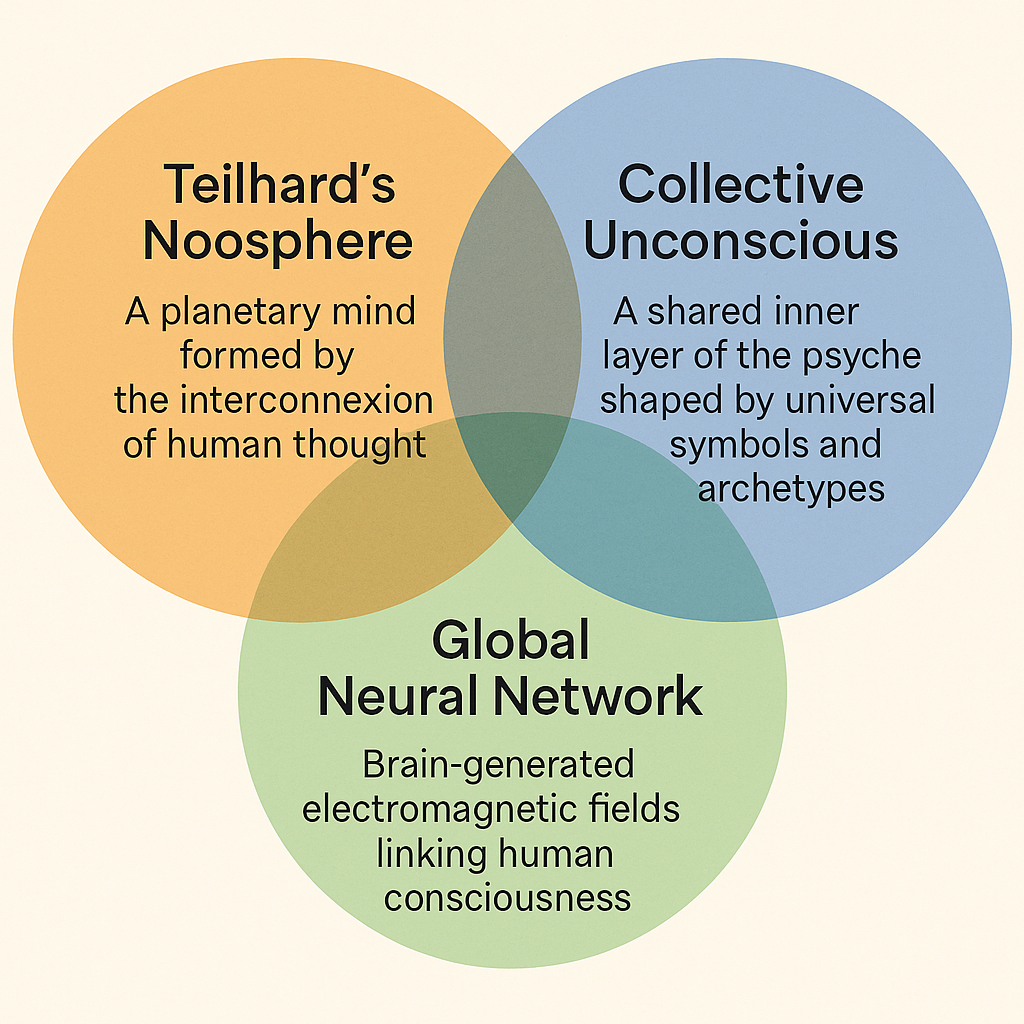
If today’s neuroscience is indeed showing that our brains create coherent electromagnetic fields that can interact over vast distances, Teilhard’s Noosphere could be seen as a philosophical precursor to the idea of a measurable “global neural network.” His work provides a spiritual and evolutionary map, while science may be revealing the wiring.


Carl Jung’s Collective Unconscious: A Shared Inner Landscape

Swiss psychiatrist Carl Jung (1875–1961) approached the question of interconnected minds from the inside out. He believed that beneath each person’s personal unconscious—which holds forgotten memories and repressed experiences—there is a collective unconscious, a shared psychic inheritance common to all humanity.

This collective unconscious contains archetypes—universal symbols and motifs such as the Mother, the Hero, the Shadow, and the Wise Old Man. These archetypes surface in myths, fairy tales, religious traditions, and dreams across cultures and time periods, even among people with no direct contact.

For Jung, this was evidence that human beings share a deep, pre-verbal layer of mind. It is not learned; it is innate. It shapes how we perceive, imagine, and respond to the world.

While Jung did not frame his theory in electromagnetic or physical terms, the overlap with today’s “global neural network” idea is striking. Jung saw our inner lives as partly communal, built on a shared psychological blueprint. If Teilhard’s Noosphere describes the outer, collective field of human thought, Jung’s collective unconscious describes the inner, symbolic content that moves within it.

In this way, modern neuroscience could be pointing to the biological infrastructure that allows both Jung’s and Teilhard’s visions to operate—not just as metaphors, but as lived human realities.


Why This Matters for Healing and Growth

In my own work as a counselor, coach, and educator, I have seen first-hand how human connection shapes personal transformation. Whether it’s in one-on-one sessions, group counseling, or community workshops, I help people tap into the deeper currents of their emotional and somatic experience—currents that may also resonate in the kind of global neural network scientists are beginning to imagine.

Through approaches like somatic breathwork, trauma-informed counseling, and creative expression, I guide clients in attuning to themselves and, by extension, to the subtle ways they are connected to others. When we align our inner rhythms, we often find more empathy, more clarity, and more courage to live authentically.

If science is pointing to a real, measurable link between our brains, it could explain why shared experiences—whether joyful, painful, or deeply transformative—can ripple outward and create change beyond the individual. It reinforces the truth I see every day: your healing is never just your own.


Let’s Explore This Together

If the idea of a connected human consciousness resonates with you, and you’re ready to explore your own healing and growth in a way that honors mind, body, and connection, I would love to work with you.

You can learn more about my services and schedule a consultation at www.dr-kat.org/work-with-dr-kat, or reach out directly by email at help@dr-kat.org.

Your journey may just be part of a much larger story—one that spans not only hearts and minds, but perhaps even the invisible waves that connect us all.

Dreams as Messengers: What Nighttime Narratives Reveal About Your Inner Life

Dream Time by Uttam Bhattacharya

What if the bizarre, vivid, or even distressing dreams you experience weren’t random at all—but were instead meaningful messengers, surfacing from the depths of your subconscious to guide, warn, or reveal? Across psychology, spirituality, and philosophy, dreams have long been viewed as more than nighttime entertainment—they are tools of insight, healing, and revelation.


The Brain’s Way of Working Things Out

From a neurological perspective, dreams are not aimless. Research suggests that during REM sleep, our brains continue to solve problems, regulate emotions, and consolidate memory. According to Carl Jung, dreams are a natural expression of the unconscious—the psyche’s effort to bring balance and understanding through symbolic communication. We might not be consciously aware of a dilemma, but our brains often are, and dreams are one of the ways our minds nudge us toward resolution.

That frustrating dream of being chased, failing an exam, or missing a flight? It may not be about the literal content at all, but a metaphor for stress, decision paralysis, or fear of failure that’s surfacing because your conscious mind is too overwhelmed or too distracted to process it during waking hours.


Messages in a Bottle: Montague Ullman’s Theory of Dreams

Montague Ullman (1916–2008) was a psychiatrist and psychoanalyst best known for his groundbreaking work in dream theory and group dreamwork. Ullman believed dreams were not merely products of the id or subconscious discharge but communicative acts—messages in a bottle sent from the self to the self. According to Ullman, dreams function as internal mail, offering emotional truth that bypasses our intellectual defenses.

He championed the idea that dream interpretation should be democratic and community-based. Through dream-sharing groups, Ullman emphasized the value of collective wisdom in decoding dreams. Rather than pathologizing or medicalizing them, he invited people to explore their dreams with curiosity and emotional honesty, viewing each dream as a meaningful commentary on one’s lived experience.


The Recurring Dream Loop

When dreams repeat—whether it’s being trapped, falling, or teeth crumbling—they’re like a psychological ping that something still needs attention. Recurring dreams often indicate unresolved conflict, trauma, or patterns that have yet to be integrated or addressed.

The 20th-century French philosopher Gaston Bachelard explored the poetic and recurring nature of dreams in The Poetics of Reverie. He believed dreams, especially recurring ones, served as invitations to revisit emotional truths hidden beneath surface awareness. Bachelard wrote that dreams are not only echoes of our past, but “images that ask to be born anew in consciousness.”

Processing a recurring dream involves journaling, emotional reflection, and noticing patterns across time. Ask yourself:

  • What emotions am I resisting in waking life?
  • What is the underlying fear or longing behind this dream?
  • Has anything about the dream changed since I last had it?

Bringing awareness to the dream’s emotional tone and symbolic content often softens its repetition. Recurring dreams rarely stop because we analyze them—they stop because we integrate what they’re trying to teach us.


Prophetic Dreams and the Role of Intuition

Some dreams seem to tap into something beyond time—an intuitive awareness of what is happening beneath the surface or even what is to come. This isn’t always about clairvoyance but rather the emergence of information not yet processed consciously.

Heart-based research supports the idea that the body—especially the heart—is a seat of intuitive knowing. According to the HeartMath Institute, the heart has its own intrinsic nervous system, sometimes called the “heart-brain,” which processes information independently of the cerebral brain. Studies have shown the heart responds to stimuli seconds before they appear, suggesting a form of intuitive foresight. In this sense, prophetic dreams may reflect the heart’s ability to sense subtle energy shifts in our relationships, environments, or health long before our conscious minds register them.


Trauma Revisited in the Dream Space

Unresolved trauma often finds its way into dreams, especially when waking life begins to feel safe enough to explore it. A woman who was cheated on may dream repeatedly of her spouse in new affairs, not because it’s happening again, but because her psyche is still trying to make sense of the betrayal, the loss of trust, and the fracturing of her identity.

Conversely, a man who has cheated and lost his wife as a result may experience nightmares of abandonment, rage, or seeing his family torn apart. These dreams aren’t about punishment but are a manifestation of unprocessed grief, shame, and guilt. The dream becomes a mirror—reflecting both what happened and what the dreamer still carries inside.

This scenario can also give rise to complex, layered dreams in which multiple timelines play out—alternate lives where the betrayal never happened, or where healing was possible. These parallel dream-worlds may point to the emotional ambivalence within the dreamer: regret, longing, and the wish to undo what cannot be undone.

Philosopher Søren Kierkegaard explored such internal conflict in relation to despair and the multiplicity of the self. He argued that part of being human is reconciling these opposing inner states—hope and regret, freedom and consequence. Dreams allow for this reconciliation to happen symbolically, playing out what the conscious mind cannot resolve.


Dreams in Addiction Recovery: Including Sexual Addiction

Freud famously interpreted dreams as wish fulfillment—a way for the unconscious to safely act out desires that the waking ego represses. In addiction recovery, dreams about using substances may reflect lingering cravings or guilt around past behaviors. But they are not signs of relapse. They are the psyche detoxing its internal landscape.

Carl Jung, in contrast, viewed dreams as part of the individuation process—a symbolic roadmap for the integration of the self. Jung would likely view dreams of relapse or destructive behaviors not as shameful, but as the unconscious presenting the shadow self, asking for attention, compassion, and transformation.

In recovery from sexual addiction, dreams may include imagery of past behaviors, unresolved desires, or even shame-inducing content. These are not regressions but reflections of healing-in-process. They may be an invitation to reclaim parts of the self that were numbed or fragmented during active addiction.

To process these dreams:

  • Reflect on what the dream may be trying to communicate about unmet needs or fears.
  • Practice self-compassion rather than shame.
  • Bring the dream into therapy or group work, where symbolic themes can be safely explored.

Philosophers on Dreams: Expanded Perspectives

  • Plato believed dreams were glimpses into the soul’s true desires. In The Republic, he described dreams as unchained expressions of inner impulses and argued that the just person could control dreams as a measure of moral integrity.
  • Aristotle, more empirical, saw dreams as physiological processes influenced by digestion and temperature, yet still acknowledged their capacity to reflect emotional states and signal bodily imbalance.
  • Descartes questioned the reliability of dreams entirely, using them to illustrate the fallibility of sensory experience and launching the philosophical query: How can we know we’re not dreaming now?
  • Nietzsche saw dreams as echoes of archaic human instinct. He believed dreams brought us in contact with primordial forces and the “Dionysian” side of the psyche—a vital counterbalance to rationality.
  • Krishnamurti held that dreams were a reflection of inner disorder and that true clarity arises only when the mind is silent, not cluttered with interpretation. He emphasized dream observation rather than analysis.

Each philosophical view adds nuance to the nature of dreams—whether as moral mirror, biological feedback, existential challenge, or spiritual insight.


How to Work with Dreams

Working with dreams begins in the present moment. Instead of chasing meaning, start where you are—with the feelings, symbols, or questions that arise when you wake.

Eckhart Tolle teaches the power of now—the idea that transformation begins when we fully inhabit the present moment. Dreams often point to the places where we’re not present—where we’re caught in old stories, regrets, or fears. Use them as anchors to return to yourself.

Tips:

  • Keep a dream journal by your bed and write as soon as you wake.
  • Look for patterns, symbols, and emotional themes over time.
  • Share dreams in trusted spaces—therapy, dream groups, or with a mentor.
  • Practice mindfulness to increase dream recall and integrate insight.

Dreams are not problems to solve. They are invitations—to feel, to remember, to imagine, and ultimately, to awaken. What messages are your dreams sending you tonight?


You Are the Author: Autonomy, Addiction, and the Power of Inner Choice

Emiliano di Cavalcanti (1897-1976), Sonhos do carnaval, 1955. Oil on canvas.

For anyone who has walked through the storm of addiction—whether it be to substances, sex, control, or even another person—the idea of “choice” can feel either liberating or infuriating.

Many recovery programs begin with a confronting admission:
“We admitted we were powerless over [our addiction]—that our lives had become unmanageable.”

At first glance, it sounds like surrendering your power entirely. But what if powerlessness doesn’t negate autonomy? What if surrender is not the end of power—but its beginning?


Autonomy Is Not Control

To understand this, we have to clarify the difference between autonomy and control.

  • Autonomy refers to your ability to act freely and make choices based on your own values, needs, and inner alignment. It’s the foundation of self-governance.
  • Control, by contrast, is the attempt to manipulate external outcomes—your urges, your behavior, other people’s reactions.

Control comes from fear. Autonomy comes from ownership.

In recovery, many people rely on control mechanisms early on. Avoid bars. Cut off triggering relationships. Install blockers. These measures can help—temporarily. But they only go so far. Why? Because they focus on managing symptoms rather than transforming internal systems.

Control is a behavior-based strategy. Autonomy is a being-based reality.


Reframing Powerlessness: The First Step Is Not the Last Word

Let’s revisit Step One in the 12-step framework:

“We admitted we were powerless over [our addiction]—that our lives had become unmanageable.”

This statement often gets misunderstood. It does not mean, “I am powerless over myself.” It means, “I cannot control the outcomes of my behavior using willpower alone.”

It’s not saying you lack choice—it’s saying that your current method of control isn’t working.

That’s powerful.

Why? Because once you stop wasting energy trying to dominate your impulses, you can begin cultivating a deeper relationship with yourself—the part of you that observes those impulses and chooses a different path.

Powerlessness, then, is not the same as helplessness. It’s a crossroads: where control ends, and conscious participation begins.


Autonomy and Inner Choice: Frankl and Bohm in Dialogue

Philosopher and psychiatrist Viktor Frankl wrote, from the depths of a Nazi concentration camp, that even when stripped of everything, one inner freedom remained:

“Everything can be taken from a man but one thing: the last of the human freedoms—to choose one’s attitude in any given set of circumstances.”

Frankl’s message is not just theoretical—it’s existential. His insights reflect the very heart of autonomy: that no matter what has happened to us, we retain the capacity to respond from within. This is the essence of recovery: reclaiming that internal space where we are free to choose, even when impulses rage and old neural pathways scream for attention.

At the same time, quantum physicist and philosopher David Bohm reminds us that the world we experience is not separate from our consciousness. He wrote:

“Thought creates the world and then says, ‘I didn’t do it.’”

Bohm’s view of reality aligns seamlessly with Frankl’s. In addiction, we often act from unconscious patterns and then disown them. But as Bohm teaches, when we bring conscious observation to our thought and behavior, we reclaim authorship. We stop blaming and start creating.

Together, Frankl and Bohm offer a powerful synthesis: our inner world shapes our outer experience. Through the lens of choice (Frankl) and observation (Bohm), we return to ourselves not as victims of addiction, but as conscious participants in our healing.


Belief and the Brain: Wiring Your Reality

Your brain is a meaning-making machine. Through neuroplasticity, it continuously rewires itself based on your repeated thoughts, beliefs, and behaviors.

If you repeatedly tell yourself, “I can’t control this,” or “This is who I am,” you’re not just describing a condition—you’re reinforcing a neural pathway. That belief becomes a mental groove. With time, it becomes automatic. In neuroscience, this is called Hebbian learning:
> “Neurons that fire together, wire together.”

This is why beliefs matter.

If your foundational belief is that you are powerless, flawed, or doomed to repeat the past, your brain will find ways to make that true. Not because you are weak—but because your brain is efficient. It seeks familiarity, even if familiarity is dysfunctional.

But here’s the other side of the equation: you can rewire your brain.

Every time you pause before reacting…
Every time you choose to sit with discomfort rather than numb it…
Every time you speak to yourself with compassion instead of judgment…

You are creating new synaptic pathways. You’re literally reshaping your inner landscape.

Beliefs, when consciously examined and updated, become the scaffolding of recovery.


The Quantum Mirror: Your Attention Shapes Reality

Quantum physics offers a compelling metaphor for recovery: the observer effect. In the double-slit experiment, particles behave differently based on whether or not they are being observed. The act of conscious observation changes the outcome.

This has profound implications. What if your mere attention to a thought, a sensation, or a craving changes it?

Let’s apply this to recovery. When you pause and witness a compulsion without acting on it, you are becoming the observer. You are stepping out of identification with the behavior. You are no longer saying, “I am this urge.” You’re saying, “I see this urge.”

And the moment you do that, you begin to reclaim authorship.

Just like a quantum particle shifts based on awareness, your inner world reorganizes itself around your presence.

This is why meditation, breathwork, and mindful somatic practices are not just “self-care”—they are biophysical interventions that restructure your nervous system and your choices.


Trying to Control vs. Living Authentically

Scenario 1: Sexual Addiction

A person struggling with compulsive sexual behavior installs blockers, avoids media, and sets strict boundaries around relationships. While these may be temporarily helpful, they’re still rooted in fear. The deeper question remains unaddressed: What need am I trying to meet through this behavior? Is it loneliness? Shame? Unworthiness?

Until the person learns to sit with those core emotions and offer themselves understanding and care, the compulsion remains under the surface—waiting.

Control is surface management. Autonomy is inner transformation.

Scenario 2: Alcohol Use

Someone avoids bars, parties, and friends who drink. These are smart boundaries in early recovery. But if avoidance becomes the only strategy, they risk remaining stuck in fear. The goal of healing is not to eliminate all triggers—it’s to become untriggerable by learning how to self-regulate.

Over time, the individual who chooses authenticity over appearance, connection over control, and self-awareness over escape finds themselves walking past a bar with complete neutrality.

That’s autonomy.


Letting Go to Receive Everything

Here’s the paradox: when you let go of trying to control your urges, outcomes, and emotions, you gain access to something deeper—your innate clarity.

It’s not that you become passive. You become present. You choose not from fear of what might happen, but from trust in who you’re becoming.

This is not about “letting go” and drifting. This is about letting go of false control so you can experience real authorship.

Your cravings no longer scare you. Your past no longer defines you. Your future is no longer based on damage control—it’s shaped by conscious creation.


From Inner Shift to Outer Change

We often try to change our world by changing our circumstances. But the most lasting transformations start inward.

This is why trauma work, somatic healing, and spiritual practice are vital to recovery. They don’t just “fix” behavior—they restore connection with the self.

When you shift inwardly—through awareness, breath, compassion, and choice—your entire external life begins to mirror that new vibration.

  • Relationships change.
  • Boundaries become clearer.
  • Self-respect deepens.
  • Addiction loses its grip.

That’s not magic. That’s coherence between mind, body, and soul.


When You Believe You Can’t, You Teach Your Brain You Can’t

This is where neuroscience and quantum physics overlap again:

  • In neuroscience: beliefs wire the brain.
  • In quantum physics: beliefs collapse potential realities into form.

In both models, what you believe matters.

If you believe your addiction defines you, your brain and your environment will mirror that back. But if you believe you can change—even if you’re scared, even if you’ve relapsed—you are opening neural and energetic doors to new possibilities.

That belief alone begins to carve out a new future.


What Autonomy Looks Like in Practice

Let’s make this practical. Autonomy doesn’t always look like bold confidence. Sometimes it looks like:

  • Taking a deep breath before reacting.
  • Texting a trusted friend when you’re triggered instead of isolating.
  • Saying “no” to something that isn’t aligned, even if it disappoints someone.
  • Sitting in discomfort without numbing or running.
  • Journaling your truth instead of self-censoring it.
  • Meditating for 10 minutes instead of checking out online.

Every one of those small actions sends the signal:

“I choose me.”
“I am not a victim of my wiring—I am the one shaping it.”


Final Thought: You Are the Author

Addiction is not a life sentence. It’s a communication—one that points you back to your unmet needs, your unresolved pain, and your unrealized power.

And recovery is not just about abstaining from harmful behaviors. It’s about remembering who you are beyond them.

You are the observer, the chooser, the creator.

You are not powerless. You are autonomous.

And the moment you stop trying to control your world and start aligning with your truth, your entire life shifts.

Because you are the author.
And every day, with every choice, you are writing your next chapter.


Reflective Prompts for Integration:

  1. What do I believe about my ability to change?
  2. Where am I relying on control instead of cultivating autonomy?
  3. What would it feel like to observe my urges without reacting?
  4. Where can I shift from “managing” to “relating” in my recovery?
  5. What story am I writing today—and is it aligned with the truth of who I am?

The Transformative Power of Empathy

Empathy is a cornerstone of human connection, yet it is often misunderstood or diluted in everyday discourse. Far more than simply “feeling for” another person, empathy is the profound capacity to enter into the lived experience of someone else, to perceive their emotions and reality from their own perspective—not filtered through our own. This complex process requires a cultivated awareness, emotional maturity, and deep inner work. The 20th-century philosopher and phenomenologist Edith Stein (also known as St. Teresa Benedicta of the Cross) offered one of the most precise and psychologically rich frameworks for understanding empathy—one that remains profoundly relevant today.

Do I Have Empathy?

The question, “Do I have empathy?” may seem simple, but it invites introspection. True empathy involves more than passive listening or an instinctual reaction to another’s suffering. According to Edith Stein, empathy is an intentional act of consciousness—a means of perceiving another’s experience as separate from our own, yet real in its own right. Unlike emotional contagion, where we mirror another’s feelings unconsciously, empathy is an aware, reflective experience of the other.

Empathy, then, is not something we either “have” or “don’t have,” but rather a human capacity that can be developed, deepened, and refined over time. It involves not only emotional availability but cognitive and moral engagement. It requires us to become still enough within ourselves to perceive what is not immediately visible: the emotional landscape of another being.

Empathy, Compassion, and Sympathy: What’s the Difference?

While often used interchangeably, empathy, compassion, and sympathy are distinct. Sympathy involves feeling for someone—often accompanied by pity or sorrow. Compassion includes a desire to alleviate suffering and is often tied to action. But empathy, as Stein described, is the process of perceiving and feeling the experiences of another without merging them into our own. It’s a kind of “emotional seeing”—a relational experience that honors the otherness of the other.

Unlike sympathy, which may create distance through pity, or compassion, which may involve a power differential (I act to help you), empathy levels the relational field. It demands that we see others as equal in their humanity, worthy of being understood, not fixed. It brings both humility and strength, as it requires us to be vulnerable enough to truly see and be affected by another’s truth.

How to Develop Empathy

Empathy can be cultivated with intentional practice. First, it requires a slowing down of our mental and emotional reactivity. When we’re truly present, we can begin to sense not only what a person is saying, but what they are feeling. Stein emphasized the importance of phenomenological openness—setting aside our biases and assumptions to encounter the other as they truly are.

Strategies for developing empathy include:

  • Active listening without the urge to interrupt, advise, or relate.
  • Mindfulness to notice our internal reactions and quiet them.
  • Reflective questions: What might this person be feeling beneath their words? What is their lived context?
  • Reading literature or engaging in narrative work, which trains us to see from multiple perspectives.

In therapeutic and educational settings, role-play and guided reflection can help participants recognize how their own experiences shape the way they interpret others’ emotions. Journaling and meditation practices aimed at compassion and curiosity can also increase empathy by building emotional resilience and perspective-taking.

How to Step Into Someone Else’s Shoes

“Stepping into someone else’s shoes” is often cited as a metaphor for empathy, but it is more than imagining how we would feel in their situation. Edith Stein clarified that true empathy is not projecting our own emotions onto another but recognizing their unique experience as distinct from our own.

To step into someone else’s shoes:

  • Suspend judgment. Assume you don’t know what it’s like to be them.
  • Inquire gently. Ask open-ended questions to explore their perspective.
  • Feel with, not for. Stay attuned to their emotional tone without overshadowing it with your own.

This capacity to co-experience the other while maintaining psychological boundaries is essential in any relational or helping profession. It allows us to be fully present without becoming enmeshed, to accompany without overpowering, and to validate without losing ourselves.

Empathy’s Challenge to Narcissism and Codependency

Empathy, properly practiced, acts as a corrective to both narcissism and codependency. Narcissism denies the reality of others’ emotional worlds, while codependency blurs the boundaries between self and other. Empathy challenges narcissism by inviting us to look beyond ourselves, and it challenges codependency by asking us to feel alongside another without becoming lost in them.

Stein’s philosophy insists on the preservation of selfhood even in empathic connection. We do not become the other—we resonate with them while staying rooted in our own being. This is the delicate balance where healing relationships can flourish. Moreover, empathy does not ask us to abandon our truth to validate someone else’s; rather, it invites us to be strong enough to witness pain without absorbing or denying it.

In a narcissistic culture that prioritizes individualism and self-promotion, empathy stands as a counter-cultural force. In relationships plagued by codependent patterns, empathy restores a sense of self while maintaining connection. It is a bridge between independence and intimacy.

The Role of Discomfort and Trauma in Blocking Empathy

Many people struggle with empathy because their own unprocessed trauma or emotional discomfort gets in the way. If another’s emotions mirror our own unresolved pain, we may shut down or become overwhelmed. Conversely, if their experience challenges our worldview, we may become defensive.

To cultivate empathy, we must do our own inner work. This means:

  • Acknowledging how past wounds influence our current perceptions.
  • Learning emotional regulation skills to remain grounded in the presence of others’ pain.
  • Seeking therapy or support when our history limits our capacity to be present.

Stein believed that empathy was not simply a mental skill, but a spiritual and moral development—an unfolding of the human person toward deeper understanding and communion. She argued that empathy was fundamental to the experience of love and relationship, not because it allows us to feel everything others feel, but because it affirms their reality as valid and worth knowing.

When we are trapped in unresolved grief, shame, or rage, empathy feels dangerous. It asks us to open a door we have kept shut. But in doing so, it also offers us healing—the chance to rewrite the inner scripts that keep us isolated.

Conclusion

Empathy is not merely an interpersonal tool—it is a way of being in the world, a mode of perception that calls for attentiveness, courage, and humility. Through Edith Stein’s lens, we see that empathy is not about merging or fixing, but about witnessing the other with reverence and clarity. In a world marked by disconnection and polarization, the practice of empathy remains a radical and healing act—one that honors both self and other in the fullest sense.

Whether in our families, communities, classrooms, or professional lives, empathy is the bridge that allows us to cross into another’s world without losing sight of our own. It is, ultimately, an ethical invitation to live more fully human lives.

Revolutionizing Intimacy: A Guide to Understanding and Practicing Parasympathetic Lovemaking

Intimacy is often portrayed as a whirlwind of passion, a dance of bodies fueled by the fire of desire. But what if there’s another way to experience closeness—one that transcends the frenetic energy so often depicted in mainstream narratives? Imagine intimacy that flows like a gentle stream, where connection isn’t just about physicality but also emotional safety and mindfulness. Welcome to the world of parasympathetic lovemaking, where understanding your nervous system can transform your intimate experiences into something profoundly deeper. I know it may sound complicated, but bear with me: I promise you it’s not as daunting as it seems. Incorporating principles of the parasympathetic nervous system can revolutionize the way you approach intimacy and pleasure. Slowing down can enhance pleasure and fulfillment in ways you may never have considered. So let’s dive in and explore the art of parasympathetic lovemaking.

Understanding the Sympathetic and Parasympathetic Nervous Systems

The human body operates through two primary nervous systems: the sympathetic and parasympathetic. Each plays a distinct role in our overall well-being.The sympathetic nervous system triggers the “fight or flight” response. It prepares us to face challenges head-on, increasing heart rate and blood flow to muscles. This mechanism is vital for survival but can lead to chronic stress if overactivated.In contrast, the parasympathetic nervous system embodies calmness and restoration. Often referred to as the “rest and digest” system, it promotes relaxation and healing after periods of stress. Think of it as your body’s natural way of unwinding.These systems don’t operate independently; they complement each other, regulating emotional states and bodily functions. Understanding their dynamics is crucial for enhancing intimacy, particularly when exploring deeper connections during lovemaking experiences.

Comparing Sympathetic versus Parasympathetic Arousal

Sympathetic arousal ignites the body’s fight-or-flight response. It floods you with adrenaline, heightening your senses and making you feel alive. This kind of arousal is often associated with passion and urgency in intimate encounters. It always amazes me how in movies and shows characters transition from that first kiss to a fervent exchange of passion, often characterized by the clichéd notion of knocking something off a table or slamming against a wall, all within mere seconds. This rapid escalation is undeniably exhilarating; it evokes an internal stir—a subtle pelvic rock of pleasure mixed with anticipation. However, this pathway of lovemaking necessitates intensity; high levels of excitation are crucial to maintain arousal. And while this kind of lovemaking can be exciting, it can also be exhausting and unsustainable.

 When the body is in a constant state of arousal, it can lead to feelings of burnout and disconnection. It can leave you feeling drained and disconnected, a far cry from the intimacy you were hoping to achieve.The allure of such scenarios may explain why addiction to the seeming delights of pornography becomes prevalent among many men; like thrill-seekers chasing ever-greater highs, there exists an insatiable demand for more—more intensity, more excitement, more heat. As life introduces complexities such as children, job responsibilities, financial pressures, and familiarity into intimate spaces once vibrant with fervor, sustaining this ever-increasing supply of intensity presents considerable challenges that can ultimately diminish the desire for one another over time in profound ways.

Now, parasympathetic arousal promotes a state of calmness and relaxation. It’s about being present, allowing intimacy to unfold naturally without pressure or expectation. This state invites deeper connections based on vulnerability and trust. Safety is the foundational element in human relationships and cultivates an environment where genuine arousal flourishes effortlessly. When individuals experience profound safety—manifested through the warm gaze of a partner who embodies unwavering support—the body instinctively relaxes into its most authentic state. This is not merely a physical response but rather a holistic awakening of the senses that transcends traditional notions of intimacy characterized by intensity and friction.

The very essence of safety resides in its ability to dismantle barriers erected by societal expectations or personal insecurities, allowing one’s unique beauty to be celebrated without pretense or pressure. As safety deepens within oneself and one’s relational dynamics, the brain releases neurochemicals which further enhance feelings of pleasure and connection—a biological affirmation that our bodies are inherently wired to respond positively when we feel secure. In such spaces, where acceptance reigns supreme, arousal flourishes organically; it does not demand theatrical displays or intricate preparations but thrives instead on the simplicity of being fully present with another—nurtured by an ambiance rich in comfort and authenticity that nourishes one’s essence in all its beauty and uniqueness.

Marcus Aurelius on Parasympathetic Arousal

Marcus Aurelius, the Stoic philosopher and Roman emperor, had an intriguing perspective on human experience that reveals a profound understanding of emotional states often overlooked in philosophical discourse. His reflections frequently alluded to intimate relationships, underscoring how self-awareness serves as a foundational pillar for navigating complex emotional landscapes. In his meditations, he emphasized the importance of cultivating an inner tranquility that aligns closely with the concept of parasympathetic arousal. By advocating for mastery over one’s impulses and emotional reactions, Aurelius highlighted an essential aspect of intimacy: it requires not only vulnerability but also a disciplined serenity that allows individuals to engage authentically with one another. Through this lens, he invites us to explore how introspection can enhance our relational dynamics while promoting resilience against life’s inevitable challenges.

Aurelius advocated for mindfulness in every moment, emphasizing that the act of being fully present with another person cultivates an environment conducive to vulnerability and authentic connection. This philosophy resonates profoundly within intimate encounters where emotional safety is paramount; it transforms what might otherwise be a fleeting physical interaction into a deeply spiritual communion. The essence of his teachings encourages us to embrace lovemaking not merely as a corporeal exchange but as a sacred ritual that nurtures the soul. When partners engage from this serene state of mindfulness rather than succumbing to the pressures of haste or distraction, they unlock richer experiences together—experiences imbued with empathy and compassion. Such insights are timeless, serving as poignant reminders that ancient wisdom can illuminate modern relationships, guiding them toward meaningful connections characterized by depth, understanding, and genuine affection—the very hallmarks of true intimacy.

Understanding Emotional Energy in Intimacy

Emotional energy forms the backbone of meaningful intimacy, serving as a vital conduit through which partners can explore their deepest selves. In the realm of parasympathetic lovemaking, this energy flourishes against a backdrop of safety and connection; it is within this nurturing environment that vulnerability can emerge without fear or hesitation. However, contemporary influences such as pornography often undermine this intimate experience by promoting objectification—reducing partners to mere physical entities devoid of emotional depth. This pervasive culture not only distorts perceptions of sexuality but also erodes the foundational trust necessary for profound emotional engagement. When individuals internalize these objectifying narratives, they inadvertently create barriers to genuine intimacy; without emotional safety, the very essence of vulnerability is stifled, leading to an impoverished relational landscape where true connection becomes elusive. As mutual respect and understanding wane under the weight of superficial portrayals, couples may find themselves trapped in cycles that prioritize transient pleasure over enduring closeness—thereby diminishing their capacity for authentic emotional exchange.

When we engage with our partner’s emotions, we unlock deeper levels of connection that transcend the superficiality often depicted in popular media. This transformative experience is not solely reliant on physical touch; rather, it revolves around cultivating a nurturing environment where both individuals can articulate their desires without fear of judgment. The concept of emotional safety plays a pivotal role in this dynamic, as it permits partners to explore each other’s bodies and minds with an openness that enhances arousal in nuanced ways that pornography frequently fails to capture. By delving into one another’s emotional landscapes, couples foster compassion and empathy during intimate moments—each whisper or caress becomes imbued with significance when rooted in mutual respect and understanding. In such a space, intimacy evolves from mere mechanics into an enriching experience that rejuvenates both body and spirit, reinforcing the notion that true erotic connection is deeply intertwined with emotional engagement. As energy flows effortlessly between lovers who prioritize this emotional safety as the foundation for their encounters, they create a profound dance of vulnerability and trust where pleasure is maximized through heartfelt communication and shared exploration.

Rewiring the Erotic Nature of Your Nervous System

Revamping the sensuous aspects of your nervous system requires an inward voyage. This entails acknowledging and altering your responses to intimacy.Begin by delving into your sensations without the weight of expectation, creating a sanctuary where safety reigns paramount. In this space, direct your attention towards what brings you pleasure—whether it manifests as a gentle caress against your skin or the warmth of laughter shared with another. This exploration fosters connection on multiple levels: physically, through heightened awareness of bodily responses; emotionally, by nurturing intimacy that transcends mere physicality. Engaging in this practice aids in the formation of fresh neural connections within the brain that promote a sense of enjoyment rather than worry or restraint. As one immerses in these pleasurable experiences, particularly those tinged with erotic connection, they cultivate an enriched understanding of their desires and boundaries—a crucial aspect for both personal fulfillment and relational harmony. Such deliberate focus not only enhances individual well-being but also deepens interpersonal relationships by encouraging vulnerability and authentic expression within safe environments.

Through the practice of breathwork, one can experience profound transformations that extend beyond mere relaxation; this technique serves as a powerful conduit for fostering safety and enhancing connection at multiple levels of human interaction. The act of taking deep, leisurely breaths sends a vital message of security to the body, activating the parasympathetic nervous system and inviting an atmosphere conducive to tranquility and openness. In this serene state, individuals often find themselves more attuned to their own emotional landscapes, allowing for deeper intimacy not only with oneself but also with others. This sense of safety is paramount in facilitating authentic connections that may evolve into forms of erotic connection—where vulnerability meets desire—thus enriching interpersonal relationships through shared experiences grounded in breath-centered awareness. In breathwork, they cultivate a rhythm that nourishes both trust and mutual understanding, reinforcing the idea that true intimacy thrives within environments steeped in calmness and acceptance.

Incorporating touch into everyday life significantly enhances the neurobiological rewiring process that underpins emotional and physical intimacy. By engaging in casual caresses devoid of ulterior motives, individuals cultivate a profound sense of safety and connection within their relationships. This tactile engagement fosters an environment where vulnerability can flourish, allowing partners to explore deeper layers of intimacy over time. The regularity of such affectionate gestures lays a foundational bedrock for erotic connection, as it normalizes touch and creates familiarity between partners. As they navigate through these unguarded moments, the brain releases oxytocin—often referred to as the “bonding hormone”—which strengthens trust and emotional ties. Consequently, this practice not only enriches daily interactions but also paves the way for heightened experiences during more intimate encounters, transforming ordinary exchanges into pathways toward deepened relational fulfillment.

Engaging in practices that encourage presence, such as meditation or mindful walking, serves not only to sharpen your awareness but also fosters a profound sense of safety and connection within oneself and with others. By immersing yourself in the rhythmic cadence of breath or the gentle embrace of nature beneath your feet, you cultivate a heightened sensitivity to your body’s responses—an essential precursor to exploring intimacy on deeper levels. This state of mindfulness creates a nurturing environment where erotic connection can flourish; it invites an exploration into one’s desires and boundaries without fear or judgment. As you navigate this expansive landscape, each subtle sensation becomes an opportunity for discovery and expression, allowing you to forge connections that are rich in authenticity and depth. Such embodied practices illuminate pathways toward understanding both personal eroticism and the intricacies of shared experiences with partners—transforming mere physicality into a sacred dance infused with emotional resonance and mutual respect.

Incorporating Mindfulness and Sensory Awareness into Your Intimate Encounters

Mindfulness transforms intimacy into a profound experience by establishing a sense of safety that allows partners to engage fully with each other, both physically and emotionally. By cultivating presence in the moment, individuals can explore not only their partner’s body but also the intricacies of their emotional landscape without the interference of distractions or external pressures. This heightened awareness fosters deeper connections that transcend mere physical attraction; it nurtures an erotic connection rooted in genuine understanding and acceptance.

Engaging the senses becomes paramount in this journey; partners might focus on tactile sensations—the warmth of skin against skin—and allow themselves to revel in the soft whisper of breath as it dances between them. Listening intently to heartbeats creates an intimate rhythm shared solely between two souls, heightening the sacredness of each touch and glance, while savoring every fleeting moment together deepens their bond beyond superficial encounters. In this way, mindfulness enriches intimacy by weaving together safety and connection into a tapestry where love can flourish freely and authentically.

In the intimate realm of lovemaking, closing your eyes for a few moments can serve as an intentional act of safety, fostering an erotic connection that transcends the physical. By shutting out visual distractions, partners invite a deeper awareness of each other’s presence, allowing the textures of skin against skin and the warmth shared between bodies to become focal points in their experience. This heightened sensitivity is further enriched by engaging in synchronized breathing exercises; inhaling and exhaling together cultivates not only a harmonious rhythm but also reinforces trust and vulnerability within the relationship. As breaths align, they create an atmospheric cocoon where scents—the subtle aroma of sweat mingled with perfume—become intoxicatingly vivid while ambient sounds like whispered words or gentle moans resonate with greater clarity, enveloping both individuals in a symphony of intimacy. In this sacred space liberated from performance anxiety and external judgment, couples are encouraged to explore one another’s desires freely; love flows unimpeded through open hearts and minds as they engage in what could be described as a dance—a profound exchange that connects souls on multiple levels beyond mere physicality.

In Conclusion

Exploring the depths of intimacy through a parasympathetic lens invites a profound embodiment of self-awareness and connection, fundamentally reshaping both interpersonal relationships and intrapersonal understanding. By prioritizing safety—both emotional and physical—individuals can cultivate an atmosphere where erotic connection flows freely, unencumbered by the habitual anxieties that often disrupt genuine affection. This approach encourages partners to engage in practices that heighten their awareness of bodily sensations and emotional responses, promoting a deeper attunement to one another’s needs and desires. As they navigate this delicate balance between vulnerability and strength, individuals find themselves not only more connected with their partner but also unlocking layers of their own identity previously obscured by societal expectations or personal fears. Such exploration fosters resilience in relational dynamics, allowing for richer exchanges characterized by trust, presence, and an authentic embrace of each other’s complexities.

Through the lens of thinkers such as Thomas Nagel and Plato, we uncover that our experiences of love and desire are not merely reflexive responses to biological imperatives; rather, they are deeply intertwined with philosophical inquiries about the nature of embodiment itself. Nagel’s exploration of subjective experience urges us to consider how our perceptions shape our connections, illuminating the profound ways in which physicality intersects with emotional intimacy. Similarly, Plato’s dialogues challenge us to transcend mere sensual enjoyment by seeking a higher form of love—one that embodies truth and beauty beyond fleeting pleasures. In this light, instantaneous gratification offered by pornography becomes a distraction from genuine engagement; it often neglects the rich tapestry woven from shared vulnerabilities and authentic exchanges between partners. By reflecting on these insights, we can cultivate an understanding that values embodiment not just as a physical state but as a holistic integration of mind and spirit within relationships—encouraging us to foster deeper connections grounded in mutual respect, empathy, and existential inquiry rather than succumbing to superficial encounters devoid of substance.

Rewiring the erotic nature of our nervous system is an intricate process, akin to the stoic philosophy espoused by Marcus Aurelius, who emphasized mindful reflection and self-awareness as pathways to deeper understanding. By practicing mindfulness and sensory awareness during intimate moments, we engage in a form of embodiment that fosters a rich tapestry of connection between partners. This journey requires patience and intentionality; it invites us to explore not only the physical sensations but also the emotional landscapes that accompany them. As we cultivate this practice, we create a safe emotional space where vulnerability can flourish—essential for true intimacy. The deliberate focus on presence transforms each shared experience into an opportunity for profound engagement rather than mere physical interaction. The rewards manifest as heightened pleasure and stronger interpersonal bonds, ultimately enriching our lives in ways that extend beyond romantic encounters. Such fulfillment aligns with our deepest desires, creating lasting connections rooted in authenticity and mutual respect—a testament to both personal growth and relational harmony inspired by ancient wisdom.

Beyond Substance Abuse: Why Sexual Addiction Stands Apart from Other Addictions

When we think of addiction, our minds often gravitate toward substances like alcohol and drugs—tangible items that alter our state of being. However, there’s a less visible but equally compelling form of addiction that lurks in the shadows: sexual addiction. Often misunderstood and frequently stigmatized, sexual addiction operates on a different plane than substance abuse, weaving itself into the very fabric of personal relationships and self-identity. But what truly sets it apart? Here, I will dive deep into the unique characteristics of sexual addiction, exploring its emotional underpinnings and societal implications while shedding light on why it requires distinct approaches for understanding and healing.

The Bad Faith of Sexual Addiction

Often misunderstood and frequently stigmatized, sexual addiction operates on a different plane than substance abuse, weaving itself into the very fabric of personal relationships and self-identity. Sartre’s existential philosophy sheds light on this complex phenomenon by emphasizing the individual’s responsibility for their choices within a world that can feel absurdly chaotic. Just as Sartre posits that we are condemned to be free, those grappling with sexual addiction find themselves in an agonizing dance between desire and autonomy. The compulsive behaviors associated with sexual addiction often stem from deep-seated feelings of inadequacy or alienation—echoing Sartrean notions of “bad faith,” where individuals deceive themselves to avoid confronting uncomfortable truths about their existence. Relationships become battlegrounds of authenticity versus performance; partners may oscillate between intimacy and withdrawal, mirroring the perpetual struggle for meaning inherent in human connections as described by Sartre. In this context, understanding that sexual addiction is not merely a moral failing but rather an intricate interplay of psychological needs, societal pressures, and existential questions invites us to reframe our perspective through a more compassionate lens—a call to acknowledge the profound impact such struggles have on one’s sense of self amid life’s relentless search for significance.

Sexual Addiction and its Prevalence

Sexual addiction prevalence is alarmingly high, revealing a hidden crisis that many struggle to articulate. Individuals ensnared in this web of compulsive behaviors often experience profound disruptions in their relationships and personal well-being, echoing the turmoil faced by those grappling with more recognized forms of substance abuse. However, sexual addiction demands equal attention for its unique challenges and complexities; it intertwines not only with physical impulses but also with deep-seated emotional issues and societal taboos that compound the stigma surrounding it.

Unlike traditional addictions such as alcohol or drugs, which can be approached through established treatment protocols, sexual addiction dwells within a nebulous realm where pleasure mingles dangerously with guilt and shame. This tumultuous journey involves cycles where euphoric highs are invariably followed by debilitating lows—creating an emotional rollercoaster that’s difficult to navigate without support.

As I delve deeper into the labyrinth of sexual addiction, exploring how it manifests differently from other forms of dependency becomes crucial; its implications on mental health are often underestimated or overlooked altogether. By shedding light on this pressing issue—marked by silence yet prevalent among diverse populations—I aim to foster greater understanding and compassion towards those grappling with these complexities, ultimately paving paths toward healing and recovery that acknowledge both individual struggles and societal inflences.

Understanding the Cycle of Addiction and How it Relates to Sexual Addiction

Addiction often follows a predictable cycle, particularly pronounced in sexual addiction, where compulsive behaviors take center stage. This intricate dance begins with a trigger—stress, loneliness, or boredom might ignite cravings for sexual activity, drawing individuals into the gravitational pull of their desires. The initial engagement offers an enticing reward; it feels like a salve to emotional wounds and provides a temporary escape from discomfort. However, this fleeting relief is deceptive; as the euphoria wanes, feelings of guilt and shame descend like storm clouds on what was once a bright horizon. Instead of acting as catalysts for change or reflection, these negative emotions reinforce the cycle—encouraging individuals to retreat back into familiar patterns of behavior as they seek solace in misguided coping mechanisms. Such repetitive loops create formidable barriers that make escaping the clutches of sexual addiction increasingly difficult.

Moreover, understanding this pattern becomes essential not only for effective recovery strategies but also for acknowledging how deeply intertwined addiction can be with individual sexuality—a complex interplay woven through personal history and development that complicates efforts to simply “quit.” Recognizing that these aspects are fused together is key since it creates a complex tapestry that complicates the journey of sexual development.

This fusion typically leads to an entangled relationship where compulsive behaviors and genuine sexual desires coexist, making it increasingly challenging for individuals to simply quit these patterns. In particular, men frequently find their experiences shaped by the pervasive influence of pornography use, which becomes interwoven with their understanding of attraction and intimacy from a young age. As they navigate through formative stages of sexual identity, the constant stimulation provided by erotic media messaging — whether through explicit imagery or unrealistic portrayals of relationships — distort natural expressions of desire and connection. Consequently, what begins as curiosity escalates into habitual consumption that reinforces unhealthy views on sex and self-worth, further complicating their ability to disentangle from this cycle later in life.

The Impact of Pornography on Sexual Addiction and Male Sexuality

The pervasive accessibility and variety of pornography profoundly distorts expectations around intimacy and pleasure, particularly for many men who find themselves ensnared in a cycle where real-life connections inevitably pale in comparison to the curated experiences found online. This phenomenon creates a chasm between fantasy and reality, leading to feelings of inadequacy, frustration, and loneliness that resonate deeply within personal relationships. As these men grapple with the stark contrast between their digital encounters and genuine emotional connections, they often turn to compulsive behaviors as coping mechanisms—seeking solace in an escalating need for more intense or extreme content just to achieve the same fleeting moments of arousal they once easily accessed.

The normalization of such habits breeds not only unhealthy patterns but also undermines existing relationships by obscuring the line between desire and addiction. Emotional intimacy is frequently sidelined amidst this struggle; what should be a primary conduit for physical closeness instead becomes lost in translation. Consequently, many men find themselves isolated while paradoxically yearning for connection—a disconnect that underscores the complex interplay between human desires shaped by ever-present stimuli and the profound impact on their relational landscapes.

The Role of Shame and Guilt in Sexual Addiction

Shame and guilt are powerful emotions that often fuel sexual addiction, creating a tumultuous cycle where individuals find themselves entangled in behaviors they later regret, further intensifying their feelings of worthlessness. Many who grapple with this addiction carry deep-rooted beliefs about their sexuality, shaped significantly by cultural narratives, religious doctrines, or familial expectations that dictate what is deemed acceptable. These entrenched notions foster an internal dialogue steeped in self-reproach; the belief system instills the idea that one’s desires are inherently wrong or sinful. Consequently, this internal conflict manifests itself as secrecy and isolation—a solitary battle fought behind closed doors.

People who struggle with sexual addiction may come to feel unworthy of love or genuine connection because of these pervasive feelings of shame and guilt, which only serves to propel them deeper into compulsive behaviors as a means of escape from their emotional turmoil. Compounding this distressing situation is the stigma surrounding sexual addiction; fear of judgment looms large over those seeking assistance. This reluctance to reach out for support not only hinders recovery but also perpetuates a damaging cycle where understanding oneself becomes increasingly elusive amidst layers of shame-based thinking. Addressing these emotional barriers through knowledgeable and compassionate frameworks illuminates paths toward healing—encouraging individuals to reclaim their narratives and dismantle harmful ideologies associated with sexuality that have long held sway over their lives.

How Sexual Addiction Differs from Other Addictions

The thrill of the chase in sexual addiction can create a euphoric high, but this doesn’t always lead to the same physiological withdrawal symptoms typically seen in substance abuse. This distinction presents unique challenges for individuals grappling with {keyword}, as their experiences often lack the overt markers of dependency that characterize traditional addictions. Societal attitudes toward sex complicate recovery further; while drug users may encounter stigma, they simultaneously benefit from an array of widely accepted treatment methods designed to facilitate healing. In stark contrast, those struggling with sexual addiction frequently find themselves ensnared by feelings of shame and isolation due to societal taboos surrounding their behaviors.

The normalization of pornography consumption exacerbates this issue—it’s often viewed not only as a rite of passage for men but also as an acceptable form of entertainment when kept “under control.” This cultural acceptance creates a pervasive denial among many men regarding their porn use, obscuring its harmful effects and hindering their ability to recognize it as problematic. With society framing such behavior as typical rather than troubling, individuals caught in this cycle feel increasingly alienated and misunderstood on their path toward awareness and recovery.

Additionally, triggers for sexual addiction—such as loneliness or boredom—can be more insidious than those for substance use disorders. These feelings are universal and can make it hard for individuals to identify when they’re slipping back into unhealthy patterns. The pervasive nature of loneliness, often amplified by social media’s curated connections, fosters an environment ripe for compulsive behaviors associated with sexual addiction. Unlike the clear physical withdrawal symptoms seen in substance abuse, the emotional undercurrents driving sexual addiction frequently go unnoticed until they manifest in destructive behaviors that disrupt personal relationships and mental health.

Understanding these differences is crucial for effective treatment and support strategies tailored specifically for sexual addiction; recognizing that a person’s struggle may not stem from overt cravings but rather from a complex interplay of emotional states allows clinicians to develop more nuanced interventions that address root causes instead of merely treating surface-level symptoms. This approach emphasizes empathy and validation while providing practical tools to navigate the intricate landscape of human emotions where triggers lurk silently, waiting to ensnare those unaware of their presence.

Treatment Options for Sexual Addiction

Therapy is often the cornerstone of recovery for sexual addiction, serving as a crucial lifeline for individuals grappling with the complexities of their compulsive behaviors. It is essential to recognize that not all counselors possess the expertise needed to navigate this intricate landscape; hence, choosing wisely becomes paramount in this journey toward healing. A good counselor should be mindfulness-based and well-versed in understanding sexual addictions, recognizing that manifestations can differ markedly between genders—what may trigger one individual might not affect another in the same way. Group counseling plays an equally vital role by adding layers of support and accountability within a collective environment, where participants can openly share experiences without fear of judgment. This communal aspect significantly decreases feelings of shame, fostering connections that often lead to breakthroughs in self-awareness and personal growth. In such settings, individuals learn they are not alone in their struggles—a powerful realization that paves the way for deeper understanding and lasting change on their path to recovery from sexual addiction.

Mindfulness practices are essential in overcoming sexual addiction because they intricately weave together the threads of self-awareness and emotional regulation, both of which are fundamental to understanding one’s personal sexuality. Engaging in mindfulness techniques allows individuals to cultivate a deeper awareness of their thoughts, feelings, and bodily sensations related to sexual urges. This heightened self-awareness serves as a powerful tool for recognizing triggers that may lead to compulsive behavior, enabling individuals to pause before acting on impulse. Furthermore, mindfulness fosters emotional regulation by teaching skills such as acceptance and non-judgmental observation; these skills help individuals navigate complex emotions tied to shame or desire without resorting to harmful behaviors. As individuals develop a compassionate relationship with their own sexuality through mindful exploration, they begin to dismantle the cycle of addiction that often arises from an aversion or disconnection from one’s authentic self. In this way, mindfulness not only aids in recovery but also encourages a more holistic understanding of intimacy and connection—essential components for anyone seeking balance in their sexual lives while escaping the clutches of addiction.

The Importance of Addressing Underlying Trauma and Mental Health Issues in Recovery

Recovery from sexual addiction often requires delving deep into the psyche, as individuals confront not only their compulsive behaviors but also the underlying trauma that may have catalyzed these struggles. Indeed, unresolved emotional pain frequently acts as a wellspring for addictive actions; in search of temporary relief from this distress, individuals may find themselves trapped in a cycle of unhealthy outlets.

Understanding past traumas allows individuals to gain insight into their triggers—those moments that ignite urges—and fosters the development of healthy and emotionally fulfilling sexuality. Therapeutic interventions need to promote emotional healing and self-awareness and steer away from mere symptom management to create profound personal transformation. By exploring these deep-seated issues within a supportive framework, individuals can begin to reclaim agency over their lives and redefine their relationship with sexual intimacy and connection.

Navigating Relationships and Intimacy in Recovery from Sexual Addiction

Recovery from sexual addiction often transforms the way individuals approach relationships and intimacy, as it necessitates a profound shift in understanding one’s own behaviors and their impact on others. This journey is not merely about abstaining from compulsive actions; rather, it requires patience, self-awareness, and open communication to foster healthier connections. As individuals navigate this path of recovery, building trust becomes foundational—an essential component that allows partners to embark on new relational dynamics free from the shadows of past behaviors. Both partners must learn how to connect genuinely without relying on sex as an avenue for closeness; instead, they can cultivate emotional intimacy through shared experiences, vulnerability, and mutual respect. This evolution in relationship dynamics emphasizes the importance of transparency and ongoing dialogue about needs and boundaries—elements that were perhaps overlooked during periods defined by addiction.

Intimacy might feel daunting at first, especially when navigating the complex layers of connection within a relationship. It can be beneficial to explore emotional closeness before diving into physical aspects again; this foundational work fosters a deeper understanding between partners and allows them to redefine their concept of intimacy. By engaging in heartfelt conversations, sharing vulnerabilities, and creating safe spaces for expression, couples can nurture an emotional bond that serves as fertile ground for later physical expressions of affection. This gradual process not only reinforces trust but also reshapes how both individuals perceive intimacy—transitioning from viewing it merely as physical closeness to recognizing it as an intricate tapestry woven with threads of empathy, support, and shared experiences. As such, redirecting the flow of intimacy from emotional being the catalyst to physical closeness as the symptom of that emotional intimacy enables partners to cultivate a richer relational dynamic where each embrace is imbued with meaning derived from their profound connection rather than just surface-level interaction.

Participation in group counseling can play a pivotal role during this time too, as it creates a safe environment where individuals can share their experiences and connect with others who truly understand the complexities of their emotions. This communal sharing fosters empathy and validation, significantly decreasing feelings of shame, anger, and guilt that often accompany personal struggles. By engaging in these discussions, participants learn that healing isn’t linear; rather, it’s a dynamic journey characterized by both triumphs and setbacks. Each difficult obstacle encountered becomes an invaluable opportunity for growth—a chance to revise the self and redefine one’s narrative amidst life’s challenges. Moreover, maintaining an ongoing dialogue about feelings not only strengthens interpersonal bonds but also cultivates mutual understanding among peers navigating similar uncharted territories within their relationships. In this collective space of vulnerability and support, every voice contributes to a richer tapestry of healing experiences that underscores the importance of connection in overcoming adversity together.

Breaking the Stigma Surrounding Sexual Addiction

Many people mistakenly view sexual addiction as a moral failing or a lack of self-control, which can lead to isolation for those affected. This misconception prevents individuals from seeking help; they might fear judgment or shame, feeling that their struggles are less valid than other forms of addiction. In reality, sexual addiction is often rooted in complex psychological and emotional factors that warrant understanding rather than condemnation. Raising awareness through group work helps shift perceptions by emphasizing the shared human experience behind these struggles—individuals grappling with trauma, anxiety, or depression may find themselves caught in cycles of behavior they cannot easily escape. By sharing stories and insights about the complexities of sexual addiction within supportive environments, we create space for empathy that encourages healing. Support networks play an essential role in changing narratives too; when communities foster open discussions, it becomes easier to dispel harmful stereotypes while promoting acceptance and validation. Encouraging dialogue not only empowers those struggling but also equips others with knowledge to better understand their journeys without facing societal backlash related to stigma and misunderstanding.

Conclusion: Moving Towards Healing and Recovery

Sexual addiction is a complex issue that requires understanding and compassion, distinguishing itself from other forms of addiction through its unique interplay of emotional, psychological, and relational factors. As individuals embark on the challenging journey toward recovery, they often experience a profound sense of empowerment by confronting and dismantling the layers of shame and guilt that have long overshadowed their lives. This transformative process not only fosters healthier relationships but also cultivates intimacy as they learn to connect with others in more meaningful ways. It’s crucial for those grappling with sexual addiction to engage with professionals who specialize in this area; the nuances differ significantly between genders, making targeted support essential to effective healing.

For men seeking assistance, specialized help is available that provides proven strategies tailored specifically for their experiences—click here for help because taking that first step can be pivotal in reclaiming one’s life from the grips of addiction. Healing is undoubtedly a gradual process but becomes increasingly attainable when approached holistically—with patience, forgiveness, and an abundance of love directed both inwardly towards oneself and outwardly towards others affected by these struggles. Embracing life’s possibilities means shedding what no longer serves one’s well-being while nurturing hope for a brighter future filled with authentic connections.