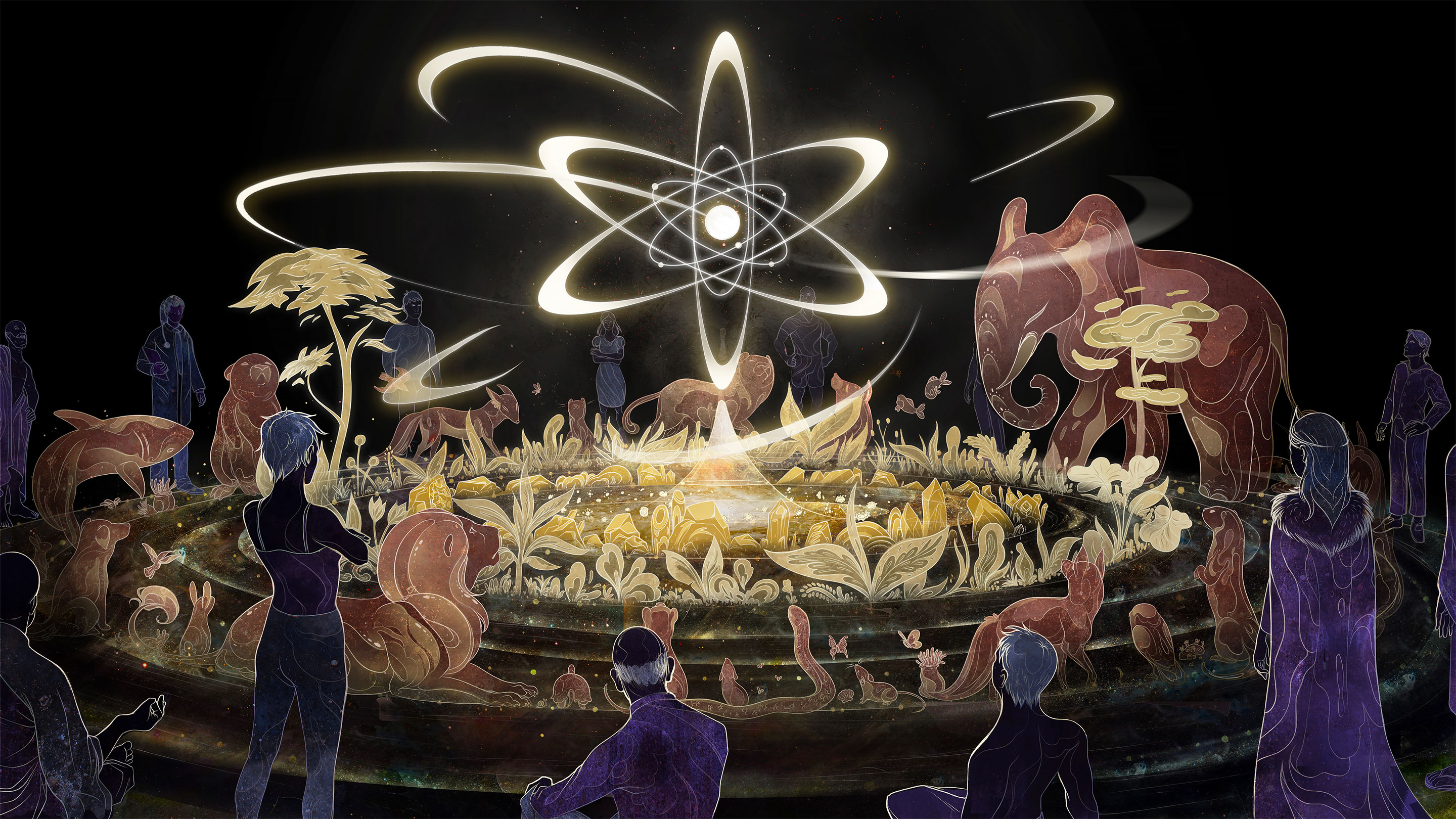
Our world is full of intriguing phenomena that can be explained through studying energy in all its forms. Understanding energy and its properties can help us comprehend the workings of our existence. In this beginner’s guide, I will take a journey through the quantum world and unveil some mind-boggling concepts. I explore the fundamental nature of reality and discuss how everything around us is connected by one common thread – Energy.
Introduction to Quantum Physics and Energy
Quantum mechanics is the branch of physics that studies the behavior of matter and energy in the presence of an observer. It is the foundation of modern physics and the theory of the wave-particle duality.
Quantum mechanics was developed in the early 20th century to explain the behavior of subatomic particles, such as electrons. The theory has since been extended to describe the behavior of molecules, atoms, nuclei, photons, and other elementary particles. Even though quantum mechanics has been successful in describing many physical phenomena, it still remains a subject of active research.
One of the key concepts in quantum mechanics is energy. Energy is a property of matter that can be observed only when matter interacts with other matter or with electromagnetic radiation. Energy has various forms, such as kinetic energy, potential energy, thermal energy, electromagnetic radiation, and nuclear energy.
In classical physics, energy is considered to be a continuous variable that can take on any value. However, in quantum mechanics, energy is quantized, which means it can only take on certain values that are determined by its wavelength. The quantization of energy leads to some interesting properties of matter, such as superconductivity and superfluidity.
Philosophers have attempted to explain the intricate field of quantum physics through their respective philosophical frameworks. The keyword “reality” is one that has been central to many of these explanations, as quantum mechanics challenges our traditional notions of what is real and knowable. For example, some philosophers argue that the observer effect in quantum mechanics indicates that reality is not objective but rather subjective and dependent on observation. Others claim that the uncertainty principle suggests a fundamental indeterminacy at the heart of reality itself, rendering any deterministic worldview invalid.
Some philosophers have tried to reconcile quantum theory with metaphysical concepts such as causation and determinism by suggesting alternative interpretations or conceptualizations of physical phenomena. Overall, while philosophers may not provide definitive answers about how we should interpret or understand quantum physics, they offer valuable perspectives on the nature of reality in light of this enigmatic scientific field.
While the study of quantum mechanics can be intimidating, it is an indispensable part of modern physics and is applicable in daily life. Through the understanding of quantum mechanics, one can gain a comprehensive understanding of the behavior of matter and energy, and use this information to transform one’s life. So let’s begin with the basics. Below are some of the core principles in quantum physics.
Heisenberg Uncertainty Principle
The Heisenberg uncertainty principle is a fundamental theory in quantum mechanics that states that there is a limit to the accuracy with which certain properties of particles can be known. It was first proposed by German physicist Werner Heisenberg in 1927. The uncertainty principle is often interpreted as a statement about the inherent limitations of measurement, but it can also be seen as a statement about the nature of reality itself.
At its core, the uncertainty principle says that certain properties of particles (such as momentum) cannot be known with absolute certainty. This is because these properties are fundamentally linked to other properties (such as position) in such a way that measuring one property will necessarily perturb the other. The more precisely one property is measured, the less accurately the other can be known.
This may sound like a rather abstract and academic idea, but the implications of the uncertainty principle are far-reaching and profound. In particular, it places limits on what we can know about the behavior of subatomic particles and has important consequences for our understanding of quantum mechanics.
It also has implications for our understanding of reality more generally, suggesting that the classical notion of absolute certainty about the behavior of physical systems may be an illusion. Because the uncertainty principle asserts that any measurement cannot be exact beyond a certain limit due to inherent limitations of observation (even to everyday objects such as cars or balls being thrown around us), this suggests that our knowledge about another person’s state (such as behavior or mood) will always be limited by our own observations and subjective interpretation of those observations. Ultimately, the uncertainty principle is a reminder that our understanding of nature is necessarily incomplete and that there are certain limits to knowledge.
Wave Function Collapse and the Copenhagen Interpretation
In quantum mechanics, the wave function is a mathematical description of the state of a system. The Copenhagen interpretation is an approach to interpreting quantum mechanics that was developed in the 1920s. It suggests that the wave function represents a probability wave, and that the act of measurement causes the wave function to collapse, resulting in a definite outcome.
The Copenhagen interpretation is the most widely-accepted approach to interpreting quantum mechanics, and it has been influential in shaping our understanding of the quantum world. However, it is not without its critics, who argue that it is not a complete description of quantum mechanics, and that it fails to explain some key features of the quantum world.
One approach that has been suggested as a supplement to the Copenhagen interpretation is Wave Function Collapse (WFC). This theory suggests that instead of collapsing into one single outcome, the wave function can collapse into multiple outcomes, creating an “ensemble” of possible outcomes. The idea is that this ensemble contains all of the information necessary to describe a system, and could potentially provide a more complete description of quantum phenomena than the Copenhagen interpretation.
Although WFC is still a relatively new approach, it has already gained significant attention from physicists and philosophers alike. It provides an interesting alternative to the Copenhagen interpretation, and could potentially provide insight into some of the mysterious features of quantum mechanics.
Regardless, Copenhagen interpretation principle has significant implications for our daily lives, particularly in our understanding of causality and determinism. The very notion of cause and effect becomes more complex when we consider the probability-based nature of reality at the quantum level. Furthermore, this principle highlights the limitations of human perception and measurement – what appears to be a particle may actually behave like a wave under certain circumstances. Thus, it emphasizes the importance of humility in scientific inquiry and encourages us to question assumptions about objective reality. In everyday life, we can apply this principle by recognizing that uncertainty is inherent in all aspects of existence – from interpersonal relationships to financial investments – and learning to live with ambiguity rather than seeking complete control or predictability over outcomes.
Quantum Entanglement and Nonlocality
Quantum entanglement is a phenomenon that occurs when particles are sharing an energy state such that the quantum state of each particle cannot be described independently of the others. This nonlocal connection between particles exists even when they are separated by large distances. When one particle in an entangled pair is measured, the other particle instantly takes on a corresponding measurement, no matter how far apart they are.
This strange behavior has baffled scientists for decades, but recent advances in quantum physics have begun to unravel the mystery. It turns out that quantum entanglement is responsible for many of the strange and seemingly impossible properties of quantum mechanics.
Some of these properties include:
quantum teleportation: the ability to instantaneously transport information or matter over long distances
quantum computers: computers that can perform certain calculations much faster than any classical computer
quantum cryptography: a secure method of communication that is impossible to eavesdrop on
quantum levitation: the ability to suspend an object in midair with no external force applied
These phenomena are made possible by the strange properties of quantum entanglement, which have caused many scientists to describe it as a form of “spooky action at a distance”. As research into quantum mechanics continues, the implications of entanglement and nonlocality may become clearer. Ultimately, it is likely that quantum entanglement and nonlocality will be used to create new technologies that could revolutionize our lives.
Schrödinger’s Cat Experiment
In 1935, Erwin Schrödinger proposed a thought experiment in which a cat is placed in a sealed box with a device that has a 50% chance of releasing a poisonous gas. If the gas is released, the cat dies; if not, the cat lives. Since the box is sealed, there is no way to know whether or not the gas has been released until it is opened.
In quantum mechanics, it is impossible to know both the position and momentum of a particle at the same time. This means that, before the box is opened, the cat exists in a superposition of states: it is both alive and dead. Once the box is opened and the state of the cat is observed, it will be either alive or dead; but prior to observation, its state is indeterminate.
The Schrödinger’s Cat experiment demonstrates one of the strange and counter-intuitive consequences of quantum mechanics: that particles can exist in more than one state simultaneously. It also highlights one of the key differences between classical physics and quantum mechanics: in classical physics, objects have definite properties (such as position and momentum) even when they are not being observed; in quantum mechanics, objects only have definite properties when they are being observed. This thought experiment has been used to illustrate the concept of quantum superposition and entanglement, as well as to challenge the notion of determinism in physics.
Schrödinger’s Cat experiment can be applied to daily life situations where multiple outcomes are possible before an observation or decision is made. For instance, when making important decisions such as accepting job offers or buying houses, there may be several uncertainties about how things will turn out until an action is taken or a choice is made. By considering all possibilities at once rather than focusing on one particular outcome before it happens can help individuals make better-informed choices while avoiding regrets associated with missed opportunities or wrong decisions caused by singular thinking patterns.
Multiple Worlds Theory
The multiple worlds theory,posits that there are an infinite number of parallel universes existing alongside our own. The application of this theory to daily life is multifaceted and complex. One possible interpretation suggests that every decision we make creates a new universe in which the alternative choice was made. This idea presents both opportunities for reflection on the paths not taken and the reassurance that all possibilities exist simultaneously.
Another potential application lies in its impact on mental health. Individuals struggling with anxiety or depression may find comfort in knowing that alternate realities exist where their circumstances are different. Exploring the implications of the multiple worlds theory can lead to thought-provoking discussions about determinism versus free will and one’s place within the larger scheme of existence.
This theory could imply that we do not have complete control over our actions and outcomes since there are infinite versions of ourselves making different decisions in parallel universes. Some argue that this undermines the idea of personal responsibility and accountability while others see it as liberating since it means there is always an opportunity to make better choices in another reality. Limitless possibilities. Nonetheless, the implications of the multiple worlds theory on free will continues to spark philosophical and scientific debates about determinism versus indeterminism and the nature of reality itself.
Conclusion
This beginner’s guide to the quantum universe has been a great introduction into understanding energy and its properties. By exploring theories such as wave-particle duality, entanglement, and uncertainty principle, you now have a better grasp of the nature of physical reality. With this knowledge comes an appreciation for the beauty and complexity of our universe. I hope that you’ve enjoyed learning about these fascinating concepts and are ready to explore more about how these are applicable in creating your desired life.
 Philosophical Healing
Energy out of quantum probability made quantum fields undulate into matter!
Since matter (i.e. field excitations) started out in equilibrium with thermal radiation, energetic variations due to cosmic expansion led to an evolving universe leading to the origin of life! What is life, if not the finest thread of cosmic disequilibrium?